


Belated Launch on the Home Market
The sixth generation Honda CR-V debuted globally back in 2022, but for unknown reasons, it was not offered in Japan itself for a long time. This situation changed only recently when the CR-V e:HEV model was presented at the Japan Mobility Show. Now the company has revealed details regarding local features, among which are the flagship Black Edition trim and the optional “Tough Premium” style package.
Spartan Choice of Trims
The Japanese lineup of the crossover is limited to just two variants: e:HEV RS and e:HEV RS Black Edition. This differs significantly from the trim structure for the US market, where the CR-V is offered in numerous variants, including the off-road TrailSport.
The flagship Black Edition version features black lower body cladding, dark-finished 19-inch noise-absorbing alloy wheels, a panoramic sunroof, and a special emblem on the rear doors. The interior is also executed in a dark theme with black headliner upholstery and Piano Black inserts.
Standard and Additional Equipment
The base CR-V e:HEV RS trim is equipped with a 9-inch multimedia system, a 10.2-inch digital instrument panel, a 12-speaker Bose audio system, wireless charging, hands-free power tailgate, heated seats, and the Honda Sensing safety system suite.
The Black Edition additionally receives a panoramic sunroof, ventilated seats, a head-up display, and the expanded Honda Sensing 360 suite. The latter has wider radar and camera viewing angles, improved collision avoidance systems, as well as support for lane changes and passing on highways.
Hybrid Powertrain
For Japan, the CR-V is available exclusively with the e:HEV hybrid powertrain. It combines a 2.0-liter internal combustion engine with two electric motors and an E-CVT. The RS trim offers a choice between front-wheel and all-wheel drive, while the Black Edition has all-wheel drive as standard. Detailed specifications have not yet been disclosed, but it is known that a similar hybrid system in Europe develops a combined output of 181 hp.
Style Accessory Packages
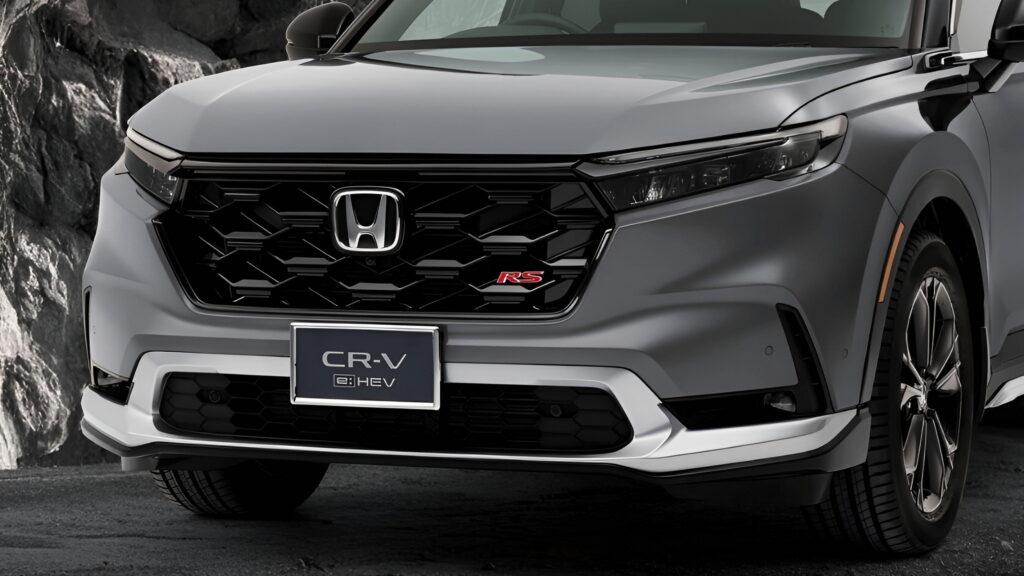
Despite the limited choice of trims, Japanese buyers will be able to diversify the exterior of their car with the help of two style packages. The “Tough Premium” package is designed for the Black Edition version and includes a lower bumper insert and sturdy side steps in Luna Silver Metallic color, as well as a rear spoiler in Crystal Black Pearl color and black emblems.
The “Urban Premium” package is available for the RS e:HEV trim and adds the same components but in dark finish to better match the body’s colored cladding. Honda’s original accessory catalog is also expected to include a wider range of items, such as the depicted wind deflectors.
Prices and Timing
Honda will start accepting orders for the CR-V from December 12, with first deliveries scheduled for February 2026. According to Creative Trend reports, the CR-V e:HEV RS is expected to cost from 5,122,700 yen (approximately $33,100), while the all-wheel-drive Black Edition version will start from 5,779,400 yen (about $37,400).
It is worth noting that the hydrogen-powered CR-V e:FCEV with a plug-in hybrid setup is already available in limited quantities on the Japanese market, but is significantly more expensive, starting from 8,094,900 yen (over $52,000). Honda’s local SUV lineup in Japan also includes the smaller WR-V, Vezel, and ZR-V models, the latter being a local variant of the American HR-V.
The belated launch of the new CR-V on the home market may indicate the company’s strategic priorities, where the focus was on more mass-market regions such as North America and China. The limited choice of trims and emphasis on hybrids corresponds to the specific demands of Japanese buyers, who often prefer compact dimensions and eco-friendly technologies. The new model’s price positioning places it in the premium compact crossover segment, where it will compete not only with other Japanese brands but also with European models offering similar technologies. The model’s success may largely depend on how well customers perceive it as an alternative to the already available hydrogen and electric variants from Honda itself and its competitors.