


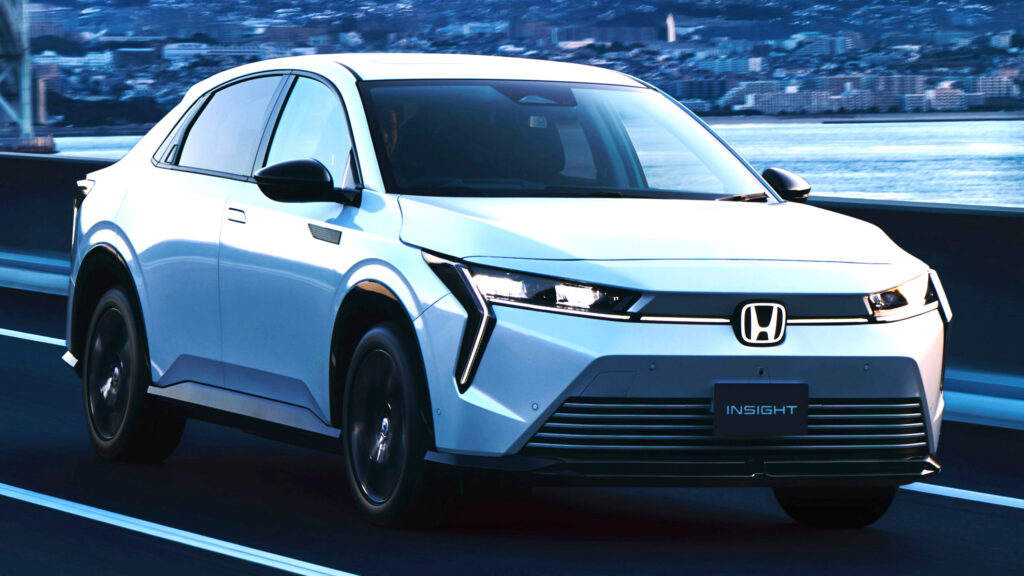
New Honda Insight enters the Japanese market
This week, the electric Honda Insight, manufactured in China, will appear on Japanese roads. However, it is unlikely to become a common sight, regardless of its qualities.
The car was developed jointly with the Chinese partner Dongfeng as part of a joint venture. Initially, the model was introduced in the Chinese market under the name e:NS2, and then adapted and renamed for Japan as the Insight.
We have set a limited sales volume, based on the number of target customers and Honda’s share in this market segment.
The price in Japan is 5.5 million yen (approximately $34,500). Taking into account the state subsidy for electric vehicles of 1.3 million yen ($8,100), the effective price is reduced to 4.2 million yen ($26,350). Despite this, Honda does not expect high demand, as the share of electric vehicles in the new car market in the country is less than 2%. The company plans to sell only 3,000 units nationwide.
Technical specifications and equipment
The new Honda Insight is built on the e:N Architecture F platform. It is equipped with a CATL battery with a capacity of 68.8 kWh and a front electric motor with a power of 201 hp. The declared WLTP cycle range is 311 miles (500 km), which is a good indicator for a relatively small battery.
Japanese buyers will have access to five color options, including bright shades of Obsidian Blue Pearl and Aquatopers Metallic II. The interior can be ordered with black or white upholstery.
Key interior elements include a head-up display, a 12-speaker Bose audio system, a large central multimedia screen, and a small digital instrument panel. The car also features heated front and rear seats, a heated steering wheel, and heated front door panels, which should be an ideal solution for the Japanese winter.
The launch of the Insight in the Japanese market reflects Honda’s cautious strategy, testing the waters in the domestic market with a globally developed but locally manufactured product. The low sales targets speak to the company’s realistic assessment of the current situation, where traditional hybrids remain significantly more popular than fully electric models. The success of this model could be an important signal for the further electrification of the brand’s lineup in the region.