


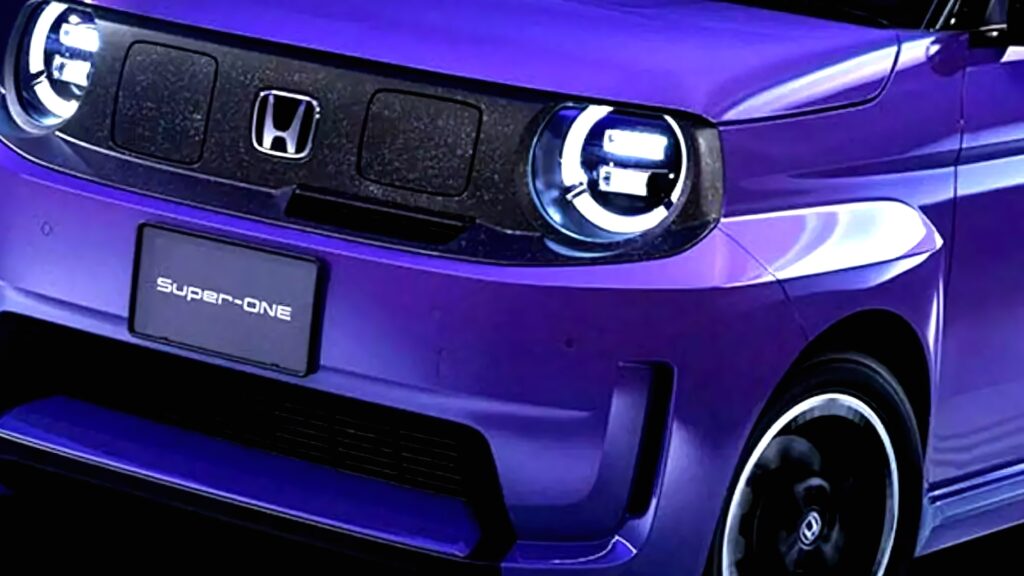
New Electric Spirit from Honda
Forget the clinical efficiency and quiet hum of modern electric vehicles. Honda has other ideas on this matter. The brand is bringing some of its brightest spirit from the 80s into the electric era, drawing a direct line from the analog madness of the City Turbo II to its latest compact experiment.
After showcasing the prototype at the Japan Mobility Show, Honda has lifted the curtain on the production version of the Super One via a new teaser site ahead of its domestic launch.
Wide-Track Pocket Rocket
The Super One is not just a slightly dressed-up N-One e:. It is an urban hot hatch with a wider track, updated chassis, and an electric powertrain that attempts to replicate the character of a gasoline engine using synthesized sounds. Honda claims it is the spiritual successor to the 1980s City Turbo II Bulldog.
Visually, the Super One stands out with reprofiled bumpers featuring functional air intakes, characteristic “bubble fenders” along the sides, and a roof spoiler. It has also received a new set of 15-inch alloy wheels with a matte Berlina Black finish and a machined face, paired with wider Yokohama tires.
In terms of dimensions, the Super One is 3,589 mm long, 1,573 mm wide, and 1,616 mm tall. This makes it 194 mm longer, 98 mm wider, and 71 mm taller than the standard N-One e:, although it retains the same 2,520 mm wheelbase.
Honda has introduced a new color called Boost Violet Pearl, inspired by lightning and available exclusively for the Super One. Other available finish options include Platinum White Pearl, Crystal Black Pearl, Citron Yellow Pearl, and Mono Gray, each offered in both monochrome and two-tone combinations.
Interior Updates
Inside, the dashboard layout is largely carried over from the N-One e:, but the Super One adds its own touches in the form of reprofiled seats with more powerful side bolsters, purple accents, and special graphics for the 7-inch digital instrument cluster. When Boost Mode is activated, the display switches to show a simulated tachometer.
Adding to the theatrics, the Active Sound Control system simulates gear shifts and engine roar through the standard eight-speaker Bose premium audio system. The equipment level is generous: a 9-inch multimedia system, heated front seats, a heated steering wheel, and a full suite of Honda’s advanced driver assistance systems.
Power Boost
The tiny hot hatch is powered by a front-mounted electric motor. While Honda has not officially confirmed power figures, preliminary details from the Singapore Motor Show in January suggest it produces 94 hp in Boost mode.
This may not sound very impressive, but it represents a significant increase compared to the 63 hp of the N-One e:. However, it is less powerful than the discontinued Honda e, which in its most potent version produced 152 hp.
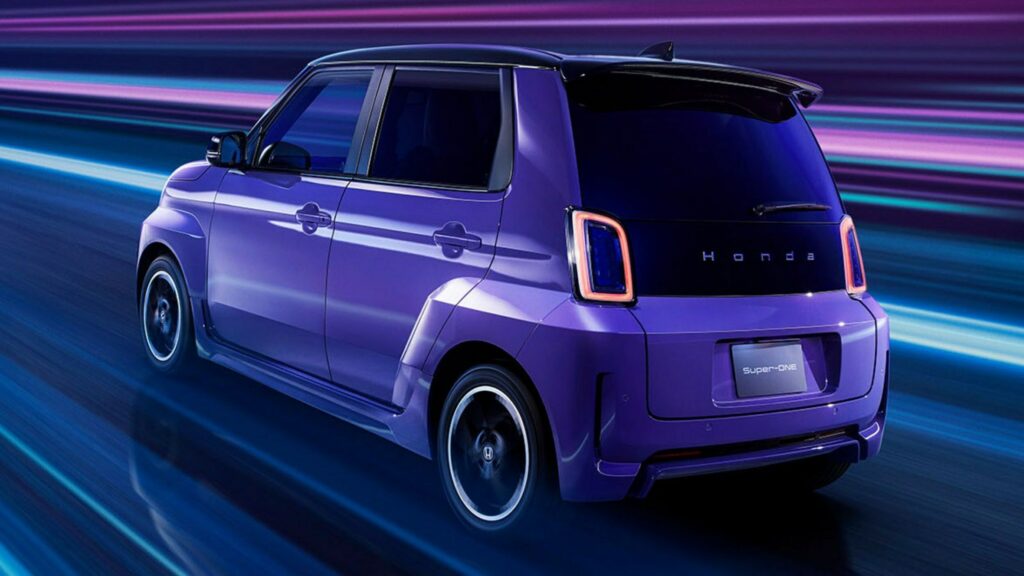

The additional power and increased width mean the Super One will be classified as a passenger car, not a kei car. Honda has not yet revealed battery capacity or range data, although the N-One e: uses a 29.6 kWh pack.
Rounding out the list of changes, the sporty EV has received a special chassis tune with lowered suspension and a wider track for improved handling.
The Price Question
Full pricing and launch timing details for the Super One will be revealed in the coming weeks. However, the Japanese publication Creative Trend reports that Honda is targeting a price range of 3,000,000 to 3,500,000 yen (approximately $19,700 to $22,900 USD) before incentives are applied.
This places it above the standard N-One e:, which starts at 2,699,400 yen and can drop to 1,625,400 yen with full subsidies applied.
After its debut in Japan, the Super One will also arrive in additional markets, including the UK, Europe, Australia, New Zealand, and parts of Asia.
The launch of the Super One clearly demonstrates Honda’s strategy of diversifying its electric portfolio, offering not just a means of transport but an emotional product. The emphasis on driving feel, artificial sound, and sporty design indicates an attempt to attract enthusiasts skeptical of the sterility of conventional EVs. The success of this model in markets like Europe could be an indicator of whether there is demand for small but characterful electric cars that combine environmental friendliness with driving emotion. The price positioning, significantly higher than the base model, will also test buyers’ willingness to pay a premium for such an experience in the compact segment.