


Impact of Trump’s Tariffs on Canada’s Automotive Industry
The tariff policy implemented by the Trump administration has led to a significant decrease in automobile production in Canada. At the same time, the United States has seen an increase in the number of vehicles produced. Unsurprisingly, the Canadian government is actively seeking ways to attract Chinese brands to assemble cars on its territory.
Production Statistics: Canada Loses, US Gains
According to the Center for Automotive Research (CAR), automobile production in Canada fell by 15% year-over-year in the period leading up to April. Factories in Canada produced approximately 64,000 fewer vehicles than in the same period last year. In contrast, US production increased by nearly 44,000 units, representing a 1.2% rise.
CAR Chief Economist Tyler Harp presented this data during the annual Management Seminar in Michigan.
Tariff Burden for Canadian Manufacturers
According to Harp, vehicles assembled in Canada face effective tariff rates of 12 to 13 percent, even if they contain over 50% American components. These rates are nearly equal to the tariffs on vehicles from Japan and South Korea, which stand at 15%.
Flavio Volpe, President of the Automotive Parts Manufacturers’ Association, explained that exemptions under the USMCA agreement for Canadian and Mexican parts apply only to direct export shipments, not to those same parts when already installed in a finished vehicle destined for the US. Thus, a Canadian-made car can face high duties even if a significant portion of it is made in America.
“Vehicles assembled in Canada face effective tariff rates of 12 to 13 percent, even if they contain over 50% American components.”
Production Cuts and Market Share Changes
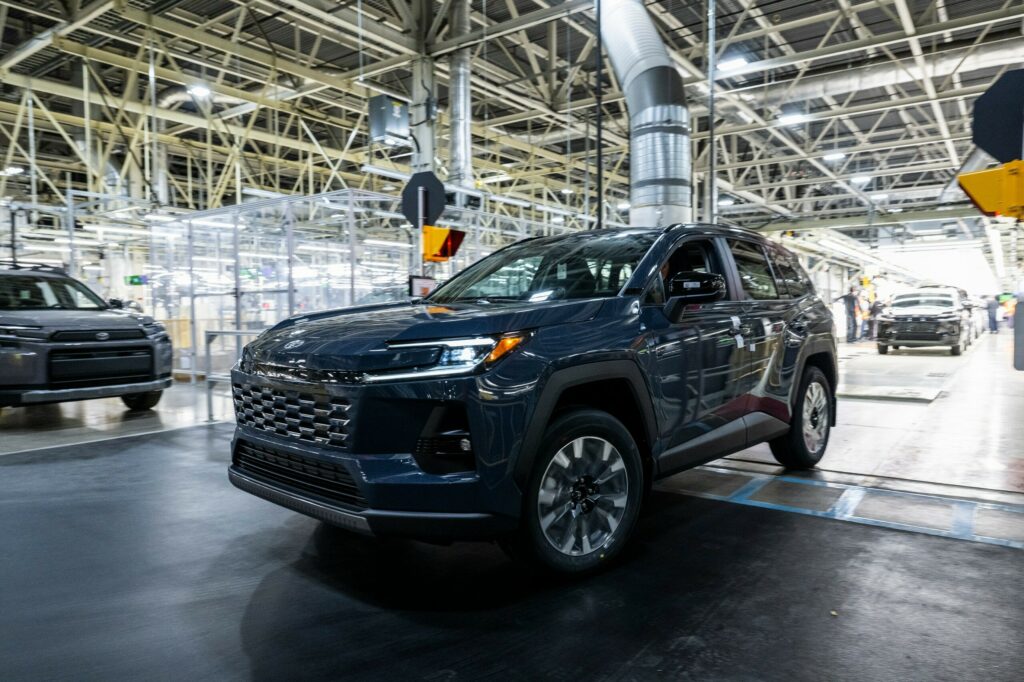
Not all vehicles lost by Canada are now being produced in the US. GM completely halted production at its CAMI Assembly plant in Ontario after discontinuing the BrightDrop van. Additionally, Toyota’s plant in Ontario, which manufactures the RAV4, operated at reduced capacity for several weeks due to the transition to a new generation of the model.
Nevertheless, the share of vehicles produced in the US increased by 5.94%, while Canada suffered 45% of the losses among trading partners. Together with Mexico, these two countries account for 69% of the total market share losses over the past year.
Harp noted that the tariff policy had a lesser impact on imports from overseas, instead redistributing sales and production within North America.
Outlook for Canada: Possible Deterioration
The situation for Canada could worsen. The Automotive News Research Center notes that many of the country’s most popular models posted disappointing results in the first quarter. For example, the transition to the new generation of the RAV4 led to a 47.9% drop in sales. Sales also declined for the Chrysler Pacifica, Honda CR-V, Honda Civic, and Chevrolet Silverado, all of which are produced in Canada.


The US tariff policy, aimed at protecting the domestic market, has effectively created a paradoxical situation: Canadian cars with a high content of American parts are still taxed almost as heavily as imports from Asia. This incentivizes manufacturers to move production to the US, weakening Canadian industry. At the same time, Canada’s attempts to attract Chinese brands may be a response to this crisis, but such a decision carries new risks, including political and technological ones. Declining sales of key models, such as the RAV4 and Honda Civic, indicate that even temporary production pauses due to generational changes can have serious consequences in an unstable trade environment.