


New Law and Its Immediate Effect
The state of Kansas has begun invalidating thousands of driver’s licenses issued to transgender residents, based on a new state law. This law requires that identification documents reflect the sex assigned at birth. This measure is not related to driving safety and focuses solely on how sex is indicated on official documents.
The law took effect immediately after publication in the Kansas Register, after legislators overrode the veto of Democratic Governor Laura Kelly. Since lawmakers did not provide for a grace period, any driver’s licenses held by transgender individuals became invalid the moment the law took effect.
Notification to Drivers
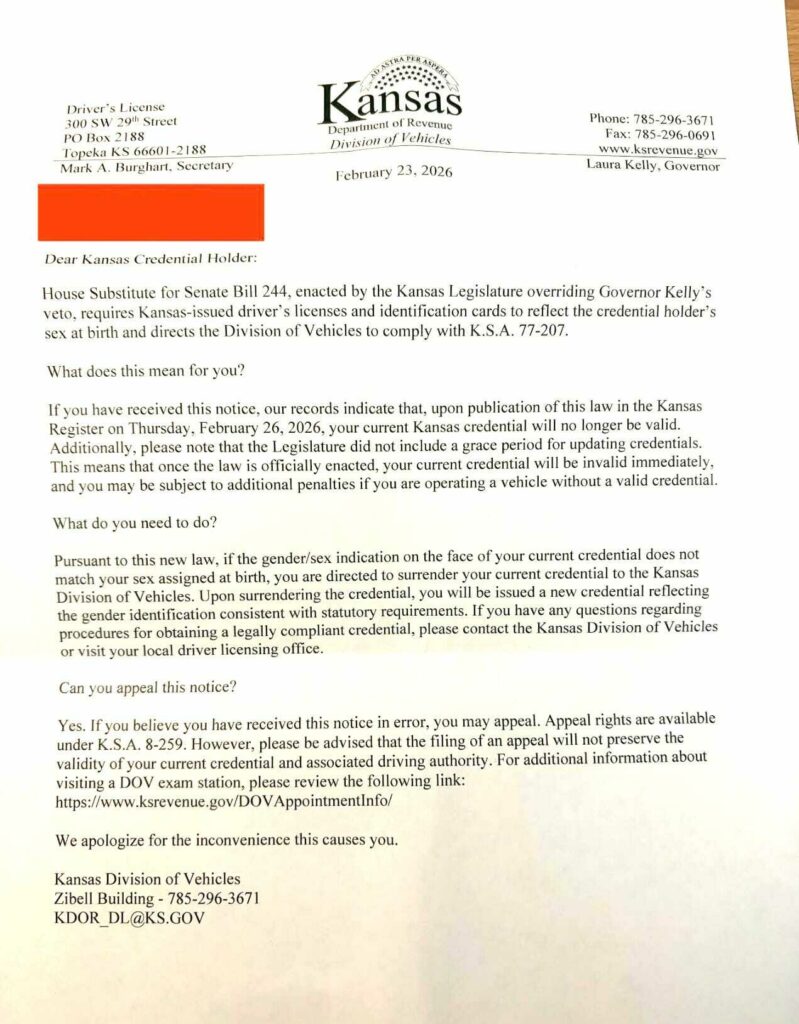
Residents received a letter confirming the changes and warning that driving with an invalid license after the law takes effect could lead to additional penalties. This letter was published by the resource Erin In The Morning, which covers transgender issues.
“If you received this notice, our records indicate that after the publication of this law in the Kansas Register on Thursday, February 26, 2026, your current Kansas document will no longer be valid. Also, please note that legislators did not include a grace period for updating documents. This means that after the law officially takes effect, your current document will become invalid immediately, and you may be subject to additional penalties if you operate a vehicle without a valid license.”

Scale and Replacement Procedure
According to state officials, at least 1,700 driver’s licenses, as well as up to 1,800 birth certificates, will be subject to reissuance. Letters sent to affected residents instruct them to surrender their current documents and obtain replacements.
Furthermore, legislators require transgender drivers to pay for these changes themselves. The standard fee for a new license is $26, and the state has not allocated funds to cover this cost. The letter also states that new licenses will be issued to drivers after they surrender their existing ones.
Financial Burden and Lack of Grace Period


Regardless of personal views on transgender rights, which is a truly controversial topic, forcing drivers to pay for changes when the state itself initially allowed them to change or choose their gender marker seems harsh. The affected drivers did not fail tests, accumulate excessive violation points, or violate insurance rules.
The absence of any grace period also appears excessively severe. If men were ordered to immediately surrender their licenses because Kansas suddenly required adding a profile photo to ID cards, and they were not allowed to drive until receiving a new license, it would cause chaos.
Legal Consequences and Comparison with Other States
Under Kansas law, driving without a valid license is a class B misdemeanor, punishable by up to six months in jail and a $1,000 fine. The conviction can also trigger an automatic driver’s license suspension. This means that any individual unaware of their documents’ invalidation risks legal trouble simply on their way to work.


Other states, such as Florida, Tennessee, and Texas, also restrict changing the gender marker on driver’s licenses. However, Kansas appears to be the first to demand the cancellation of previously issued documents, rather than simply blocking future updates. The broader bill also contains provisions regarding access to restrooms in public buildings and mechanisms for its enforcement.
This situation in Kansas raises important questions about the stability of legislation and citizens’ trust in state institutions. A sudden change of rules for a specific population group, especially without compensation for costs and even minimal time for adaptation, sets a precedent that could affect the perception of the rule of law. The approaches of different states on this issue demonstrate how identity politics can be implemented differently at the regional level, often leading to uneven rights and responsibilities for citizens across the country.