


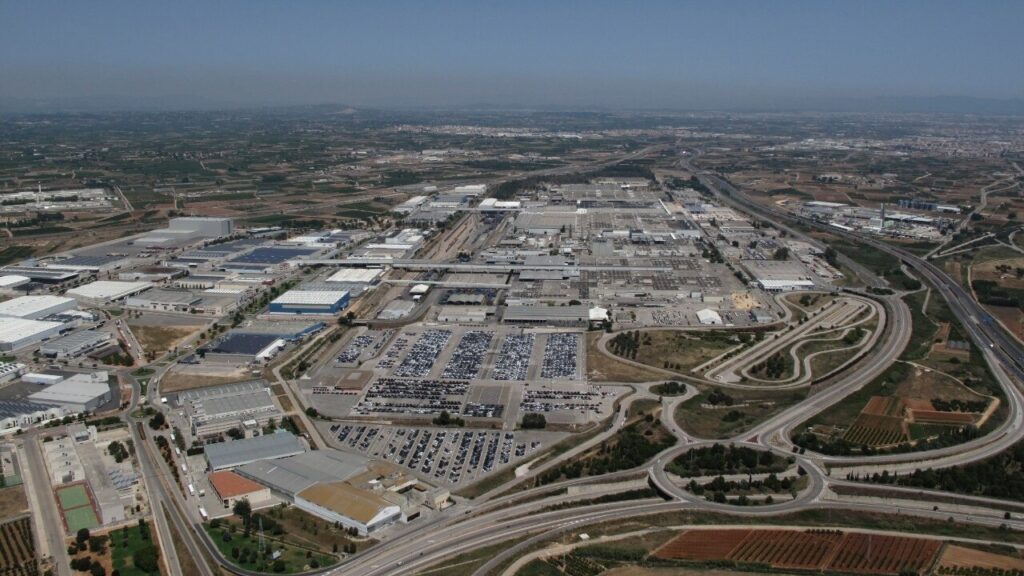
Geely may acquire Ford production line in Spain
Ford CEO Jim Farley constantly talks about the threat from Chinese automakers, but according to new reports, he may be striking a deal with one of them.
According to the Spanish newspaper La Tribuna de Automoción, Geely has reached an agreement to acquire an assembly line at Ford’s plant in Valencia, Spain. The Chinese company plans to use this equipment to produce a multi-energy vehicle based on the Global Intelligent New Energy Architecture, which underpins various models, including the Galaxy A7 and E5.
What is known about the new model
Little is known about the vehicle itself yet. The publication reports that the Geely variant has an internal code of 135. According to rumors, the model will be offered with hybrid, plug-in hybrid, and fully electric powertrains.
Although details are limited, it is believed that the mysterious model could be the EX2. This is a compact electric crossover with a length of 4135 mm, a width of 1805 mm, and a height of 1570 mm, with a wheelbase of 2650 mm.
The model will be equipped with battery packs of 30.1 and 40.1 kWh, providing a range under the CLTC cycle of up to 310 km and 410 km, respectively. The vehicle will also feature a rear-motor layout with a power output of 78 hp (58 kW) or 114 hp (85 kW).
Possible partnership with Ford
While it remains unclear whether the EX2 will be produced at this plant, the publication reports that Ford may also receive a vehicle on the same platform. This could potentially become an interesting successor to the Puma model, as both vehicles are roughly the same size.
Nevertheless, Ford downplayed this information, telling the publication:
We are constantly in talks with many companies on various topics; sometimes they materialize, sometimes they don’t. Nothing is final.
Similarly, a Geely representative in Europe told Automobilwoche that they “do not comment on rumors.” However, according to their information, “industry insiders consider the deal to be largely finalized.”
This news comes amid Ford’s active rhetoric about protecting the European market from cheap Chinese cars. If the deal goes through, it will be a vivid example of how global automakers are forced to seek compromises in the face of fierce competition and the transition to electric power. For Ford, selling the production line could be a way to optimize costs in Europe, while Geely gains a strategic foothold for production within the EU, allowing it to avoid import duties. The potential use of Geely’s platform for a Ford model also indicates that even traditional giants do not shy away from cooperation with Chinese companies when it is advantageous from a technological or economic standpoint.