


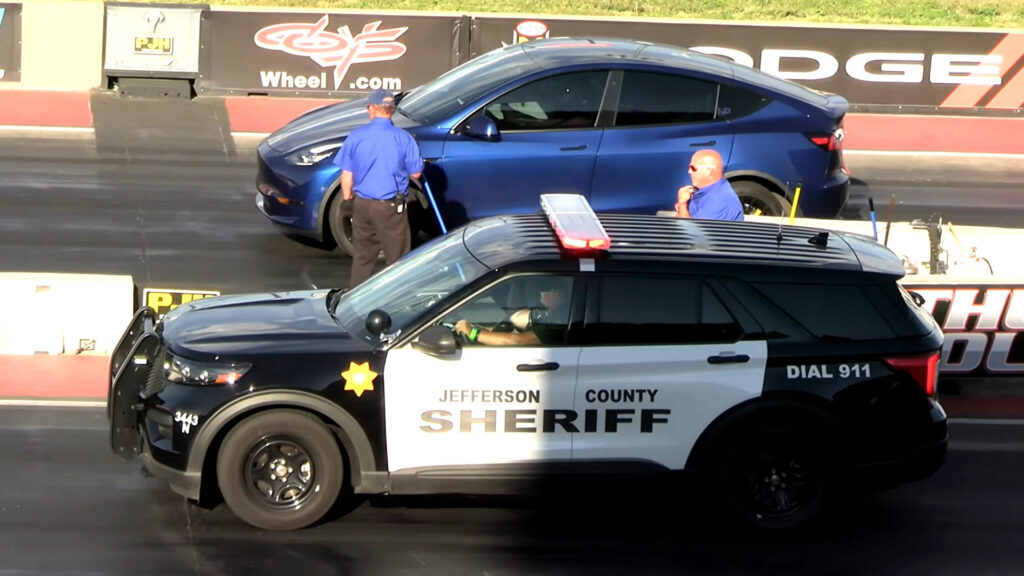
Police Ford vs. ordinary Tesla
Just a few decades ago, owning any type of police car was a special experience. Police cars were often built to be faster than regular production models. Today, they are still unique and have reinforced components, but they are no longer as powerful as they used to be. A drag strip race in Colorado vividly demonstrated the new hierarchy of power.
On one side stood a Ford Police Interceptor Utility based on the Explorer, which was likely equipped with a 3.0-liter twin-turbo EcoBoost V6 engine producing 400 hp (298 kW) and 563 Nm of torque. On the other side was an absolutely ordinary-looking Tesla Model Y, probably in the Performance version — the same crossover you can see parked near grocery stores and football practices across America. The results were anything but close.
Race results: crushing advantage
The Ford posted a respectable time — 15.7 seconds in the quarter mile at 88.57 mph. For an almost 2.3-ton police SUV, loaded with heavy cooling systems, police equipment, reinforced components, and all-wheel drive, this is actually not bad. Ten to twenty years ago, such figures would have seemed truly fast for a law enforcement vehicle. Of course, the Tesla had long finished before the Ford crossed the finish line.
The Model Y Performance blasted through the quarter mile in just 12.9 seconds at 111.96 mph, utterly demolishing the police Explorer by almost three full seconds. Even more telling was the difference in terminal speed. At the end of the race, the Tesla was traveling more than 23 mph faster than the Ford. This demonstrates how much more powerfully it accelerated down the final straight compared to the Explorer.
Altitude impact and conclusions
Altitude may have also widened the gap. The track in Colorado, located at approximately 1,770 meters above sea level, is known for degrading the performance of internal combustion engines due to thinner air. Turbocharging helps the Ford compensate somewhat, but the Tesla is far less affected by altitude since it does not rely on atmospheric pressure for fuel combustion.
Of course, this does not change the situation dramatically. Police departments will not switch to electric vehicles anytime soon. Nor will citizens switch to them hoping to escape the police. It is simply interesting to know that an ordinary crossover can “smoke” a police car if needed.
This case vividly illustrates how technology has changed our perception of speed. Not long ago, police cars were the benchmark of power on the roads, but the era of electric vehicles has made incredible dynamics accessible to ordinary family crossovers. Although in practice this will hardly affect pursuits of lawbreakers, the very fact that a production Tesla can effortlessly outperform a specially prepared police SUV speaks to colossal technical progress. It also serves as a reminder that police departments may need to reconsider their fleets in the future, as the performance gap between regular cars and service vehicles continues to grow.