


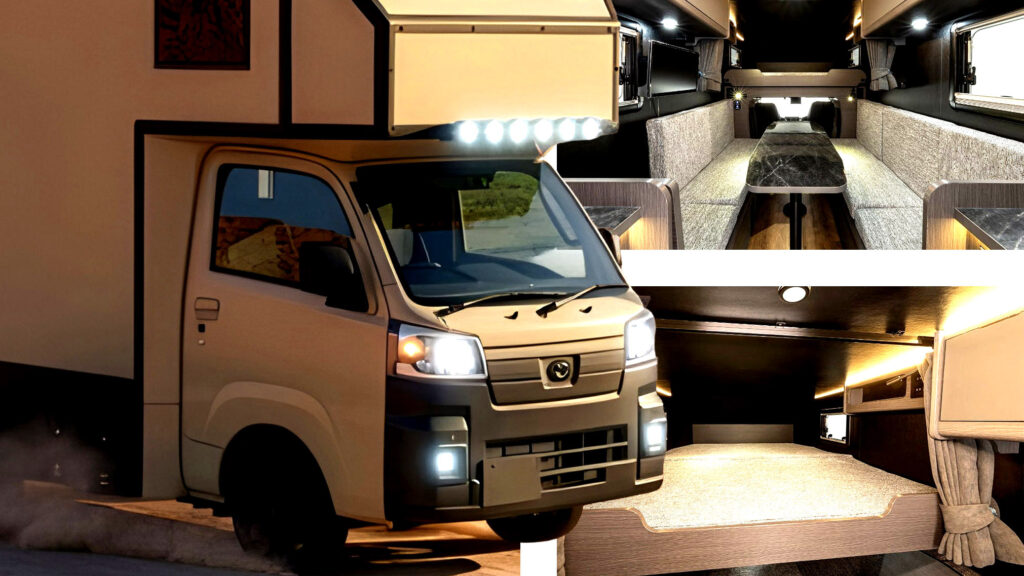
Japan is known for finding elegant solutions by reducing dimensions. Instead of bulky motorhomes that require special licenses and parking, it offers micro-campers based on kei cars. The novelty in this market is the Dune Rover, also known as the Katana Mini, from Direct Cars. This model transforms the body of a Daihatsu Hijet cargo van into a compact living space.
Exterior and Overall Appearance
Externally, the vehicle features a durable, scratch-resistant Raptor coating, combined with black accents on the bumper, alloy wheels, and metal panels. Additional LED lights on the roof emphasize its off-road character. However, for full credibility, it lacks a lift kit and more aggressive off-road tires.
Access to the living module is through the rear doors with electric steps. The interior, despite its miniature size, creates a cozy atmosphere typical of larger motorhomes.
Interior Layout and Sleeping Arrangements
The living compartment features a dining area with a table and two sofas, which, by rearranging the cushions, transform into a double bed. Another double bed is arranged above the driver’s cab, utilizing vertical space. Theoretically, the Dune Rover can accommodate up to four people overnight, but it would be very cramped. Furthermore, it should be remembered that the base Hijet remains a two-seater, so two passengers will have issues with movement during travel.
Despite the limited space, engineers managed to fit a sink, microwave oven, 35-liter refrigerator, TV, storage space under the bed, ambient lighting, and even an air conditioner. A control panel and numerous USB ports for charging devices are also present. The only serious drawback can be considered the absence of a toilet and shower, but expecting them in a camper of this size would be overly optimistic.
Power Supply and Alternative
All electrical appliances are powered by a 100 Ah lithium-ion battery, which can be upgraded to 200 Ah. For extended autonomous stays in nature, optional 100-watt solar panels are offered.
For those who find the Dune Rover too extreme, Direct Cars offers another model on the same base—the PLAT. It is oriented towards urban use, has a more aerodynamic body design, different wheels, and a silver-black color scheme. Its advantages include side doors, an awning, and a larger kitchen area.
Technical Specifications and Price
Both campers retain the standard technical components of the Daihatsu Hijet. This means they are equipped with a small 660cc engine, which in the turbocharged version produces up to 63 hp. Depending on the donor vehicle, the drive can be rear-wheel or all-wheel drive, and the transmission can be a five-speed manual or a CVT.
The price of the PLAT model starts from 4,390,000 yen (approximately $28,000). The more off-road-oriented Dune Rover costs from 5,980,000 yen (about $38,100). However, with the addition of options, the price of the latter can rise to 7,178,000 yen (almost $45,800), which is a fairly high amount for a vehicle of this class. For buyers who prefer more space, the company also offers camper conversions based on larger models such as the Toyota Dyna, HiAce, and Hilux.
View this post on Instagram. A post shared by ダイレクトカーズ【趣味・車中泊・キャンピングカー専門店】 (@direct.cars)
The emergence of niche products like the Dune Rover clearly demonstrates the trend towards personalization and optimization of mobile housing. They do not claim to replace full-fledged motorhomes but offer a unique compromise between mobility, compactness, and functionality. The high prices are likely due to manual labor, the use of special materials, and the complex engineering challenge of squeezing maximum capabilities into a minimum of space. Interestingly, the market is responding to demand not only in rural areas but also in cities, as evidenced by the existence of two conceptually different models from one manufacturer. The future of such conversions may be linked to electrification, which would make them even more autonomous and environmentally friendly.