


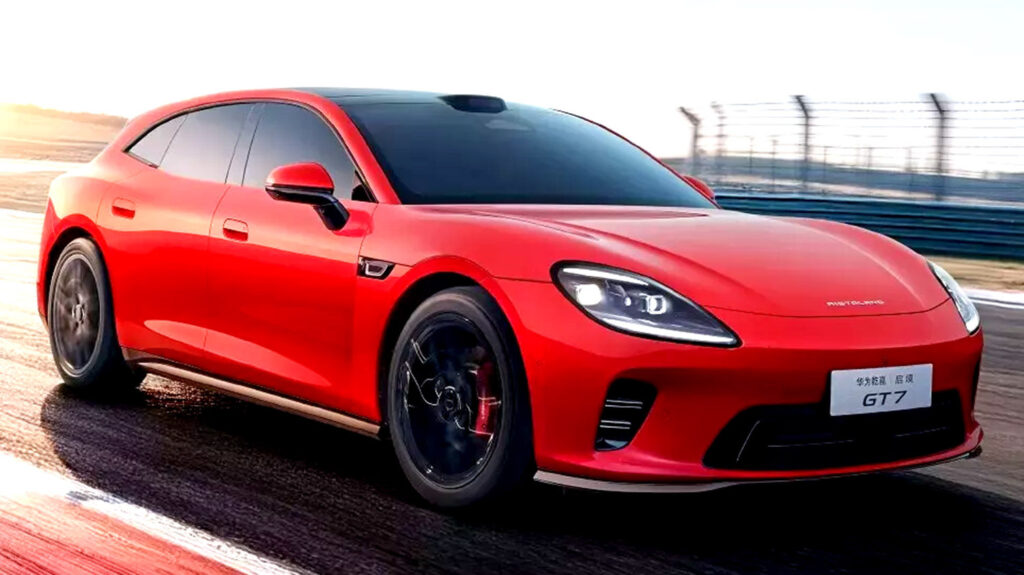
New Chinese EV Resembles Porsche Taycan
Chinese automaker Aistaland, backed by Huawei and GAC, is preparing to unveil its new electric station wagon named the GT7. The car, set to fully debut at the Beijing Auto Show in April, looks strikingly similar to the Porsche Taycan Sport Turismo.
Here are the key facts about the new model:
Market Context: Porsche Loses Ground in China
The emergence of models like the GT7 comes against the backdrop of serious problems for Porsche in the Chinese market. Last year, sales of the German brand fell by 26%, forcing the company to cut a third of its dealerships. Local brands offering cars with similar designs but at significantly lower prices are actively taking away customers.
Porsche took a heavy hit in China last year, with sales tumbling 26 percent from 56,887 units to 41,938, a drop steep enough to force significant dealership cuts.
Technical Features and Potential Competitors
The dimensions of the Aistaland GT7 are 5,050 mm in length, 1,980 mm in width, and 1,470 mm in height, with a wheelbase of 3,000 mm. Power and range figures have not yet been disclosed. The power is expected to fall between that of its competitors: the Xiaomi SU7 (664 hp in the top version) and the SU7 Ultra (1,527 hp).
The GT7 is not the only ‘descendant’ of the Taycan in China. This wave also includes the Xiaomi SU7, SAIC Z7, and the upcoming MG 07. Interestingly, many of these models have the number ‘7’ in their name.
Design: Conscientious Imitation
The resemblance to Porsche is noticeable from all angles. At the front, there are large teardrop-shaped headlights and a small black grille. The profile, with identical door handle placement and window line, also strongly resembles the original.
The rear is adorned with a full-width LED light bar, like on the Taycan. An additional touch is two light elements above the bar, which glow red and resemble jet nozzles, echoing the design of the Tesla Model Y.
Price Pressure on Premium Brands
The interior and exact prices of the GT7 are not yet known. However, if the cost is close to that of the Xiaomi SU7 (starting from $33,400), the model will become a serious alternative to the Porsche Taycan, which starts at $126,000 in China for the sedan. Such a price difference illustrates the difficulties traditional premium brands face in the world’s largest electric vehicle market. Chinese manufacturers demonstrate the ability to quickly implement cutting-edge technologies and offer them in products that are visually indistinguishable from European design icons, but at more accessible prices. This forces global players not only to defend their positions but also to seek new forms of cooperation or adaptation to local conditions.