


Unexpected Premiere from a Vacuum Cleaner Manufacturer
Few expected that a company known for manufacturing vacuum cleaners would bring supercars to CES, but that’s exactly what Dreame did. The Chinese technology firm Dreame, best known for competitively priced vacuum cleaners, presented three impressive high-performance cars at the Consumer Electronics Show in Las Vegas. They were presented under the newly created brands Kosmera and Nebula Next.
As early teasers hinted, Dreame sought style inspiration from Bugatti. However, while initial renders leaned heavily towards imitating the Chiron, the finished models went their own way, avoiding outright copying but still retaining more than a few familiar features.
What many may not know is that Dreame is part of Xiaomi’s huge ecosystem chain. The tech giant has invested in the company and may be providing more than just capital. Xiaomi itself has already become a serious contender in China’s growing electric vehicle market, though it remains unclear whether Dreame’s pivot is directly linked to Xiaomi’s automotive ambitions.
Echoes of Bugatti, But Not Clones
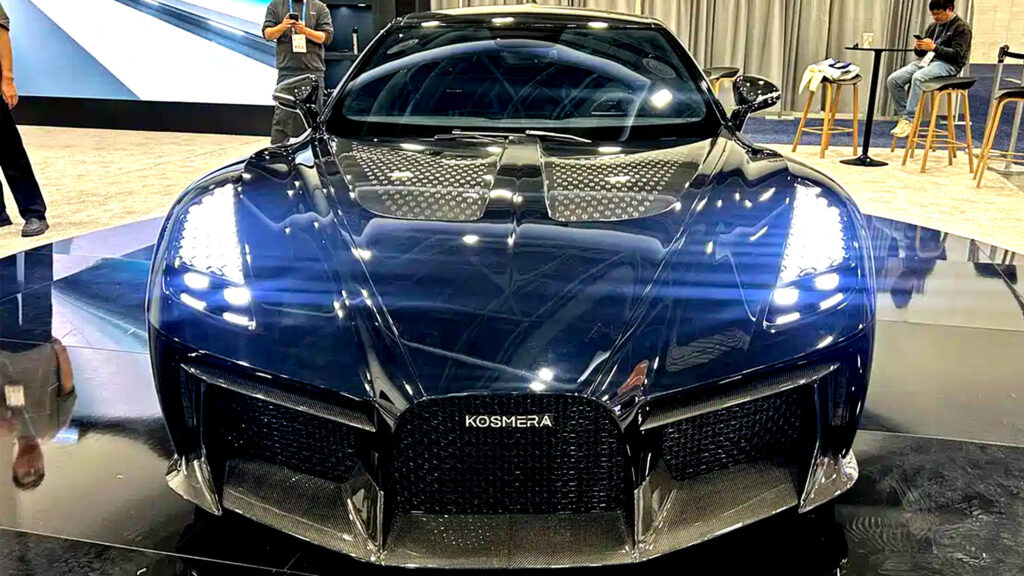
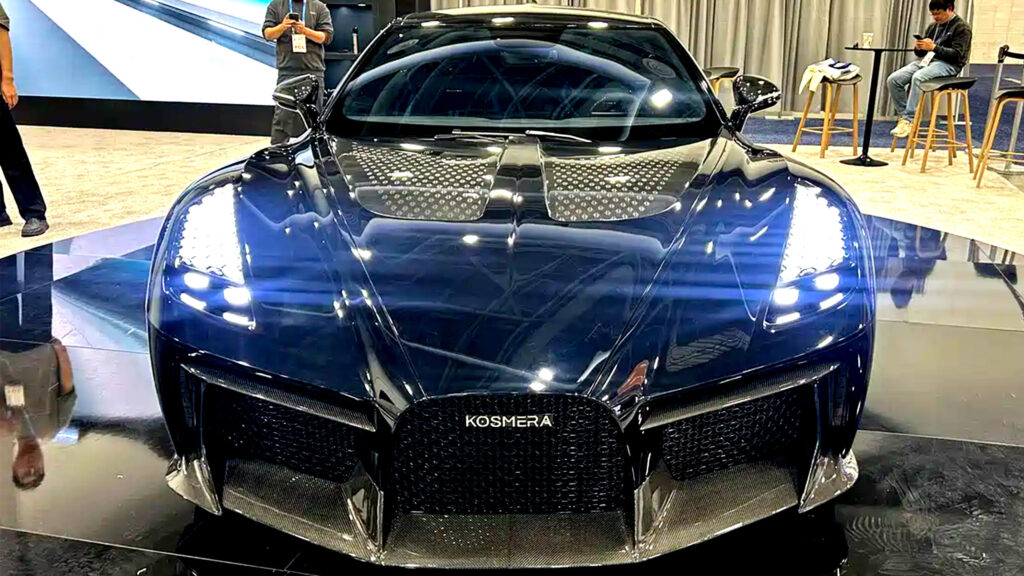
The first model, named Kosmera, is described as a super sports car and painted black. Its four-door configuration immediately sets it apart, but the front end is particularly familiar. The radiator grille, framed in carbon fiber, strongly resembles the Bugatti Mistral and Brouillard. Large air intakes are located on the sides at the front, and the overall front end has unmistakable French inspiration.
The placement of the headlights and daytime running lights continues the homage to Bugatti, as does the sculpted hood with prominent ventilation outlets for air extraction—a detail almost identical to the unique Brouillard.

However, the side profile sounds different. With smooth surfaces and a gradually sloping roofline, it resembles an elongated Porsche Taycan more than anything from Molsheim. At the rear, the car adds its own flair with a full-width LED strip, a fixed rear wing, and a vertical stop light extending down the rear window.
According to Autohome, this Kosmera sedan is equipped with four electric motors, which together produce 1903 horsepower. Interestingly, the car is reportedly weighed exactly 1903 kilograms, creating a symmetrical power-to-weight ratio of 1:1, which sounds almost too perfect to be true.
While most technical details remain secret, the car is said to include a complex suspension and a range of parts manufactured using 3D printing.
Second Concept and the Unique Nebula Next
The second Kosmera offering looks completely different. It is also a sedan, painted in dark purple, but the design is less dramatic. If the front doesn’t resemble a Bugatti, the same cannot be said for the rear, as it bears a resemblance to the Chiron, including the rear lights, the shape of the rear panel and trunk lid, as well as the split rear window. As for performance, Dreame has not yet disclosed anything about this model’s capabilities.
Rounding out the trio is the Nebula Next 01—the only car without the Kosmera badge. This is the model Dreame announced earlier. Painted green, it has the most sports car-like design of the three, but surprisingly, is also a four-door. It features numerous exposed carbon fiber details, including a front splitter and rear diffuser, and has similar Bugatti-inspired headlights to the first Kosmera car.
Local media claim that the Nebula Next 01 is equipped with the same four-motor setup producing 1903 horsepower. If true, it should accelerate from 0 to 100 km/h in just 1.8 seconds. For now, Dreame has not confirmed whether this concept will enter series production or when.
The appearance of such ambitious concept cars from a company with no automotive history highlights the dynamism and competitiveness of the modern electric vehicle market, especially in China. It demonstrates how tech giants and related companies are increasingly expanding their scope, using their expertise in electronics, materials, and artificial intelligence to create vehicles. The success of such projects will depend not only on technical specifications but also on the ability to create their own, recognizable identity that goes beyond imitating already existing automotive icons.