


Updated BYD Seagull: LiDAR at the price of a budget car
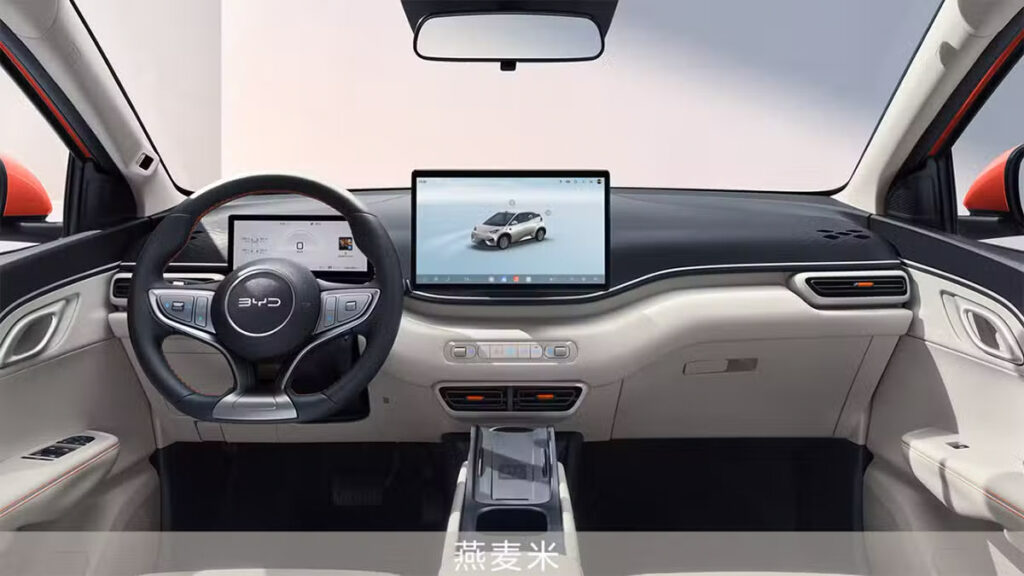
BYD has introduced an updated version of its compact electric car Seagull on the Chinese market. This small hatchback, known in Europe as the Dolphin Surf, has received new colors, wheels, and LED lights, but the main innovation is the availability of an advanced driver assistance system with LiDAR.
LiDAR technology in an affordable segment
Although Tesla insists on cameras, most experts consider LiDAR the gold standard for sensor-based driver assistance systems. It better estimates distances and detects unlit objects than cameras, and sees more details than radars. However, LiDAR is expensive, at least in Europe and America, where it is only available in cars costing over $100,000. In China, it can now be obtained on a micro electric car for $10,000.
Updates for the BYD Seagull
BYD has updated its subcompact Seagull for the domestic market. The Seagull is a small electric hatchback with a length of 3,780 mm, sold in Europe as the Dolphin Surf. For the 2026 model year, new colors have appeared: Mango Orange and Mint Green, new 16-inch Starlight wheels, and new LED taillights. The powertrain with 74 hp (55 kW) remains unchanged.
Related news: BMW is removing Level 3 autonomous driving technology from the new 7-Series
The main news is the availability of a driver assistance system that combines LiDAR with more common radars and cameras. LiDAR technology is part of the optional DiPilot 300 system, which is the middle level in BYD’s ‘God’s Eye’ assistance package lineup. Visually, the Seagull with DiPilot 300 can be recognized by a small protrusion on the roof, resembling an air intake.
Prices and options
The base version of the Seagull Vitality Edition with a smaller 30.1 kWh battery and a range of 305 km costs ¥69,900 ($10,300). The most expensive version, the Flying Edition, with a larger 38.9 kWh battery and a range of 405 km, costs ¥85,900 ($12,600). However, with the DiPilot 300 option, prices increase significantly: to ¥90,900 ($13,400) and ¥97,900 ($14,400) respectively.
LiDAR works but comes at a price
A $3,100 option on a $10,300 car looks unusual, but LiDAR is indeed expensive. That is why BMW and Mercedes, which previously offered this technology as part of Level 3 autonomous driving systems on their flagship 7-Series and S-Class models, have abandoned it, removing options worth about $7,000 from new versions of these cars.
Instead, both German brands are focusing on Level 2 systems, which still require driver attention but, unlike Level 3 systems (limited to highways), can operate without driver intervention in urban conditions. Both brands plan to return to Level 3 technologies later.
Despite the presence of LiDAR, the DiPilot 300 in the Seagull is also an advanced Level 2 system, not Level 3. However, BYD talks about Level 3 as a future development for some of its cars, and it is quite likely that even such modest models as the Seagull will get it in a few years.
Thus, the Chinese automaker demonstrates that advanced safety technologies, which were previously the prerogative of the most expensive cars, can become accessible to the mass consumer. This could significantly impact the market, forcing other manufacturers to reconsider their strategies for introducing LiDAR and other ADAS systems in more affordable models. Although this currently significantly increases the cost of a budget car, over time, as with any technology, the price of LiDAR should decrease, making such systems even more widespread.