


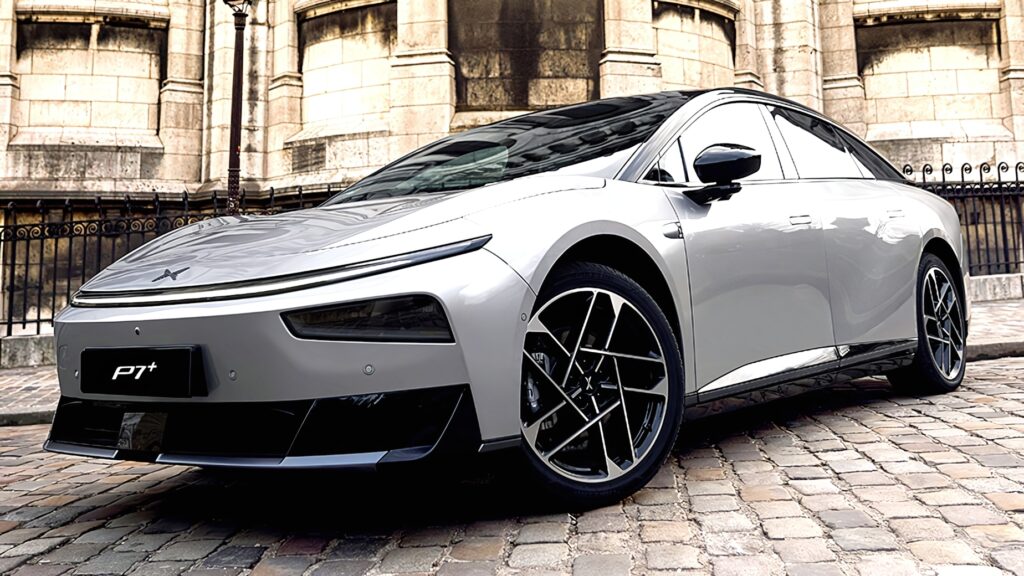
Chinese electric vehicle manufacturer Xpeng is launching its new P7+ sedan on the European market, directly positioning it as a competitor to the popular Volkswagen ID.7. The newcomer was already presented at the auto show in Brussels, and production for Europe has been set up at the facilities of contract manufacturer Magna Steyr in Graz, Austria.
Price Advantage and Compromises
One of the main advantages of the Xpeng P7+ is its attractive starting price. In Germany, the base variant will cost from 43,600 euros, which is significantly cheaper than the Volkswagen ID.7, which starts at 54,105 euros. However, behind this price advantage lie certain technical compromises. The base version of the P7+ is equipped with a battery with a capacity of only 62 kWh, providing a range of about 455 kilometers according to the WLTP standard. For comparison, the base ID.7 has a 77 kWh battery and a range of up to 619 kilometers.
Buyers who need a longer range will have to consider the long-range version of the P7+ for a minimum of 49,600 euros. It received a 75 kWh battery and a range of up to 530 kilometers, which is still inferior to the flagship ID.7 Pro S with its 86 kWh and 708 kilometers of range.
Fast Charging as a Key Advantage
According to Xpeng representatives, the main trump card of the new sedan is its high charging speed, which is meant to compensate for the smaller range. As stated by Xpeng Europe’s marketing manager, Sven De Smet, charging speed is one of the main “pain points” for electric vehicle owners. The base P7+ supports charging with a power of up to 350 kW, and the long-range version — up to 446 kW. This is significantly higher than that of the Volkswagen competitor, whose maximum charging speed is limited to 200 kW.
We believe charging is one of the pain points. A large battery is heavier, which means it consumes more electricity, and therefore needs to be charged more often.
Furthermore, Xpeng notes that smaller and lighter battery packs positively impact the car’s handling and dynamics, which could be important for European drivers who value the driving experience.
Competition in a Saturated Market
The main question is whether the P7+ can provide worthy competition to the ID.7, which is one of the sales leaders in Europe. Last year, Volkswagen sold over 76 thousand units of the ID.7 on the continent, which is only 10 thousand less than the Tesla Model 3. Xpeng is entering an already established and highly competitive market where it will have to fight for buyers’ attention.
Partners and Competitors Simultaneously
An interesting context of this rivalry is that Volkswagen and Xpeng are not only competitors but also strategic partners. Volkswagen owns a 5% stake in the Chinese company after a $700 million investment. The brands are jointly developing several electric vehicles for the Chinese market, and Volkswagen plans to integrate some of Xpeng’s technologies, including the proprietary Turing chip and VLA 2.0 software, into its future models.
The appearance of the Xpeng P7+ in Europe demonstrates how the landscape of the global auto market is changing. Chinese manufacturers are increasingly focusing not only on price but also on specific technological advantages, such as ultra-fast charging, to attract demanding European customers. The success of this model could be indicative for other brands seeking to establish themselves in this market. At the same time, the complex relationship between Xpeng and Volkswagen — partnership simultaneously with competition — may become the new norm in the automotive industry, where joint technology development is combined with the fight for customers in different regions of the world.