


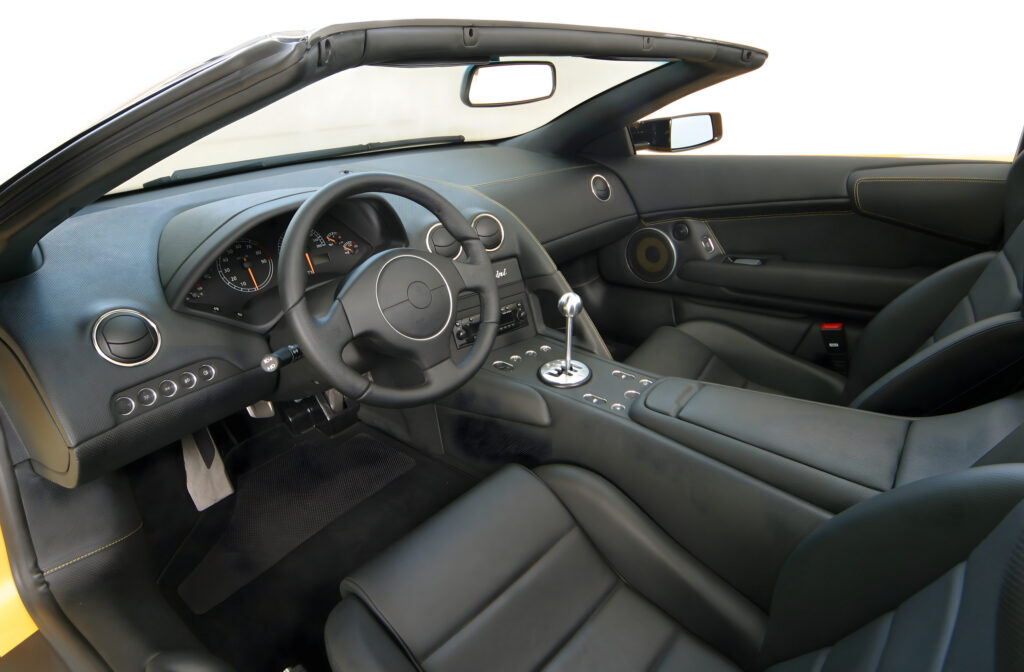
Lamborghini states that manual transmissions no longer align with its philosophy. Ferrari now remains the only manufacturer of Italian V12 supercars to offer such an option. This decision prioritizes speed over driver involvement and skill.
Once upon a time, Lamborghini built cars that demanded respect before you even turned the ignition key. They were not always polished, certainly not forgiving, and occasionally reminded drivers that a few hundred horsepower without a safety net has consequences. Those days are long gone, and Lamborghini’s latest comments on manual transmissions only reinforce how the brand has embraced absolute performance over driver engagement.
No manual for Lamborghini
Speaking to Road & Track at the Goodwood Festival of Speed, Lamborghini’s Chief Marketing and Sales Officer, Federico Foschini, dismissed the idea that the company might follow Ferrari’s unexpected return to the manual transmission. While he acknowledged that a small group of buyers still wants a manual, he made it clear that Sant’Agata Bolognese is not moving in that direction.
“There are a few clients who are still in love with such things,” Foschini said, “and I think it’s an opportunity… but it’s not a trend. Because such — let’s say, performance and driver engagement — you cannot feel with such a gearbox, you know?”
This is a difficult argument to accept if your definition of engagement goes beyond lap times and acceleration figures. Especially when so many modern supercar owners never spend a second on a racetrack.
Yes, a dual-clutch transmission will shift faster than even the most talented driver. It will also make every start more consistent, every upshift cleaner, and every performance metric easier to boast about. In fact, they are so efficient that many very good drivers still cannot fully exploit these advantages on the track. But that was never the reason enthusiasts keep asking for manual transmissions. The appeal has always been about participation, not optimization.
A simulated compromise
Ferrari seems to understand this. By introducing the limited-edition 12Cilindri Manuale, Maranello acknowledged that there is value in building a car that prioritizes the driving experience over shaving another tenth of a second off the 0-60 mph sprint. Not that the Ferrari version is a true manual. The protected shifter and clutch pedal are real, but there is no mechanical connection to the powertrain, so it is all a simulation running through an eight-speed dual-clutch gearbox and a system Ferrari calls “Manuale by Wire.” Whether the business case is limited to a special series hardly matters. Lamborghini, meanwhile, seems content to leave this niche entirely.
When Lamborghinis bit back
For decades, the appeal of Lamborghini was not just that they built the fastest cars, but cars that felt like an event. They demanded concentration, intimidated their owners, and rewarded those willing to master them. Today’s Lamborghinis use increasingly complex electronics to make four-digit horsepower accessible to almost anyone with enough money to buy one.
This is great for lap times and even better for influencers trying not to crash while speeding through Miami. It is less compelling for those who believe the driver should still play a meaningful role in the experience.
Lamborghini’s decision to abandon the manual, even a simulated one, in favor of exclusively automated transmissions is a logical step in the pursuit of performance, but it also marks a final break from the past where the driver was an integral part of the equation. Ferrari, by contrast, has found a way to offer a compromise that, while technically not a true manual, preserves the ritual and sense of participation that enthusiasts value so much. This is a clash of two philosophies: one focused on pure numbers and accessibility, the other on emotional connection with the driving process. For fans of the brand, this means the era of “wild” Lamborghinis that demanded skill has finally ended, giving way to technologically advanced but somewhat sterile machines.