


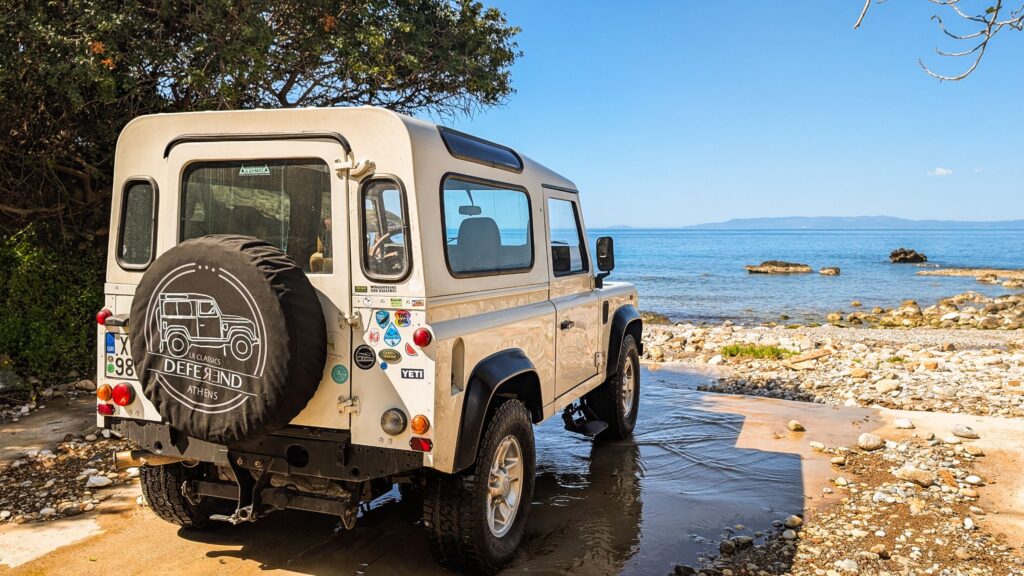
Meeting a Legend: Land Rover Defender 90 Td5
Most people come to me for advice on which new hybrid SUV to buy. My friend Stef is not like everyone else. She is the happy owner of an icon from another era, a classic Land Rover Defender 90, which has been her vehicle of choice for over ten years.
Over the years, the Defender has racked up quite a few kilometers, traversing roads from the potholed streets of Athens to endless highways, rocky mountains, and remote beaches. Her passion for this boxy vehicle sparked a huge desire in me to test it out myself. Fortunately, she kindly handed me the keys so I could experience the “magic of the Defender” firsthand. But let’s start with the basics.
History and Specifications
The Defender carries one of the longest histories in the automotive world, rooted in the 1948 Land Rover Series I. This name underwent significant updates during its 33-year production run, which ended in 2016, before the new model arrived in 2019. The original never lost its utilitarian DNA, which is why it still has such a devoted following.
FAST FACTS
Model: 2003 Land Rover Defender 90 Td5
Production: 1998-2007
Dimensions: 3,880 mm (length) x 1,790 mm (width) x 1,990 mm (height), wheelbase 2,360 mm
Curb weight: 1,770 kg
Layout: Front engine, all-wheel drive
Engine: 2.5-liter five-cylinder turbodiesel
0-100 km/h acceleration: 17.5 seconds
Top speed: 130 km/h
Power: 120 hp and 300 Nm of torque
Transmission: Five-speed manual
Stef’s car is a 2003 Defender Td5, equipped with Land Rover’s five-cylinder 2.5-liter turbodiesel, which debuted in 1998. The mileage is 190,500 km, but it has been regularly serviced throughout its life.
Exterior and Interior
Although it is not as refined as her previous right-hand-drive 2013 Defender “Puma”, the old dog is significantly more convenient to use thanks to the steering wheel position. The exterior remains mostly stock, except for LED headlights, folding side steps, a heavy-duty tow hitch, and a set of decals that tell the story of the owner’s active life. The iconic 16-inch alloy wheels are shod in a new set of off-road tires with extremely thick sidewalls.
Inside, custom tan leather covers most surfaces, elevating the cabin above the standard level. The unusual layout is the short-wheelbase configuration: two seats up front and two side-facing jump seats in the back, with a large cargo area between them. This was a hallmark feature of the Defender 90 until 2007, when safety regulations forced Land Rover to abandon it.
Driving Impressions
When I first sat in the cabin and turned the key, I was greeted by the raw, industrial clatter of the 2.5-liter five-cylinder turbodiesel. The first few minutes were a shock to the system, as the Defender feels closer to agricultural machinery than a civilized SUV. The steering is vague, and the five-speed manual has a mechanical throw that reminds you how many decades ago this platform was developed. The engine is loud and feels weak at low revs, but picks up well in the mid-range.
I already knew that handling was not the Defender’s strong suit. The body leans heavily in corners, and the ride lacks the sophistication of a modern car, although the soft suspension makes it fairly comfortable. After driving a few miles on city roads, I still wondered why anyone would choose this as a daily driver.
Changing My Mind Off-Road
Getting used to the car’s mannerisms, I found myself on a country road near the beach. The ground was still damp from the rain, but the Defender gave me the confidence to leave the asphalt. The transition onto gravel felt natural as the ladder-frame chassis entered its element. The classic SUV feels practically indestructible thanks to the old all-wheel-drive system and the chunky off-road tires. Furthermore, the generous ground clearance and almost non-existent overhangs allow you to go almost anywhere without worrying about damaging the underbody.
Half an hour later, I was still driving back and forth over gravel, sand, and asphalt, trying to find the right spots for the photoshoot. That was when I realized I had started enjoying my time behind the wheel, feeling like a child in rubber boots jumping in puddles. After returning, I was surprised at how easy it is to park the Defender 90. The visibility is so good that it feels like you have a “bird’s-eye view” camera. Despite its significant width and height, the short wheelbase and tiny overhangs make it surprisingly maneuverable, even in the tightest spots.
Verdict
When I was driving the classic Land Rover, watching the sunset in the rearview mirror, with the beach on one side and the mountains ahead, I understood why my friend Stef loves it so much. This thing is raw, mechanical, and loud, and it possesses one quality that most modern SUVs lack — character. Its analog soul is the best digital detox in a world built on touchscreens, electrification, and driver-assistance systems. At the same time, its adventurous spirit makes you jump off the couch for a trip into nature, where you can truly appreciate its exceptional off-road abilities. You might start the day hating its agricultural manners, only to end it making up excuses not to return the keys.
Many thanks to Stef for tossing me the keys to her 2003 Land Rover Defender Td5.
Photos/Video: Thanos Pappas for CarScoops
This test drive shows how a car’s true character can outweigh any technical shortcomings. While modern SUVs compete in power, technology, and comfort, the classic Defender reminds us of the primary purpose of such machines — to be a reliable tool for adventure. Its “flaws” (noise, vibration, vague steering) become part of an experience that cannot be replicated in a modern, sterile car. It’s a story that sometimes the best car is the one that has a soul, even if it is slow, loud, and clumsy.