 by
by Pros: Smooth powertrain operation, long range, attractive price.
Cons: Technology issues, weak air conditioning, unstable driver assistance systems.
The Return of Range-Extender Hybrids
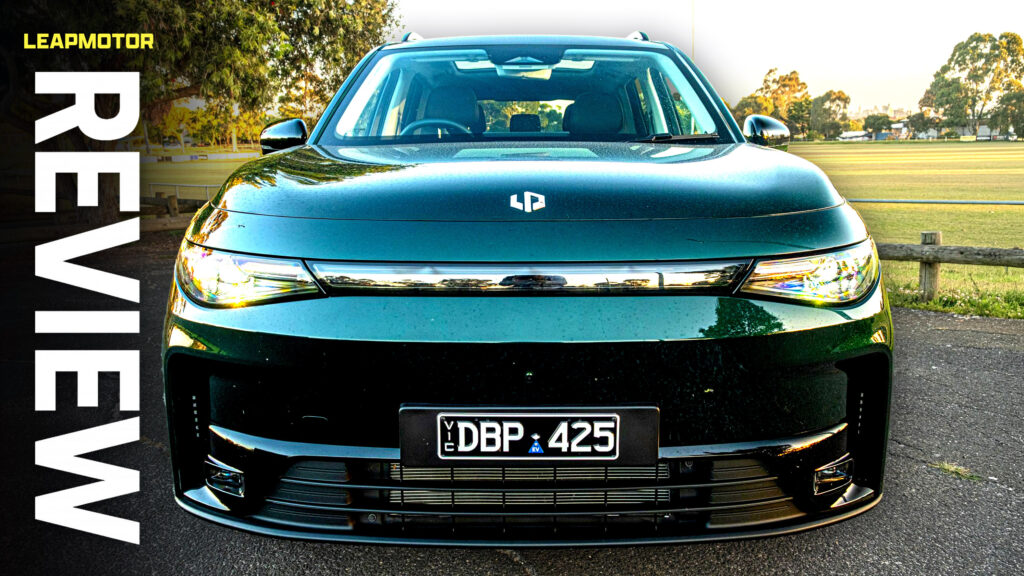
Range-extender hybrid vehicles are currently experiencing a kind of revival. Early examples, such as the Chevrolet Bolt and BMW i3, showed the world the capabilities of such powertrains, but they lost popularity in the middle of the last decade when manufacturers focused on fully electric models. However, the situation has changed. Largely thanks to a number of major Chinese manufacturers, range-extender electric vehicles are becoming increasingly common, and they are even starting to be used by well-known brands like Ford and Hyundai. Last year, the Chinese brand Leapmotor, a partner of Stellantis, joined this movement by offering a range-extender option for its mid-size SUV C10, which we had the opportunity to spend time with during the Christmas period.
In markets where charging infrastructure is still underdeveloped and long trips are part of life, the idea of a range-extender vehicle justifies itself. You get the smooth, instant response of an electric car without the need to plan your schedule around charging stops. On paper, the C10 REEV appears at the right time, positioning itself as a smart choice, not a compromise. In reality, although the powertrain lives up to these promises, the overall experience is undermined by a whole series of minor technical problems that diminish its appeal.
What Distinguishes the REEV Version?
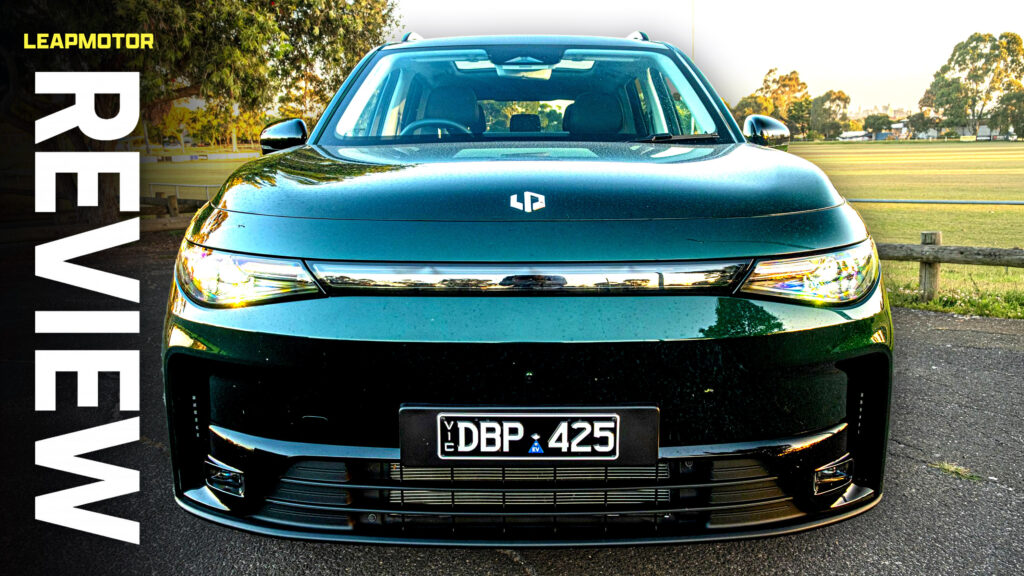
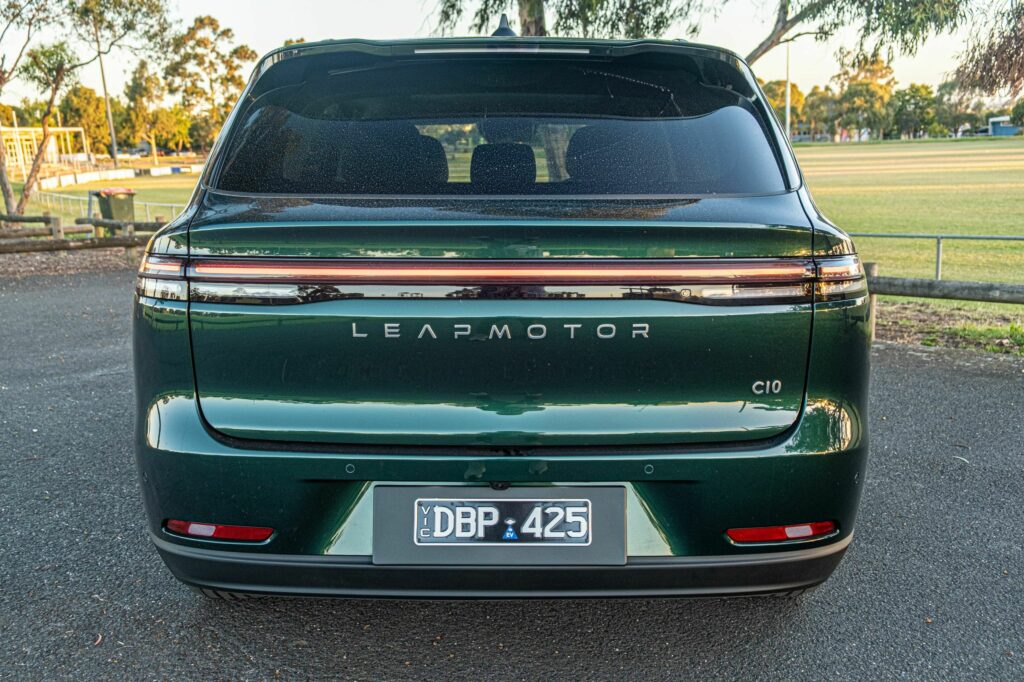
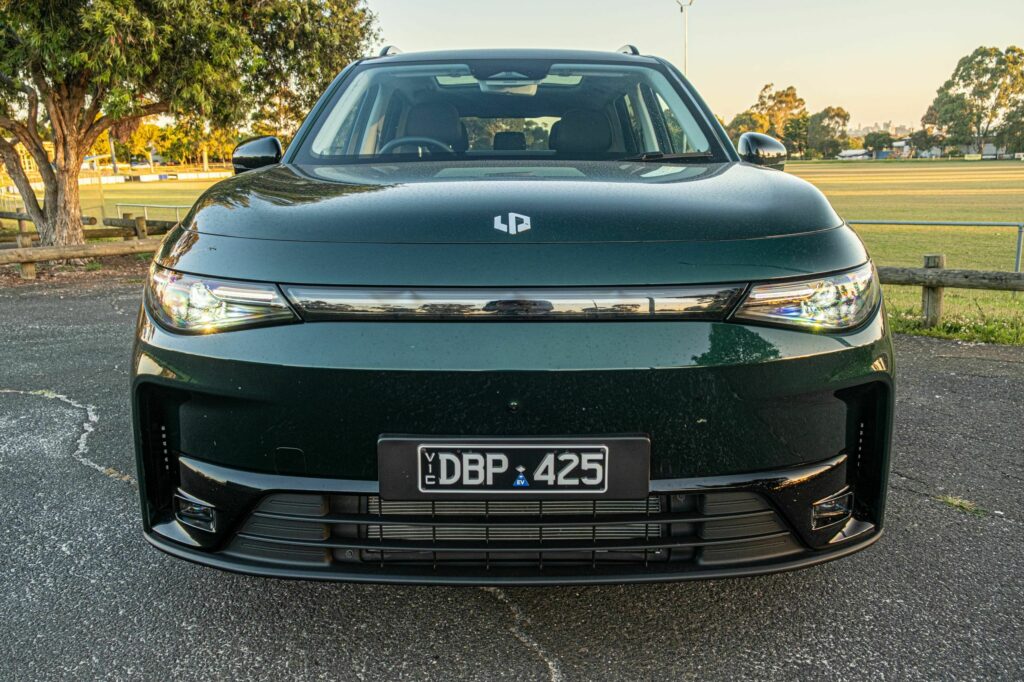
The first Leapmotor we tested last year was a regular fully electric C10 with a 69.9 kWh battery and a 215 hp rear electric motor. The C10 REEV version is significantly different. Under the hood is a 1.5-liter four-cylinder engine that never drives the wheels, serving solely as a generator to charge the battery pack. This 28.4 kWh battery powers a 158 kW (212 hp) rear electric motor. The manufacturer claims the C10 REEV can travel up to 1150 km between refuelings, consuming an average of 15.2 kWh/100 km in electric mode and having a certified fuel consumption of 0.9 l/100 km. Visually, nothing distinguishes the C10 REEV from the electric version, meaning the same inconspicuous, personality-free exterior appearance.
What is the Car’s Interior Like?
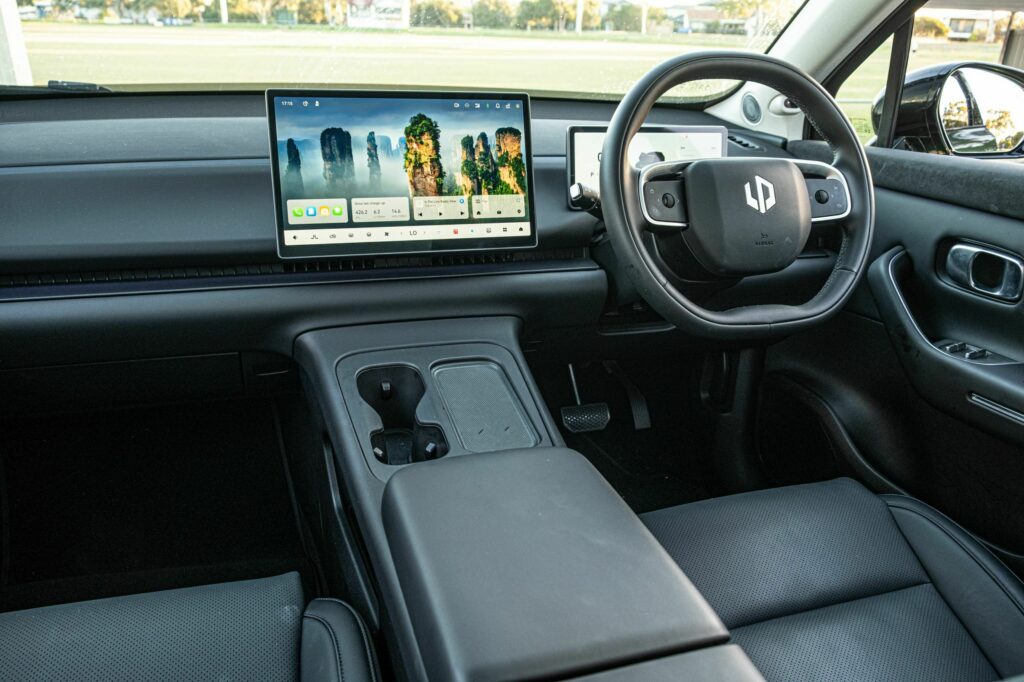
The interior is also very familiar. Leapmotor has done what Tesla popularized with the Model 3 and Model Y, opting for an ultra-minimalist design that some will like and others will find irritating. In the center of the dashboard is a 14.6-inch infotainment display running on the brand’s own operating system, which uses Android as a base. While we wouldn’t describe the C10’s system as being on par with Tesla’s, it is surprisingly not far behind. The tablet-like design doesn’t require long study, and the display is very responsive to touch. However, some settings, hidden in menus, are too extensive, and it can be difficult to find what you need while driving. Fortunately, there is a notification menu that can be configured with dozens of different toggles for important vehicle functions.
Unfortunately, the display does not support smartphone mirroring, so there is no Android Auto or Apple CarPlay, forcing you to put your phone in a holder for navigation. Furthermore, the quality of the rearview camera is shocking and does not meet modern standards. The infotainment system also needs 15 seconds to boot up after starting the car, and by that time, you’ve often already managed to reverse without the camera and start moving. All materials used are noticeably soft, especially the leather on the seats, door panels, dashboard, and center console. However, the leather gets dirty very easily. Entering and exiting the C10 REEV also proved problematic. In the first C10 we tested, the phone easily synced and was used as a key. In this car, the Leapmotor app on the phone refused to work. This might have been because the VIN was already linked to another device. Resetting the system didn’t help.
Do Minor Inconveniences Accumulate?
This forced the use of a key card for the two weeks of testing. The key card is worse than a traditional key in every way; it doesn’t even have buttons, so each time you had to touch the NFC logo on the driver’s side mirror to lock or unlock the car. It doesn’t even have an automatic lock/unlock function when approaching, so when unloading things from the passenger side or trunk, you had to return to the driver’s mirror. Key cards are in fashion, but they are inconvenient to use.
The problems didn’t end there. The air conditioning is truly disappointing. With the temperature set to minimum, the air conditioning on, and the fan at full speed, the C10 only produced moderately cool air, equivalent to what most cars do with the air conditioning off. In the Australian summer, this was very annoying. If you set aside these problems, the C10 REEV’s interior is a pleasant place to be. It is spacious, with sufficient room in the rear seats. The trunk volume is also good—up to 546 liters or 1375 liters with the rear seats folded.
Smooth Powertrain
On the open road, the range-extender powertrain quickly grew on us, even more than the traditional fully electric version. Since the engine only operates in the background to charge the battery, it doesn’t interfere with the driving experience. Even in the mode that prioritizes charging from the engine, the four-cylinder engine rarely revved above 2000 rpm, so it was practically inaudible. In the city, it runs calmly at less than 1200 rpm, remaining completely silent, while the instant power and torque of the rear electric motor make driving the REEV as smooth as an electric car. Over the two weeks, the average electricity consumption was 14.5 kWh/100 km, and fuel consumption was 6.1 l/100 km.
On the Road
It must be acknowledged that the Leapmotor is not particularly interesting or exciting to drive. It accelerates to 100 km/h in 8.5 seconds and is not an SUV that loves sporty driving. If driven calmly, it handles its tasks perfectly. As noted during the first test of the electric C10, the driver assistance systems leave much to be desired. The SUV includes both adaptive cruise control and active lane centering, and neither works well. Even if adaptive cruise control is on and the C10 detects a car ahead, it will try to maintain a constant distance, repeatedly accelerating and slowing down. Lane centering also needs improvement. During long trips on clearly marked highways, the car constantly “bounced” between the lines. This is unacceptable by modern standards.
The C10 REEV also has several other overly sensitive sensors, such as the driver attention monitoring system and speed limit warning. Fortunately, they can be easily turned off in the menu, and they weren’t as intrusive as during the first C10 test six months ago. Ride quality is good most of the time, but there were a few instances where the car seemed to “hit” the bump stops after going over a speed bump at a speed most cars would handle easily. The steering is extremely light, especially in “Comfort” mode, but it can be adjusted to a slightly stiffer response in sport mode.
Conclusion
The Leapmotor C10 REEV has potential. The hybrid powertrain works well, combining all the advantages of a traditional electric car, such as smoothness and instant power, without the drawbacks like range anxiety, especially in Australia where the charging network is underdeveloped. However, the overall ownership experience of the C10 is marred by poorly calibrated safety systems and technical issues that need fixing. If these systems can be improved through software updates, the C10 REEV will become a very attractive proposition.
The suggested price in Australia is approximately 47,888 Australian dollars, making it competitive in the market. The success of such models will depend not only on the tec