


Lotus Returns to Supercars: Hybrid V8 and 1000+ Horsepower in 2028
Lotus has officially announced its return to building supercars. Unlike the fully electric Evija, the new car will feature a traditional V8 engine and an exhaust system. It is quite possible that the model will revive the legendary Esprit name, which has not been used since 2004. For now, the car is known under the internal codename Type 135.
This news is part of a large-scale business plan called Focus 2030, in which Lotus outlines its strategy for the next four years. According to the plan, the new supercar will arrive in 2028 and go on sale immediately. Details are still limited, but the company has confirmed that the car will get a hybrid V8 powertrain with over 986 horsepower (1000 PS).
Related: Lotus wants $189,000 for its 905-hp Taycan rival, UK dealers will take $121,000
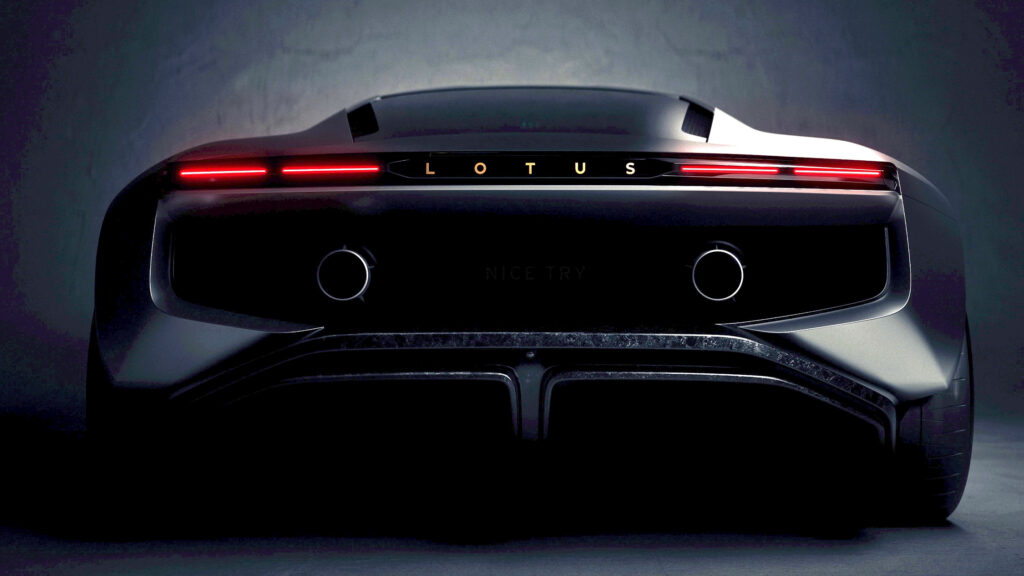
The only teaser image shows the rear of the supercar, which strongly resembles the 2024 Theory 1 concept. Narrow LED taillights are positioned above a pair of round exhaust tips, and the word LOTUS is finished in gold lettering.
Who is the engine supplier?
Lotus has not specified which manufacturer will supply the engine. However, Mercedes-AMG already supplies four-cylinder engines for the Emira sports car and is preparing to launch a new flat-plane crank V8 based on the engine fitted to the latest Mercedes S-Class. Another option is Toyota, which produces the V6 for Emiras and recently introduced a twin-turbo hybrid V8, although its output is only 641 hp (650 PS).
Hybrid, but not plug-in
Autocar suggests that the choice fell on AMG and reports that the powertrain will be a conventional hybrid, similar to the Corvette E-Ray and Porsche 911 Turbo, rather than a plug-in hybrid like the Ferrari 296, in order to keep weight low.
Lotus has recently struggled to promote its traditional lightweight message, as its main products have been heavy electric SUVs and sedans. However, the company aims to return to that formula where possible. This means more investment in the Emira: Lotus says it will unveil the most powerful and lightest version of this model in the coming weeks.
As expected, there is a further shift away from purely electric vehicles, although the company is not abandoning them entirely. Lotus previously promised to switch exclusively to electric vehicles, but in the short term, the company will aim for a split of 60% hybrids and 40% fully electric cars.
X-Hybrid Eletre to go on sale this year
A key role in this split is played by the new X-Hybrid powertrain, producing 939 hp (952 PS / 700 kW) with a 2.0-liter engine. It was presented on the Eletre X (pictured above) in China this spring and will arrive in Europe in the fourth quarter alongside the existing EV. However, according to the product roadmap released by Lotus, the related Emeya sedan will not get a hybrid version and will remain purely electric.
It appears the US will not get the Eletre or Emeya due to high tariffs on cars imported from China. Instead, the American market will be limited to Lotus sports cars. And while Eletre SUVs are already heading to Canada after tariff reductions, there is no word on the Emeya joining them later.
“We are obsessed with engineering, obsessed with performance, and obsessed with building cars for drivers, and that is what will grow our business,” said Qingfeng Feng, CEO of Lotus Group, commenting on the 2030 plan.
The gallery below contains images of the 2024 Lotus Theory 1 concept.
Lotus
This strategic shift by Lotus is indicative of the entire automotive industry. The company, which was once one of the first to announce a complete transition to electric vehicles, now acknowledges that hybrid technology is a more practical solution for high-performance models in the coming years. The abandonment of the plug-in hybrid layout in favor of a conventional hybrid for the supercar points to a priority on light weight and driving dynamics, which has always been a hallmark of Lotus. At the same time, limiting the US market to sports cars only due to geopolitical and trade barriers creates an interesting situation where American brand enthusiasts will have access to the most ‘high-performance’ models but will be deprived of more practical SUVs and sedans.