 by
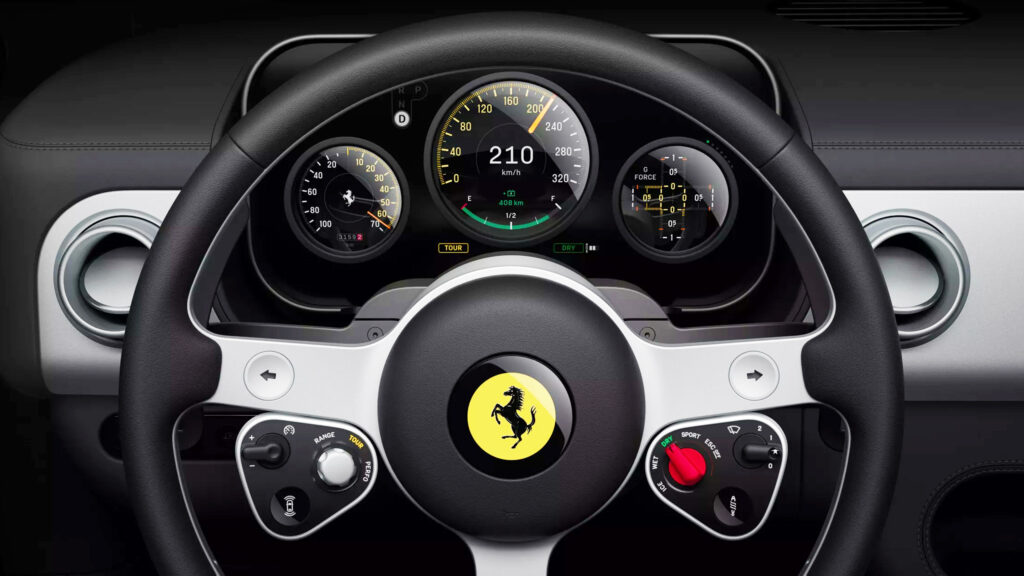
by The interior of the new electric car is dominated by aluminum switches and toggles. Even the displays in this Ferrari are inspired by analog instruments and have physical controls. Designer Jony Ive notes that automakers made a mistake by focusing on touchscreens.
Presentation of the Interior of Ferrari’s First Electric Car
Ferrari this week presented the interior of its first-ever electric car, the Luce, created in collaboration with former Apple chief designer Jony Ive. It is a retro-themed space with a large number of physical buttons, switches, and toggles, sharply contrasting with the screen-oriented and minimalist designs of most electric cars.
This approach may seem illogical, given Ive’s legacy at Apple, where he helped usher in the era of touchscreens. However, the British-American designer’s reasoning is based on practicality, not nostalgia. As it turns out, he never believed touch interfaces belonged in cars at all.
Touch Control Is Not Always the Solution
Jony Ive explained his position:
The reason we developed touch for the iPhone was that we were working on the idea of solving a problem. The big idea was to create a universal interface that could be a calculator, a typewriter, a camera, instead of having physical buttons. I would never use touch in a car for primary controls.
It’s something I would never have dreamed of doing, because it requires you to take your eyes off the road, the designer added. So, it’s simply the wrong technology for the primary interface.
This does not mean the Ferrari Luce is completely devoid of screens. The instrument panel is equipped with OLED panels from Samsung, designed to mimic the look of classic analog dials. The needle, however, is a physical element made of anodized aluminum and illuminated by 15 LEDs. In the center of the dashboard is a touchscreen, slightly tilted towards the driver.
Intuitive Physical Control
Yet almost every primary function, including climate control, drive mode settings, and even the audio system, can be adjusted using metal switches or rotary dials. Ive notes that
each individual switch feels different, so you don’t need to look at it.
When asked what distinguishes the Luce’s screen from others, the designer replied:
So much of what we did was so that you could use it intuitively, enjoy it, and use it safely.
In addition to the real switches beneath the central touchscreen, the Luce has tactile controls and buttons on the steering wheel and center console, and even an aircraft-inspired panel on the headliner. This feels like a welcome break after the touch controls of many recent Ferrari models, such as the SF90.
I think what happened was that touch control was perceived almost as a fashion, Ive explained. It was the latest technology, so companies thought: ‘we need a bit of touch control,’ and the next year — ‘we’ll have an even bigger screen,’ and it kept getting bigger and bigger.
He added:
I think the way we design car interiors is not about trying to solve problems, as we did with the iPhone.
In his opinion, this is where modern automotive user experience design often goes astray.
This project by Ferrari and Jony Ive can be seen as a deliberate rethinking of the driver’s interaction with the car in an era when cabin digitization often prioritizes visual aesthetics over tactile convenience and safety. The emphasis on physical controls, each with a unique tactile response, not only enhances the sense of luxurious craftsmanship inherent to Ferrari but also places functionality and undistracted attention to the road above fashionable trends. This could become an important precedent for other manufacturers, especially in the high-end segment, where the driving experience remains a key value even during the transition to electrification.