


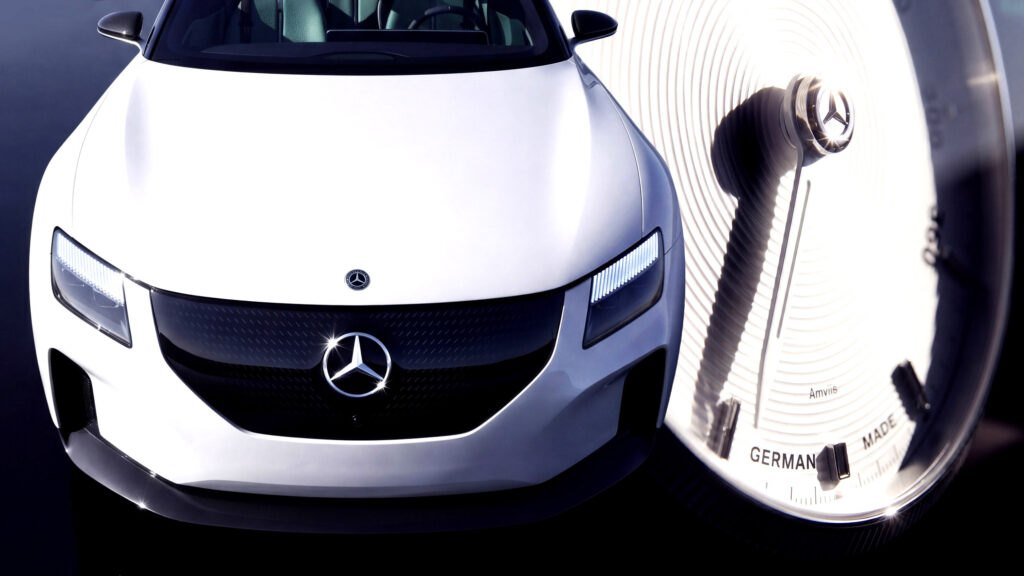
An independent designer has created an elegant Mercedes concept that offers an alternative to the brand’s current direction.
Problems of Modern Mercedes Design
Mercedes design is going through hard times. The electric era has not benefited the brand’s studio: coupe-like sedans and full-width screens have failed to resonate with buyers. Independent designer Lukas Wochinger proposed an alternative. His digital concept combines restrained exterior surfaces with an interior built around analog dials and real switches.
Who is Lukas Wochinger
Wochinger is not just an amateur with rendering software. He was the lead exterior designer at NIO from 2021 to 2025, meaning he spent the last few years seriously contemplating what a premium electric car should look like.
The Munich-based designer published a set of high-quality renders on LinkedIn. The stated goal was to create a “more structured and clearly defined design language,” taking the 1990s as a benchmark. The R129 SL, W124 E-Class, and C215 CL-Class coupe are mentioned — cars that felt no need to shout.
Inspiration from the 90s
The digital concept fits perfectly into the atmosphere of the Concorso d’Eleganza Villa d’Este in Italy, combining clean surfaces with simple lines and balanced proportions. The biggest difference from the EQS is the elongated hood, which gives the car a true Mercedes-like presence.
The front features a new closed-off grille, a huge improvement over the intricate design of the facelifted EQS or the illuminated panels on the electric C-Class and GLC. Square LED headlights, deep air intakes in the bumper, and a pronounced splitter complete the front end.
Star-shaped alloy wheels dominate the side view, complemented by flush door handles and sculpted rear fenders reminiscent of the AMG GT Four-Door. The arched roofline is pure CL coupe, and the two-tone paintwork visually lengthens the car. At the rear, there is a subtle ducktail spoiler above horizontal LED taillights set into a black panel, and a clean bumper with an integrated diffuser.
Analog Dials and Physical Controls
The exterior is impressive, but the interior is where this concept truly justifies itself. The tiresome Hyperscreen is gone, replaced by a more sensible infotainment display in the style of previous Mercedes generations, paired with analog dials behind the steering wheel. They look like expensive watches, with the speedometer finished in white.
Another crucial point is the physical controls on the center console, door cards, and steering wheel, providing the necessary tactile feedback. The interior uses high-quality materials such as mint-green leather, dark wood, and metal, and the luxurious seats feature Mercedes emblem inserts.
Powertrain and Conclusions
The powertrain remains undefined. The lack of cooling openings and exhaust pipes hints at an electric vehicle, but Wochinger envisions a hybrid, which likely explains the presence of a tachometer on the instrument panel.
Either way, this independent concept quietly but convincingly proves that Mercedes doesn’t need more pixels to reclaim its premium throne. It simply needs a little more soul and a few honest nods to its past.
This concept serves as a reminder that true luxury does not always lie in technological complexity, but often in thoughtful minimalism and tactile quality. At a time when automakers are competing over screen sizes, the idea of returning to physical controls and clear, recognizable lines could be a refreshing breath of fresh air for an industry that has somewhat lost its way.