


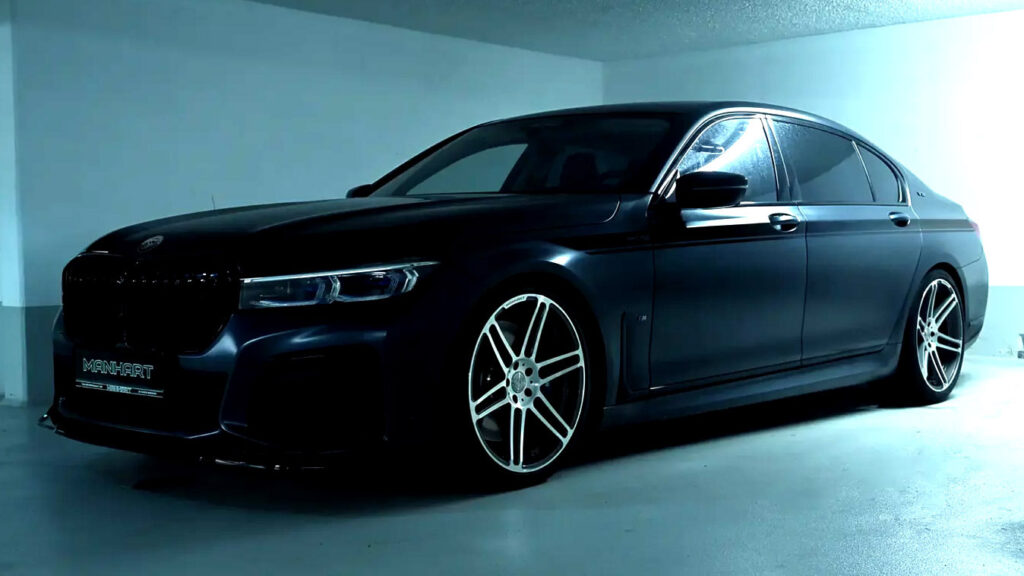
Tuning atelier Manhart has presented a powerful version of the former BMW flagship — the previous generation M760Li. The project, named MH7 700, is based on a car with the already discontinued 12-cylinder engine.
The Heart of the Modification
The main change happened under the hood. The bi-turbo 6.6-liter V12 engine received updated turbines from Manhart and an electronic control unit, the MHtronik Powerbox. This allowed increasing power from the base 601 hp to 701 hp, and torque — from 800 Nm to an impressive 1050 Nm.
Part of this increase is provided by a stainless steel exhaust system with valve control, sport downpipes, and HJS 200-cell catalytic converters. The sound of such a tuned V12 in a large luxury sedan, which has become a rare phenomenon, should be one of the car’s main features.
Dynamics and Chassis
The tuner has not disclosed exact acceleration figures, but the additional power should significantly improve the factory time of 3.7 seconds to 100 km/h. The top speed will likely remain at 305 km/h, which is impressive for a car of this class.
Changes to the chassis are moderate. The braking system remained stock, and the air suspension was lowered using new links. This gave the car a more grounded stance, emphasized by a set of 21-inch Concave One forged wheels.
Exterior and Interior
Externally, the MH7 700 demonstrates how well the previous generation 7 Series ages, especially after the 2019 facelift. Manhart did not overcomplicate the design. Changes are limited to a carbon fiber front spoiler, mirror caps, and a small trunk spoiler, as well as optional gloss black film decor.
The interior of the long-wheelbase sedan features custom brown and beige leather with intricate stitching and embroidered logos, complemented by branded floor mats. The car remains a recognizable 7 Series, but with an added dose of chic.
The full cost of the conversion has not yet been disclosed on the official website, although individual components can be ordered. M760Li owners interested in such upgrades are invited to contact the tuner for an individual proposal.
The emergence of projects like the MH7 700 reminds us of an era when large luxury sedans were often equipped with naturally aspirated or bi-turbo 12-cylinder engines. Today, this technology is gradually disappearing under the pressure of environmental regulations and the shift to electric drive. Therefore, the work of ateliers like Manhart can be viewed not only as tuning but also as a kind of preservation of automotive heritage. They give a second life to already classic, yet technically perfect models, offering enthusiasts a combination of rare mechanics with modern performance enhancement capabilities. The future of such cars will most likely be associated with collecting and special restorations, making each such specimen particularly valuable.