


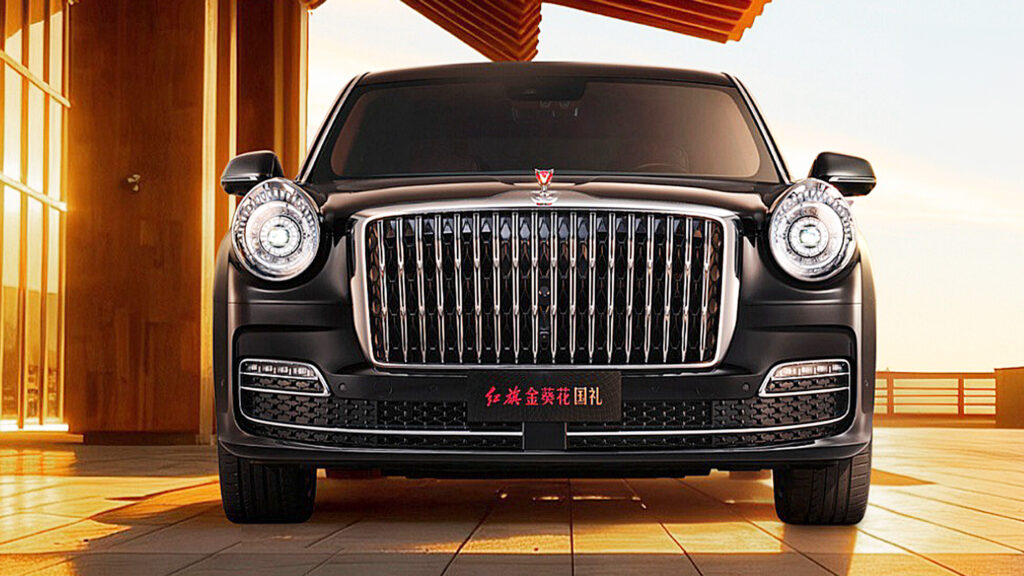
New luxurious face of China
For decades, the hallmark of success in China’s automotive world was a simple formula: VW for basic cars, Mercedes for the wealthy, Bentley for the very wealthy, and Rolls-Royce for those who wanted to show off their status. However, today more and more wealthy buyers are choosing a brand with local roots.
This brand is Hongqi, the luxury division of state-owned automaker FAW. Known primarily for limousines for Chinese political leaders — from Mao Zedong to Xi Jinping — in recent years Hongqi has been actively transforming into a serious player in the premium, luxury, and ultra-luxury segments.
Key facts:
Flagship Golden Sunflower Guoli
The brand’s latest flagship vehicle, the Golden Sunflower Guoli, leaves no doubt about Hongqi’s ambitions. This Cold War-style sedan was unveiled in April at the Beijing Auto Show. Its price reaches approximately $1.6 million, putting it on par with Europe’s most exclusive bespoke cars.
Hongqi does not try to surpass luxury competitors in horsepower or Nürburgring lap times. Instead, the company bets on Chinese culture, craftsmanship, and national identity. At the Beijing Auto Show, FAW Chairman Qiu Xiandong stated:
“Golden Sunflower Guoli is a work of art that embodies cultural confidence” (Nikkei Asia).
The detailing is impressive even by Rolls-Royce standards. While the British brand is famous for its starlight headliners, Hongqi claims that one of its craftsmen spends over 1,200 hours on intricate embroidery for a special version of the car. To create the illusion of clouds above passengers’ heads, 100 different colors of silk threads are used, each thinner than a human hair.
Demand and expansion
The strategy based on Chinese pride, heritage, and craftsmanship is evidently working. According to FAW, the ultra-luxury Golden Sunflower lineup, launched in 2024, found 1,400 buyers the following year. Rolls-Royce does not disclose separate figures for China, but analysts at MarkLines estimate that out of 5,664 global registrations of the British brand in 2025, only about 700 were in China.
Now Hongqi wants to test whether this approach works outside the country. The company is preparing to enter the Malaysian market and expanding its presence in Russia, where sanctions after the start of the war in Ukraine banned official sales of BMW and Mercedes, creating space for alternative luxury brands.
FAW/Hongqi
Hongqi’s success reflects deeper changes in the structure of consumer demand in China. More and more wealthy Chinese see domestic premium brands not only as an alternative but also as a symbol of national revival. At the same time, Hongqi’s international expansion may face challenges: in markets where European luxury has a long history and high prestige, the Chinese brand will have to make significant efforts to convince buyers of its ability to compete. The Russian market, however, looks promising due to the exit of traditional players. Further developments will show whether Hongqi can become a global player in the ultra-luxury segment or remain a phenomenon limited to China.