


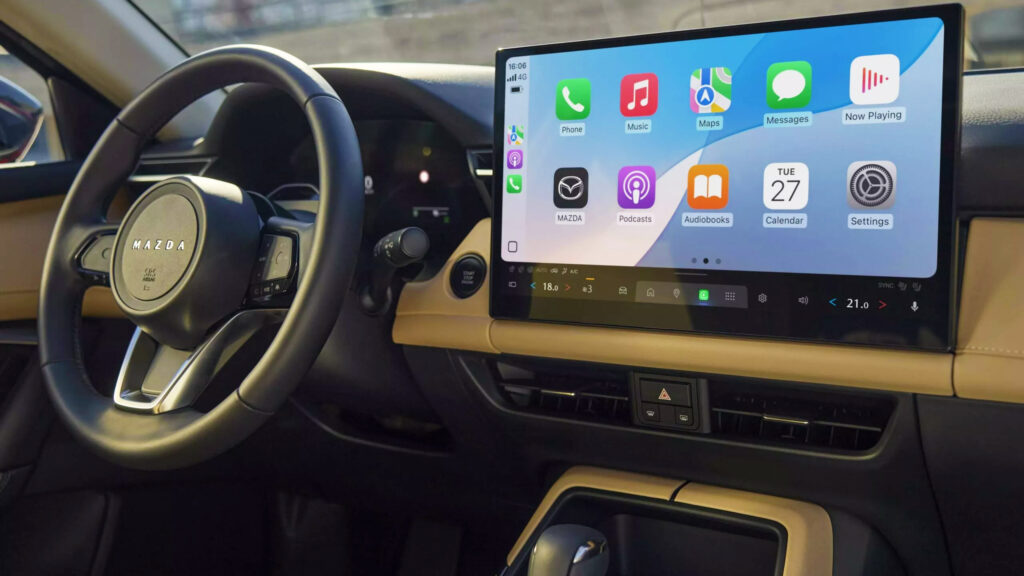
Mazda’s Philosophy is Changing
For many years, Mazda resisted the general automotive trend towards huge touchscreens and button-free cabins, insisting that tactile controls and heads-up displays offered a safer and more intuitive driving experience. However, this philosophy seems to have reached its limit.
Full Transition to Touch
In recent years, the company had already begun adding touchscreens to its models, but the new CX-5 makes a full transition to display and voice control. Even Mazda could not resist the temptation to follow its competitors.
The base 2026 CX-5 is equipped with a large 12.9-inch screen, and an even larger 15.6-inch display is available as an option, which slightly exceeds the size of the Tesla Model 3 screen.
Abandonment of Traditional Controls
Mazda has also abandoned the rotary commander joystick, which can still be seen in many of its current models, and the separate climate control panel, moving all climate settings into the multimedia system.
Our goal with the 2026 CX-5 was to make technology easy to use while keeping the driver’s focus on the road. A huge amount of research and testing went into developing Mazda’s latest multimedia system, and we believe it is perfectly suited to feel familiar to customers who interact with smartphone-like devices.
This step will undoubtedly cause controversy. According to Matthew Valbuena, manager of automotive technology and user interface projects at Mazda’s North American division, the automaker believes the most important thing for the driver is to focus on driving. Mazda wants to minimize visual, manual, and cognitive distractions as much as possible. And apparently, a 15.6-inch screen on the dashboard is the way to achieve this.
New Multimedia System
The new multimedia system includes built-in Google services and the Gemini voice control system, allowing for easy adjustments without taking your eyes off the road. The CX-5 also comes standard with Google Maps and has access to the Play Store where various apps, including YouTube, can be installed.
New Steering Wheel and Physical Buttons
Mazda has also developed a new steering wheel for the 2026 CX-5. In this case, the company was quick to place as many controls as possible on the wheel so that drivers could also keep both hands on it. The controls on the left are primarily for the audio system and include a special function for switching between different instrument panel displays. On the right side of the steering wheel are controls for all driver assistance systems, such as adaptive cruise control.
A Step Forward or Backward?
It remains to be seen how Mazda customers will react to the new concept, which is likely to be added to future Mazda models. Some companies, such as Volkswagen, are retreating from their excessive commitment to screens and touch controls. Recently, the new Subaru Outback was released with a smaller screen and a separate climate control panel, unlike the old model which moved all important functions to the display.
Mazda’s transition to a fully digital interior points to a deeper transformation in an industry where the balance between innovation and ergonomics remains fragile. While large screens and voice control offer new possibilities, consumer reaction to the lack of physical buttons may be mixed, especially among those who value tactile feedback while driving. The success of this strategy for the CX-5 could set the tone not only for the brand’s future models but also influence the approaches of other manufacturers trying to find the perfect formula for the automotive infotainment system of the future.