


Return of the Mysterious Prototype
A year and a half ago, a mysterious Porsche 911 prototype was spotted on the Nürburgring circuits, sparking rumors about the development of a touring version of the mighty 911 Turbo. Now, at the end of 2025, an almost identical prototype has reappeared on the Nordschleife. For many enthusiasts, this could turn out to be the perfect 911.
Differences from the Turbo S
The differences between this car and the all-new 911 Turbo S, unveiled a few months ago, are obvious. Like the model it replaces, the new Turbo S retains large air intakes on the rear wings that feed air to the turbo engine. However, this prototype lacks those intakes.
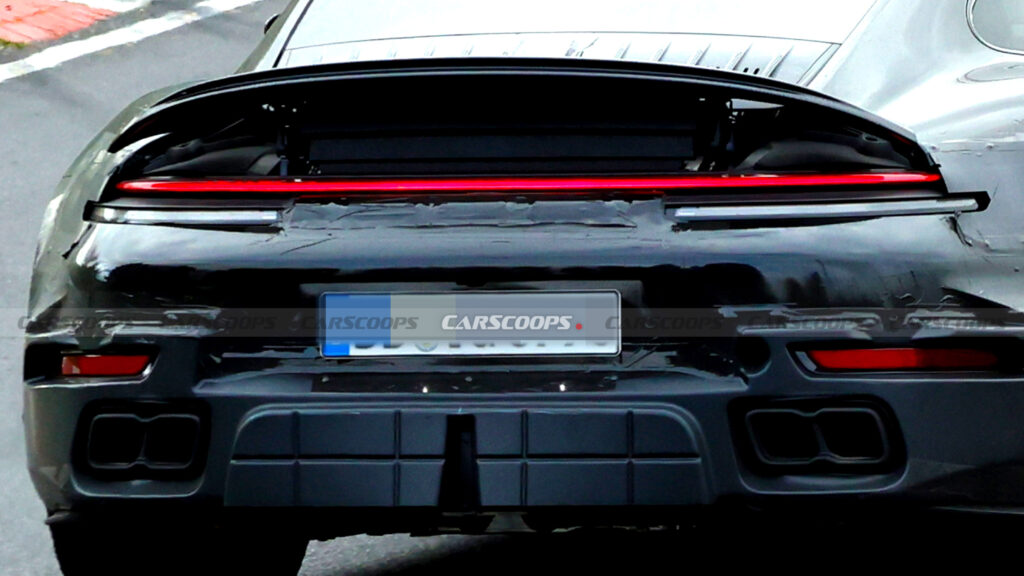
That’s not all. Unlike the Turbo S, which has vertical slats on the front air intake, this model has horizontal slats, giving it a more traditional and restrained look. The changes continue at the rear, where the Turbo S’s large fixed wing has been replaced by a retractable one, similar to other models in the 911 family.
If our spy photos are reading the signs correctly, Porsche may be working on a 911 Turbo Touring. The GT3 Touring has already shown that there is strong demand for high-performance 911s without extravagant design details.
For many buyers, forgoing the motorsport-inspired wing doesn’t mean a compromise in driving experience, it just means less attention on the road.


And if Porsche can convince potential Turbo buyers who were hesitant due to its aggressive look by offering a more discreet version, it could provide easy sales growth. No new engine, no redesign, just a cleaner silhouette with the same power under the hood.
Turbo Power in a Touring Wrapper
If what we’re looking at is indeed a 911 Turbo Touring, it’s reasonable to assume it will have an identical powertrain to the standard model. This means a 3.6-liter flat-six engine with two electric turbochargers, producing an impressive 701 horsepower and 590 pound-feet of torque.
With such a powertrain, the 2026 Turbo S accelerates from 0 to 60 mph in just 2.4 seconds, and to 124 mph in 8.4. The only tricky question is cooling. If Porsche plans to put its most powerful 911 engine in a more streamlined body, it will need to find a way to manage temperatures without the signature side air intakes. It won’t be easy, but if anyone can handle it, it’s probably Porsche.
The appearance of this prototype indicates the company’s ongoing work to expand its lineup, offering different types of clients exactly what they are looking for: from extreme performance to elegant restraint. The high-performance sports car market is becoming increasingly niche, and models like the potential Turbo Touring demonstrate a deep understanding that even in the world of supercars, elegance and discretion can be qualities as valuable as breathtaking speed. The success of the GT3 Touring sets a clear precedent, and it is very likely that Porsche is moving in this direction to meet the demand for a powerful yet diplomatic car for everyday use.