 by
by The company Yasa, owned by Mercedes-Benz, has announced key details about future Mercedes-AMG electric vehicles. The main innovations include:
Revolutionary motor for future cars
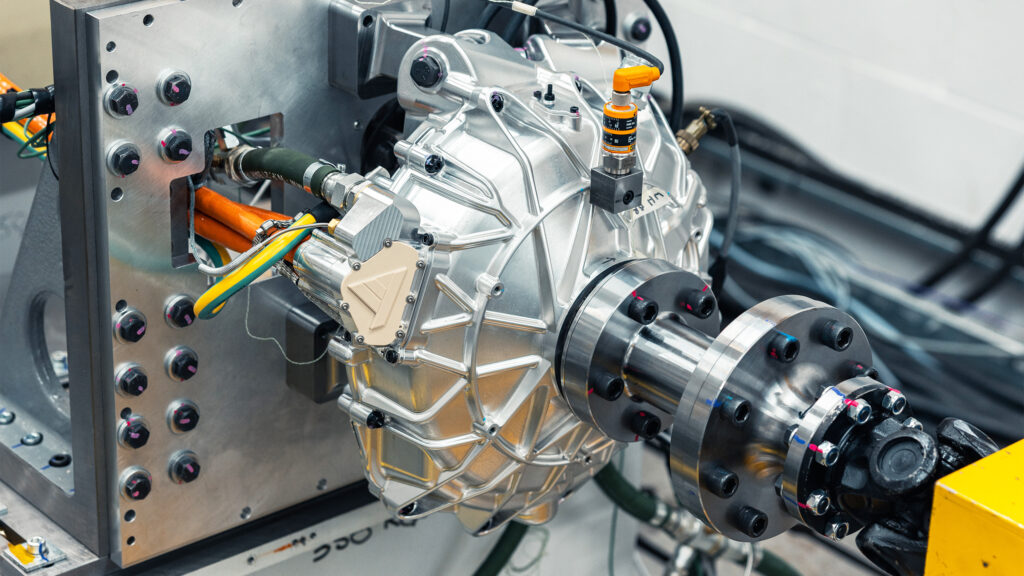
Over a month ago, the Yasa brand introduced a record-breaking electric motor weighing just 12.7 kg, capable of producing up to 1006 horsepower. The company has now confirmed that this axial-flux motor will be used as an in-wheel motor for the next generation of electric powertrains and could even replace traditional rear-wheel braking systems.
Advantages of the new technology
Although in-wheel motors are not an entirely new idea, they have not gained widespread adoption in the electric vehicle market, partly due to their weight and limited power. The new motor from Yasa has set an unofficial record for power density — 59 kW (79 hp) per kilogram. This opens up new possibilities for designers.
The motor can deliver peak power of up to 1006 hp, but its continuous power is in the range of 469 to 536 hp. It can be combined with a dual inverter weighing 15 kg, developed by Yasa itself, making it an ideal solution for powerful hypercars and other high-performance electric vehicles.
The future of braking systems
The issue of braking deserves special mention. Yasa states that their in-wheel motor offers such “incredible regenerative performance” that the system could potentially eliminate the need for traditional rear brakes.
This would allow car manufacturers not only to eliminate crucial braking components but also driveshafts, potentially saving up to 200 kg on current models and up to 500 kg on new models designed from scratch.
Thanks to exceptional regenerative capability, this system has the potential to drastically reduce rear brakes on an electric vehicle — or even eliminate them entirely in certain architectures. Furthermore, by capturing a much larger share of regenerative braking energy, this technology can also provide a significant increase in the electric vehicle’s range.
Moreover, our new in-wheel motor powertrain not only delivers significantly lighter, more efficient, and higher-performing electric vehicles but also dramatically creates space in the electric vehicle architecture, giving automakers unprecedented freedom to redesign and optimize the packaging, aerodynamics, and kinematics of their next-generation cars.
Application in real models
Yasa’s axial-flux motors will be used in the new fully electric Mercedes-AMG GT 4-Door sedan and SUV. In these models, the motors are not expected to be used specifically in the wheels. Instead, they will receive one motor on the front axle and two on the rear.
The transition to technologies such as axial-flux motors and integrated regenerative braking is not just an improvement of individual characteristics, but a systemic change in electric vehicle architecture. This allows for a rethinking of the vehicle’s very layout, focusing on efficiency, weight, and space distribution. The successful implementation of these developments in production models, starting with Mercedes-AMG, could set a new technical standard for the entire industry, where the priority will be not only power but also the rationality of design.