


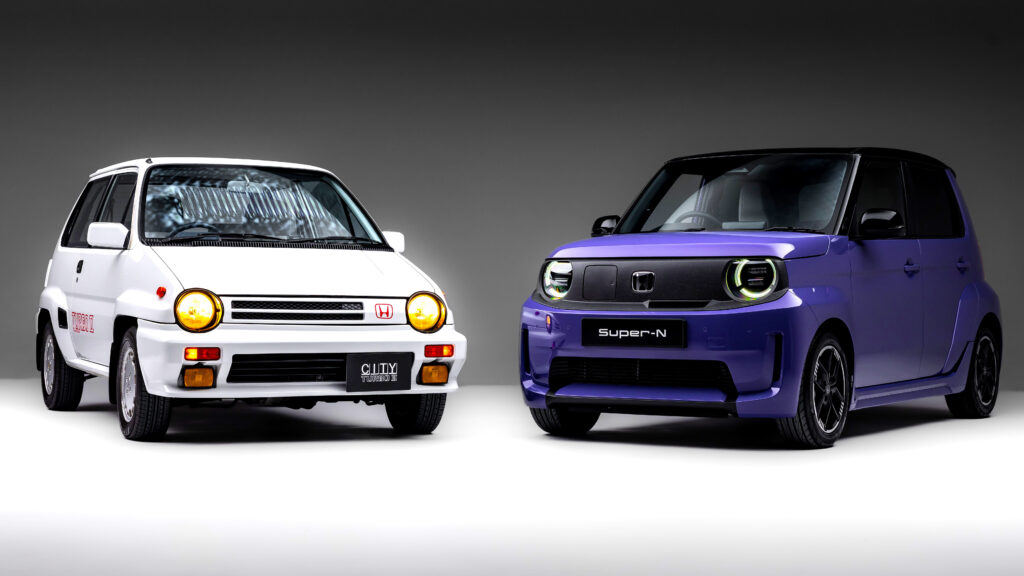
Honda Introduces the Compact Super-N Electric Car in Europe
Honda has decided that the world now needs a tiny electric city car that dreams of being a noisy 80s hot hatch. Meet the Super-N — a kei car that will arrive in the UK and mainland Europe in July. Priced at less than £20,000, it has a clear mission to prove that even with two-digit horsepower, driving pleasure can be achieved.
The Super-N is the European version of the Japanese Super-One, which itself is an evolved iteration of Honda’s Japanese N series, but with a heavy dose of nostalgia. It borrows its vibe from the legendary City Turbo II, meaning massive wheel arches, aggressive bumpers, and enough visual drama to make other sub-£20,000 electric cars like the Dacia Spring look downright boring.
Specifications and Features
Under the short 3.59-meter-long body lies a compact, front-mounted e-axle delivering between 63 and 94 horsepower. The higher power is activated in the so-called Boost Mode. This might not sound very convincing, but it is one of the lightest electric cars on the market, so it should be more lively than the numbers might suggest.
Boost Mode doesn’t just add power. It also engages a simulated seven-speed gearbox and artificial engine sound, similar to how it’s implemented in the Hyundai Ioniq 5 N.
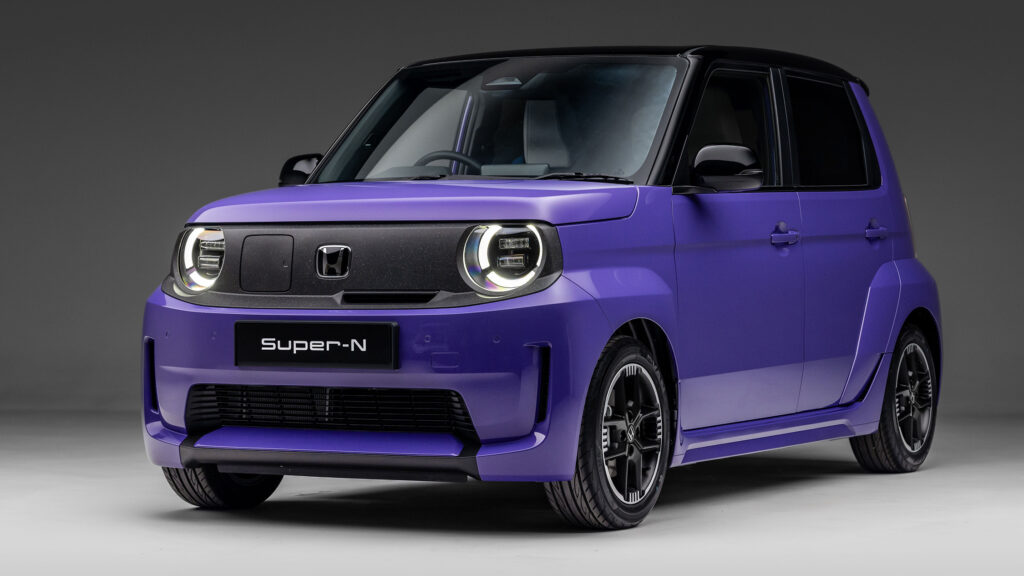

The idea is to give drivers a feeling closer to the experience of driving an old hot hatch and to convince internal combustion engine enthusiasts that affordable electric cars can be interesting. The range is focused on city driving. Honda claims up to 199 miles in the city cycle, although in mixed mode this figure drops to 128 miles. This is more than enough for daily commutes, and this car does not aspire to be a long-distance cruiser.
Interior and Competition
Inside, the Super-N looks playful thanks to sports seats, blue accents, and ambient lighting that switches to purple when Boost Mode is activated. Honda states that the suspension has been specifically tuned for UK and European roads, and its setup is apparently stiffer than that of the non-sporty N-One e: model offered in Japan alongside the Super-One.
Sales in the UK will begin in July. However, although the Super-N looks interesting, it will not be without competitors. The stylish new Renault Twingo will also hit European roads this year and will cost less than £20,000, just like the Honda.
The emergence of models like the Super-N clearly indicates the growing diversification of the affordable electric car market. Manufacturers are trying to appeal not only to practicality and eco-friendliness but also to emotions, offering compact electric cars character and playful features previously inherent to sports models. This could be the key to attracting a new wave of buyers who are looking not just for a means of transport, but for a certain experience. The success of such initiatives will depend on how successfully they manage to combine an affordable price, sufficient city range, and that very “fun factor” promised by the advertising.