


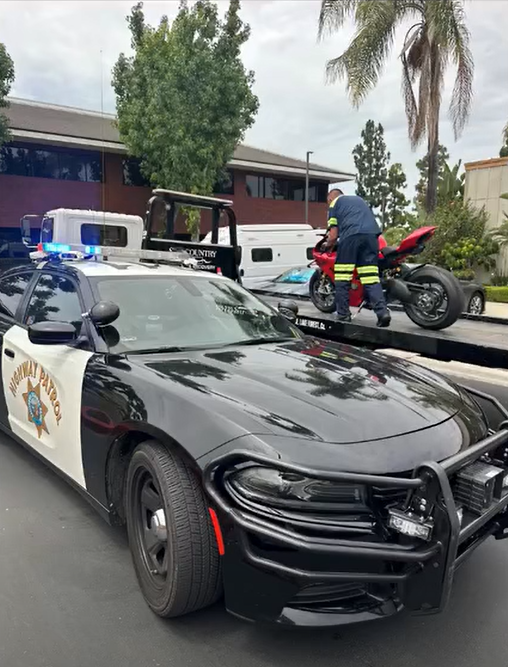
On US Independence Day, July 4th, a California Highway Patrol (CHP) officer spotted a motorcyclist traveling at over 120 miles per hour. Many police departments would have immediately initiated a high-speed pursuit, potentially escalating an already dangerous situation. Instead, the CHP used a combination of one of its most expensive and effective assets with one of its cheapest to peacefully end the incident. Perhaps this is a lesson for departments across the United States.
How the surveillance unfolded
According to the agency, a fixed-wing aircraft tracked the motorcyclist from above while officers on the ground maintained radio contact. Instead of forcing the driver to go even faster or weave through traffic trying to escape, the police simply watched from the sky until the motorcycle finally stopped. At that moment, officers approached and made the arrest.
Read: Florida teenager just found out what happens when you point a laser at a helicopter
According to the CHP, the driver was traveling at over 130 miles per hour during the incident. The motorcycle was impounded for 30 days by court order. The Capistrano area office also noted that this was already the 38th vehicle impoundment of the year related to dangerous driving, racing, or attempts to evade police. It is hard to argue against this strategy.
Why this tactic worked
Pursuing a motorcycle at speeds over 100 miles per hour drastically increases the risks for everyone nearby. Motorcyclists are already more vulnerable compared to car passengers, and when a chase begins, both the suspect and the pursuing officers are under pressure, forced to make split-second decisions at very high speeds.
By using an aircraft for visual contact, the CHP significantly relieved this pressure. The driver was not forced to take even greater risks trying to shake off patrol cars, as none were directly behind him. Instead, officers simply waited for an opportunity to make an arrest under controlled conditions.
Of course, not every agency has the budget for aviation. Air support is expensive, but this incident shows what such an investment can yield: the ability to catch a suspect without immediately increasing the risk to all other road users.
Photo: CHP
This case is a vivid example of how technology and strategic thinking can reduce the level of danger during the apprehension of offenders. Although not all police departments can afford their own aircraft, the idea of using aerial surveillance to avoid risky ground pursuits is gaining increasing relevance. In cases where a suspect’s speed significantly exceeds legal limits, this approach can save lives – not only of the driver but also of other road users and the officers themselves. It is worth noting that the 30-day vehicle impoundment is a significant deterrent, and the fact that this is already the 38th such impoundment in the region this year indicates the systematic work of law enforcement in combating dangerous driving.