 by
by Speculation Around the New Concept
The presentation of the Citroen ELO concept with its two-tier LED headlights, minivan shape, and six-seat layout immediately sparked a wave of discussion. This concerned not only the prospect of a minivan under the Citroen brand but also the possibilities for other brands within the Stellantis group. Its appearance raised questions that went beyond the concept car itself.
Could this platform become the basis for a new Fiat Multipla? At first glance, it might seem like a stretch, but the idea is not that far from reality. Rumors suggest that Fiat plans to revive the Multipla name for a family crossover.
However, the shape and proportions of the ELO lead to another thought: what if the next Multipla is closer to the spirit of the original model?
Return to the Monospace Concept
The monospace layout of the Citroen concept fits surprisingly well as a spiritual successor to the original 1955 Fiat 600 Multipla. This idea doesn’t seem so far-fetched, considering both brands are part of the Stellantis group.

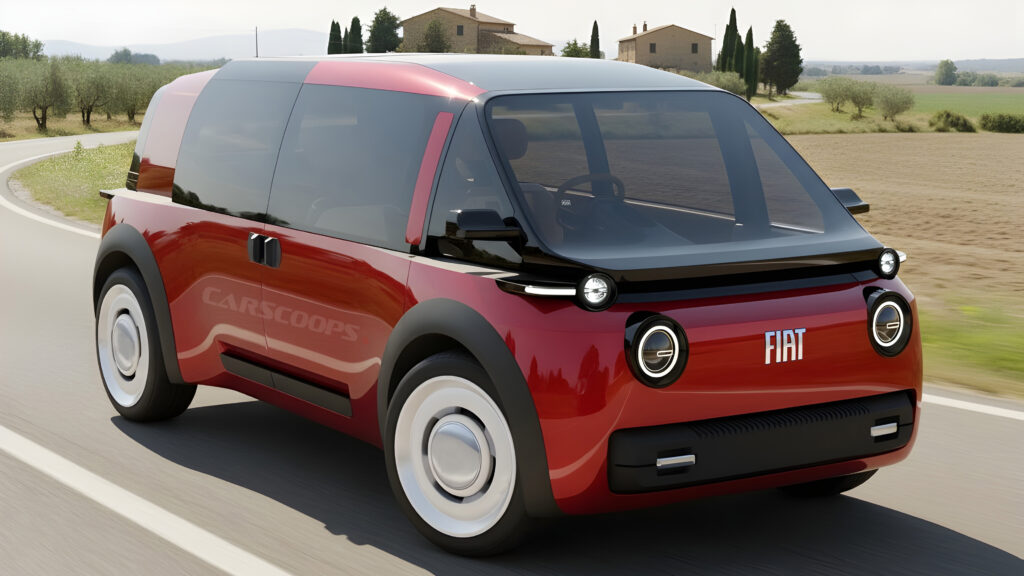
With minimal stylistic changes in the Fiat style, they could create a distinctive variant, sharing development costs with Citroen, if such a pair of minivans ever hit the roads.
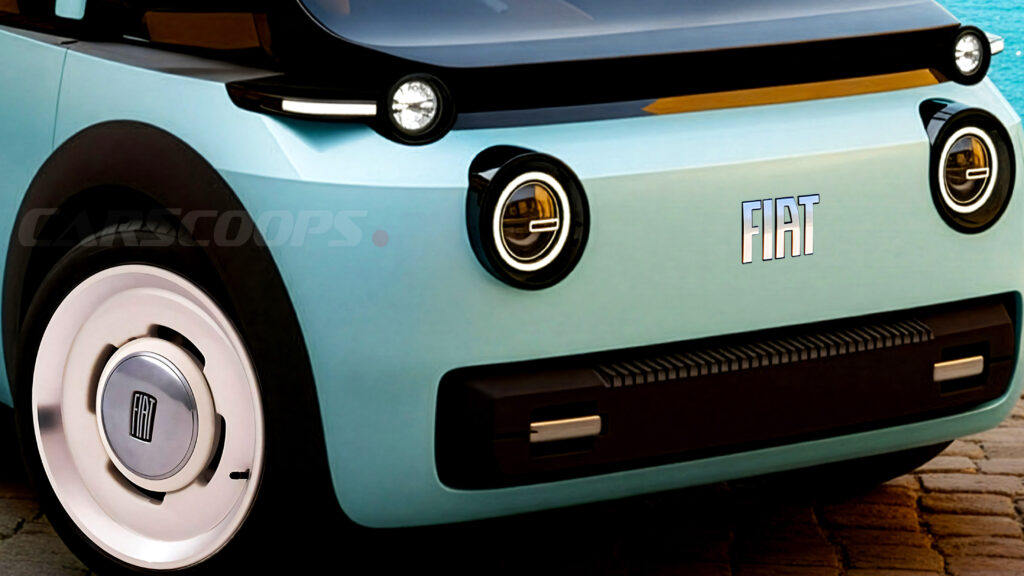
A clear visual reference is present in the lighting. The concept is equipped with round LEDs paired with thin daytime running lights at the base of the windshield, hinting at the two-tier headlights that made the 1998 Multipla famous. A slightly reworked front end with smoother surfaces and a new Fiat logo completes the update.
Design and Exterior Details
Most of the 4.10-meter-long body is carried over from the Citroen ELO, except for the rear. There, the “UFO-like” split taillights at the corners could be replaced with round units reminiscent of the cheerful Fiat Topolino style.
As a finishing touch, we added a set of retro alloy wheels from Fiat 500 anniversary special editions, as well as a more expressive body color palette. Discreet plastic wheel arch cladding with matching trim for the bumpers and door inserts make this imaginary model road-ready.

The wide sliding doors and experimental cabin layout of the Citroen concept also make sense in this case. Six individual seats, a central driving position, and the option to remove seats or add accessories like inflatable mattresses and modular storage systems could make this car the perfect companion for family adventures.
Such a layout requires a dedicated electric vehicle platform. This means no room for internal combustion engines. But a compact rear-mounted motor and a modest battery would be more than sufficient for city driving and occasional weekend getaways.
Multipla Model History
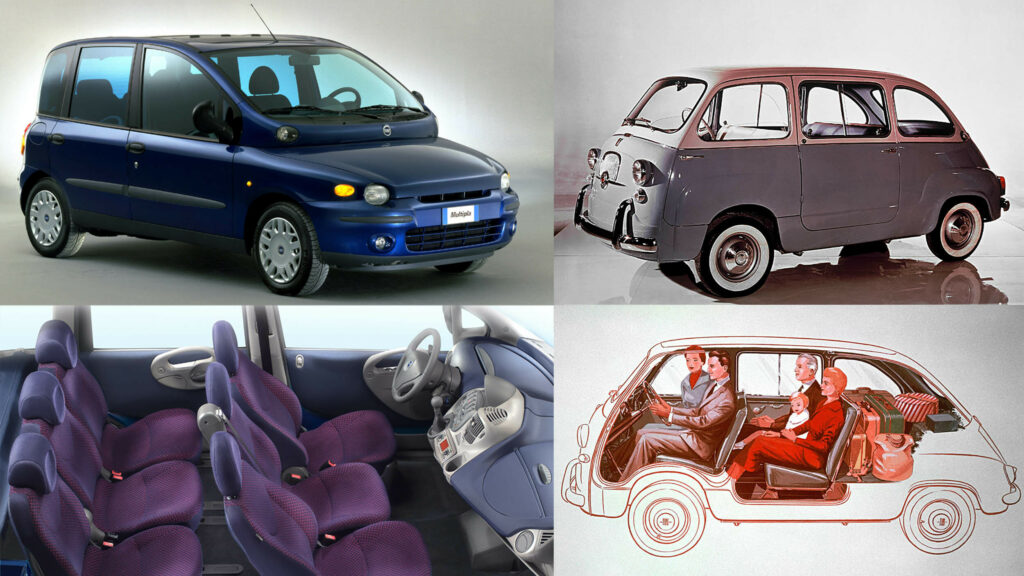
The original Fiat 600 Multipla, designed by Dante Giacosa, was introduced in 1955. It was based on the Fiat 600 chassis and had a cab-over-engine layout. Despite a length of only 3531 mm, it had a spacious interior capable of accommodating up to six passengers and their luggage.
Fiat revived the Multipla name in 1997 for a new compact minivan, and while it may be best remembered for its polarizing design, it offered genuine functionality. The design by Roberto Giolito with two-tier headlights and a large glass area stood out in every possible way.
Despite being shorter than a modern supermini (3994 mm long), the Multipla offered uncompromising practicality. Instead of increasing the length, Fiat designers cleverly widened the car, giving it a width of 1871 mm.
This allowed for two full rows of three seats, making it a true six-seater, with a minimum of 430 liters of trunk space, enough for suitcases, shopping, or one or two four-legged passengers. Because Fiat made it wide, not long, the Multipla not only had plenty of space but also handled better than most minivans, with a low seating position providing a more planted feel on the road.
The second generation of the model received a more conventional facelift in 2004 and was discontinued in 2010. However, production continued under license in China by Zotye until 2013.
Is There Room for an Eccentric Comeback?
Fiat has not confirmed the development of a new Multipla, but this name constantly appears in product rumors. Most likely, it will be assigned to a crossover in the expanded Panda lineup. This model is expected to use the Stellantis Smart Car platform, shared with the Citroen C3 Aircross and Opel Frontera, and will likely compete with budget models like the Dacia Duster and Bigster.
The future crossover is reportedly set to be offered with gasoline, mild-hybrid, and fully electric powertrains, following the example of the subcompact Grande Panda hatchback and its related crossover-fastback already seen during testing.
However, despite all the crossover plans, a quiet corner of hope remains online that Fiat remembers what made the original Multipla special: not just practicality, but also a certain willingness to stand out.
The potential for the return of a more iconic and functional model like the Multipla, in a form inspired by modern concepts, remains an interesting opportunity for the brand. It would be a bold move in a world where many cars are starting to look the same and could revive Fiat’s unique identity. The success of models like the electric Fiat 500 shows that the market values cars with character, and the Multipla always had it in abundance.