


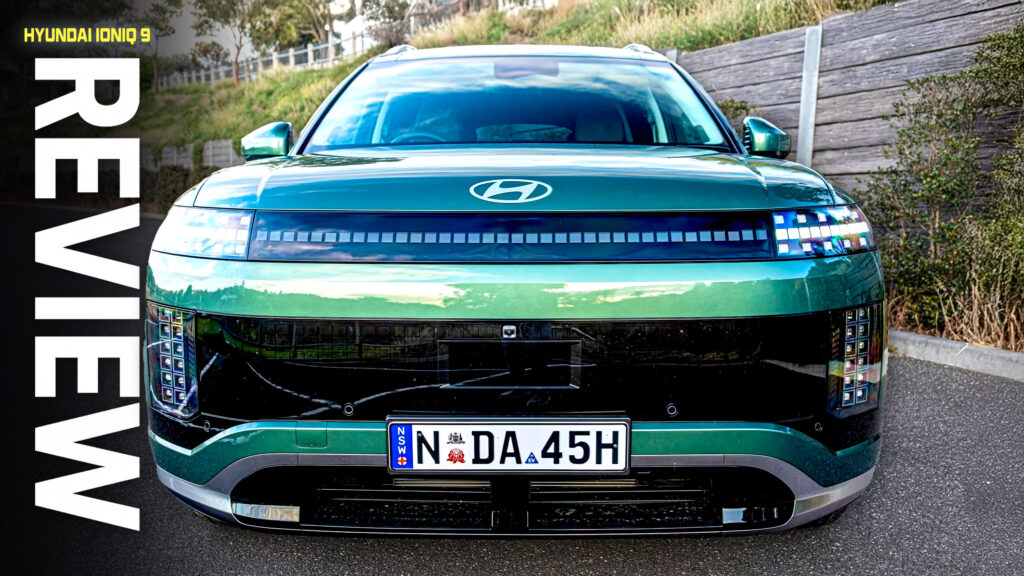
Pros: Excellent interior, great performance, bold design.
Cons: Expensive, heavy, difficult to sell compared to Palisade.
Introduction to Electric SUVs
Electric SUVs have come a long way in a short time, but progress in the three-row segment has been surprisingly slow. Hyundai made a big impression on the EV market by introducing the stunning Ioniq 5 in early 2021. A month later, Kia revealed its related EV6.
However, after the debut of the Ioniq 5 and the later arrival of the Ioniq 6, Hyundai’s rollout of its next-generation EVs slowed, especially compared to Kia. Over the same period, Kia steadily expanded its lineup, recently adding the EV3, EV4, EV5, and EV9 to its electric stable.
Review: The new Nissan Qashqai e-Power drives like an EV but doesn’t need charging.
This makes the launch of the new Hyundai Ioniq 9 even more important. The thing is, it’s related to the three-row Kia EV9, but that model was launched more than 18 months before it, meaning Hyundai has catching up to do.
Quick Model Facts
Launch Context and Positioning
Working in Hyundai’s favor is the fact that little has changed in the three-row electric SUV segment since the EV9 launched. Few contenders have emerged in this specific category, especially within the price bracket in which both the EV9 and Ioniq 9 play.
We recently had the chance to spend a full week with the Hyundai Ioniq 9 in Calligraphy trim, testing it not only to see how it stacks up against the EV9 but also to ask the tougher question: can it justify its position as the most expensive Hyundai ever sold?
The Question of Cost
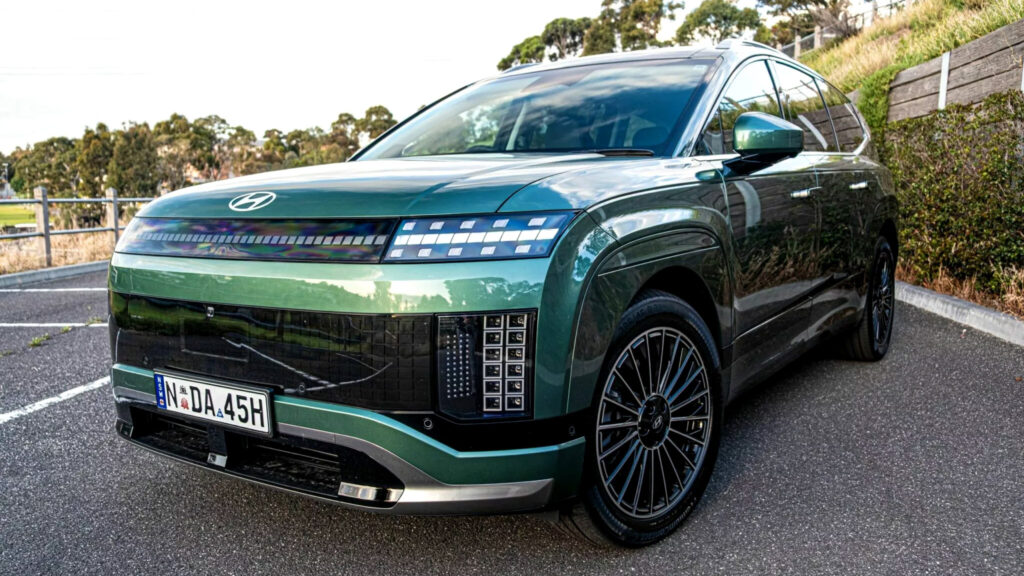

While Kia offers several versions of the EV9 in Australia, Hyundai has launched only one Ioniq 9 trim, known as Calligraphy. Buyers can choose between six or seven seats, and prices start from AU$128,413 including on-road costs.
There’s no denying it’s a lot of money for a Hyundai. However, it’s surprisingly good value compared to the Kia EV9 GT-Line, the closest equivalent to the Calligraphy, which starts from AU$138,915.
Americans just sent Hyundai EV sales through the roof, but trouble is brewing.
Buyers in the U.S. who want to get their hands on the new Ioniq 9 can do so for as little as US$58,955. The flagship Performance Calligraphy Design version is the top of the line, starting at US$76,490. While the Australian Calligraphy model doesn’t have ‘Performance’ in its name, it has the same powertrain as the U.S. model.
Underneath the concept-car looks of the Ioniq 9 lies a massive 110.3 kWh battery, larger than the flagship 99.8 kWh battery in the EV9. This battery powers two electric motors, each rated at 157 kW (210 hp), for a combined 314 kW (421 hp) and 700 Nm of torque. This gives it a significant advantage over the 283 kW (380 hp) EV9 GT-Line, although torque remains identical.
A High-End Cabin
As you’d expect from a car in this price bracket, the Ioniq 9 Calligraphy’s cabin is exceptionally luxurious and feels more premium than the EV9, which, in our opinion, has too much plastic.
Like other Hyundai models, there are two 12.3-inch screens in front of the driver, housed in a single curved display that supports wireless Apple CarPlay and Android Auto. While Kia insists on continuing to use an awkwardly placed third screen on the dash for climate controls, the Ioniq 9 uses a dedicated display under the dash with a touchpad and physical temperature dials.
Review: The new Fiat Grande Panda Hybrid makes a budget car cool again.
Our Ioniq 9 was fitted with an attractive two-tone Dark Wine and Dove Grey Nappa leather, one of three two-tone options available for those not interested in the standard Obsidian Black trim. The Ioniq 9 is available with digital rearview mirrors, but thankfully, our car didn’t have them. For comparison, the EV9 GT-Line is sold exclusively with cameras instead of mirrors.
The cabin is packed with luxury features, making the Ioniq 9 perfectly suited for any journey. This includes a heated steering wheel, heated, ventilated, and massaging front seats, and wireless phone charging.
There’s also a panoramic sunroof, three-zone climate control, customizable ambient lighting, and a head-up display. Tech enthusiasts will be pleased to learn that in addition to two powerful 100-watt USB-C ports on the dash, there are also 100-watt USB-C ports on the back of the front seats for rear-seat passengers.
Those seeking maximum comfort would be wise to opt for the six-seat version, as it replaces the second-row bench with a pair of captain’s chairs, very similar to the front seats.
Review: BYD Sealion 6 makes plug-in hybrids seamless, but fun is optional.
However, even in the seven-seat configuration, the Ioniq 9’s second row is more than spacious enough to comfortably seat three adults. Even the third row is surprisingly practical. I’m 189 cm tall, and my hair was just brushing the headliner, but I had to slide the second-row seats forward to get legroom.
Without a doubt, this is one of the most premium interiors Hyundai has ever created. However, it doesn’t feel radically more upscale than the much more affordable Santa Fe. It also shares quite a few components, including the dual screens, steering wheel, and HVAC controls. Cabin space is also only slightly more generous. The latest Palisade, by the way, feels just as sophisticated as the Ioniq 9.
Performance and Comfort
Despite not being positioned as a high-speed car in Australia, that’s exactly what the Ioniq 9 feels like, at least in a straight line. It can sprint to 100 km/h in 5.2 seconds, which is impressive considering the seven-seater weighs a hefty 2,721 kg. Stomp the accelerator, and it surges forward, squatting at the rear and leaving hatchbacks behind.
However, show the Ioniq 9 a series of corners, and it doesn’t match the uncanny agility of the EV9 GT-Line. That’s not to say it can’t be hustled through bends quickly, because it can, partly thanks to Continental PremiumContact tires. But the Ioniq 9 clearly prefers a calmer approach, and with the massaging seats doing their job, it feels most relaxed during smooth cruising.
Hyundai has calibrated the steering of its new flagship SUV well, and it’s beautifully light, perfect for a car of this size, making parking easy. While driving the Ioniq 9, I quickly forgot about its weight, although it was a little harder to forget about the sheer size of the thing.
At 5,060 mm long, it’s 50 mm longer than the EV9 and matches the Kia’s width of 1,980 mm. It’s even 8 mm longer than a full-size Range Rover.
Range to Match the Pace
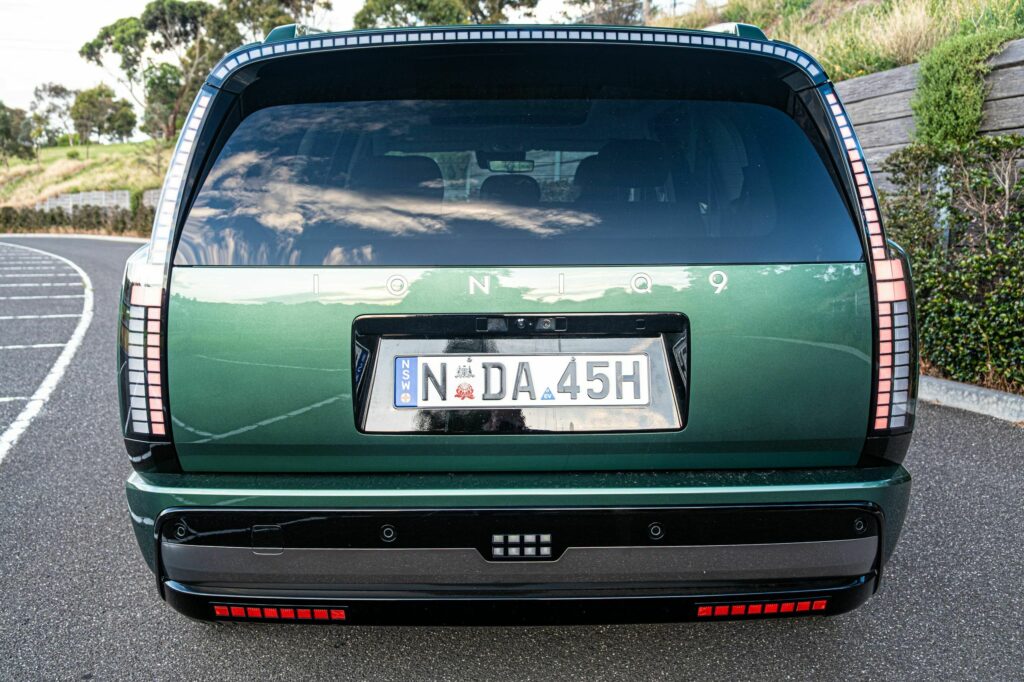

Thanks to the large battery and acceptable efficiency, the Ioniq 9 has good real-world range. Hyundai claims it can travel up to 600 km between stops and quotes an average efficiency of 20.6 kWh/100 km. During my week with the Ioniq 9, I averaged 22 kWh/100 km, traveled 210 km, and had 298 km of range remaining.
Like other Hyundai, Kia, and Genesis EVs, charging is a strong point for the Ioniq 9. It supports charging speeds of up to 233 kW, meaning the battery can be charged from 10 to 80 percent in 24 minutes via a 350 kW charger. AC charging is limited to 10.5 kW, which is sufficient for overnight home charging.
Hyundai just got a huge gift from Trump, but it’s GM that’s smiling.
Given the Ioniq 9’s significant weight, I expected the ride to be firmer, as is often the case with EVs. Instead, it proved surprisingly comfortable and noticeably softer than the EV9 GT-Line. However, the lighter and more compact Santa Fe still manages to provide an even smoother ride.
Regenerative braking is handled via steering wheel paddles, allowing you to switch between four different levels, including a one-pedal driving mode that works wonderfully.
Hyundai has also equipped the Ioniq 9 Calligraphy with its Highway Driving Assist 2 (HDA2) system, which includes adaptive cruise control and an automatic lane-changing function. It can even shift the EV towards the edge of the lane when overtaking a truck for additional