


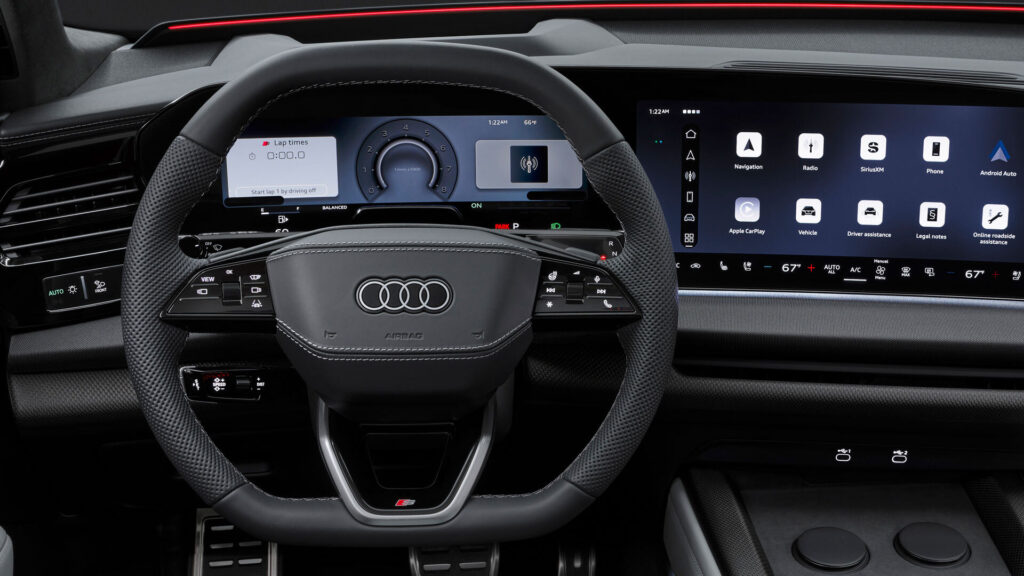
A pioneer of autonomy returns
Audi was one of the early pioneers of autonomous driving: back in 2017, the company introduced a Level 3 system. It was called AI Traffic Jam Pilot and debuted on the then-new A8. However, a few years later, the manufacturer abandoned this development and has hardly mentioned hands-free driving since.
Now the situation is changing: the 2027 Q9 crossover gets an adaptive driving assistant plus with a hands-free function. It is already included in the standard equipment of the Q9 Premium Plus, priced at $93,300, and is expected to make long journeys noticeably more comfortable.
More: The biggest Audi SUV ever costs up to $120,000 for the SQ9 version, and yes, it has a V8
Where exactly the system works
The system operates on “approved” sections of highways and autobahns in Canada, Germany, and the United States. It is Level 2 with a maximum speed of up to 85 mph (137 km/h) or up to 130 km/h (81 mph), depending on the location.
As befits such assistants, the system controls acceleration, braking, and steering. There is also an automatic lane-change function that can be activated by turning on the turn signal. If it is safe, the car will independently change to the desired lane.
The driver remains responsible
Despite the fact that the technology allows you to keep your hands free, Audi emphasizes that there is no full autonomy here. The company stated:
The driver remains responsible and must stay attentive at all times.
To make this work, the Q9 has a camera on the steering column. It monitors the driver’s eye position and head movements, checking whether they are distracted from the road.
If the driver is inattentive, a series of increasingly annoying warnings sound to bring them back to driving. And if they do not respond, the car will eventually perform a controlled stop on its own.

Technical details and expansion plans
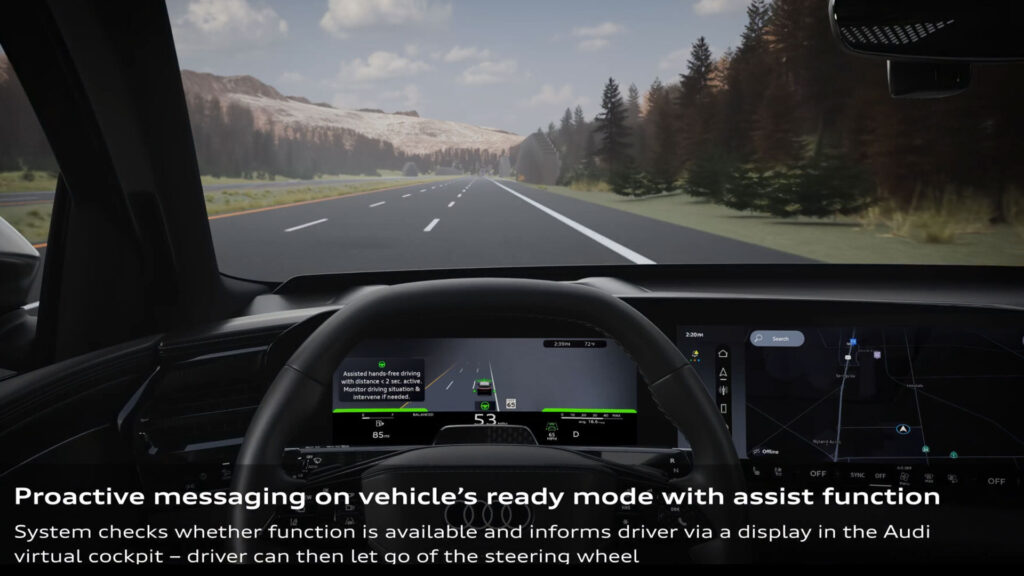
The adaptive driving assistant plus with hands-free uses a long-range front radar, side radar sensors, and a windshield camera. In addition, GPS data helps determine permitted road sections. When the car enters an area where the system is supported, a message appears on the digital instrument cluster offering to activate it.
Although the system debuts on the Q9 and will initially be available in three countries, Audi has confirmed that it will gradually spread to other markets and models. Given the similarity between the Q7 and Q9, it is quite logical to assume that the smaller three-row crossover will get this technology in the near future.
This is a noticeable shift in Audi’s strategy after the company previously abandoned Level 3 due to regulatory uncertainty and technical difficulties. Now the manufacturer is choosing a more pragmatic approach: the Level 2 system takes over a significant part of driving on the highway but leaves responsibility with the human. For buyers, this means less fatigue on long trips, and for Audi, it means the ability to introduce the technology gradually without major legal risks. The fact that the new feature appears first on the flagship Q9 shows that premium customers will try it first, and later the function will most likely reach more affordable models.