



Update for the Japanese market
Mazda has introduced a series of style and technology changes for the Flair Crossover model in Japan, closing the safety gap that separated it from competitors in the segment. This small Mazda vehicle is unfamiliar to buyers outside the Japanese market, where it exists as a rebadged Suzuki Hustler. Suzuki recently underwent a nearly identical update, so now both models are moving in step.
Dimensions and design
The dimensions show how little space this car occupies. The Flair Crossover’s length is 3,395 mm, which is less than the Mazda MX-5 Miata. Its width is 1,475 mm, height is 1,680 mm, and wheelbase is 2,460 mm, complying with Japanese kei car regulations.
The most noticeable visual change is at the front. On XG, XS, and XT trims, a significantly larger grille and Mazda emblem fill the space between the unchanged round headlights, along with an updated bumper with an air intake extending to the fog lights and plastic fender flares.
The more off-road oriented ZS and ZT versions retain a narrower grille and unpainted plastic bumpers with faux aluminum inserts, similar to the previous model, mimicking the Suzuki Hustler Tough Wild. However, they received a much smaller Mazda emblem on the nose, likely related to new ADAS sensors.
New colors and safety
Besides emblem changes, exterior updates include a new “Woodland Khaki Metallic” color and fresh two-tone options. Buyers can combine Woodland Khaki or Soft Beige with a brown roof on XG, XS, and XT trims, or a black roof on the off-road ZS and ZT versions.
The interior has largely remained unchanged, as the main focus was on the mandatory safety system update. The Mazda Flair Crossover received Suzuki’s standard Dual Sensor Brake Support II system, which combines a monocular camera with millimeter-wave radar. This is claimed to provide better detection of pedestrians and motorcycles, expanding capabilities at busy intersections.
The safety system also includes low-speed braking support, front parking sensors, lane keep assist, blind spot monitoring, and adaptive cruise control with a stop function for heavy traffic.
Equipment and engines
Other equipment updates include standard folding mirrors with LED turn signals, an electronic parking brake with an auto hold function, and USB-C ports. Additionally, all versions except the base XG come standard with a 9-inch infotainment display with navigation.
The engine lineup continues to use 660cc three-cylinder engines with a mild hybrid system, exclusively paired with a CVT transmitting power to the front or all four wheels. The naturally aspirated engine produces 48 horsepower, while the turbocharged version reaches the kei car ceiling of 63 horsepower.
Price and availability
The Mazda Flair Crossover is now available for order in Japan. Pricing starts from ¥1,610,400 for the front-wheel-drive XG version and reaches ¥2,275,900 for the turbocharged all-wheel-drive ZT. This makes it Mazda’s cheapest crossover or SUV, and along with its Suzuki twin, one of the most affordable new cars in the country. However, it is more expensive than the Hustler, which ranges from ¥1,599,400 to ¥2,097,700.
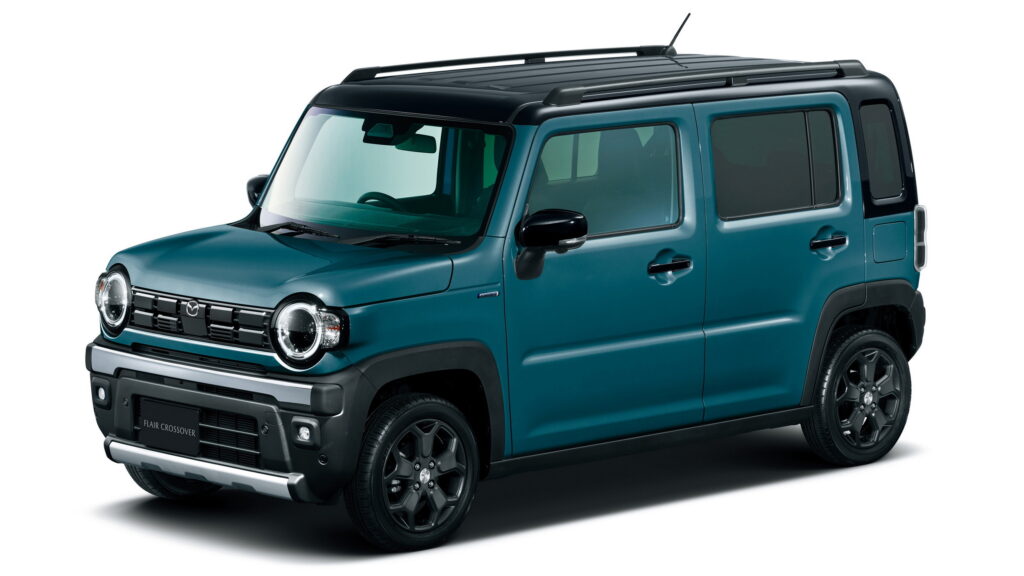

Interestingly, the Mazda Flair Crossover, despite its compact size, offers a modern level of safety and technology previously unavailable in this segment. The ADAS system updates and additional features, such as adaptive cruise control, make it more competitive in the kei car market. Although it is a rebadged Suzuki Hustler, Mazda tries to add its own touches, such as different emblem sizes, to emphasize individuality. The starting price of $9,950 makes it an extremely affordable option for those seeking an economical and practical city car, although its dimensions may be a limitation for some buyers. This is another example of how automakers adapt their models to specific local market requirements, offering unique solutions.