


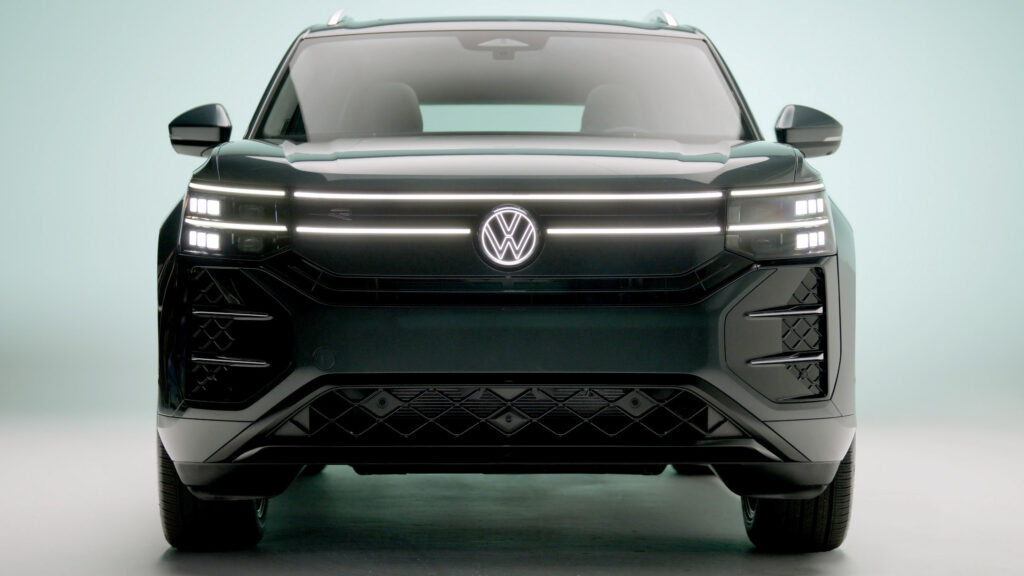
New Look and Market Position
The Volkswagen Atlas has always felt somewhat special in its segment. Initially positioned as a car striving to be average, not standing out in any particular way, its fans were rather niche. Now, the German manufacturer has gone back to the drawing board and presents an updated model with more space, luxury, and power.
The updated, pre-New York Auto Show, 2027 Atlas remains recognizable but looks sharper. The exterior gets completely new metal panels, two-tier headlights, a wider grille, larger fenders, and an overall more sculpted profile.
Most trims will get an illuminated VW logo and full-width lighting front and rear. The manufacturer is also introducing new colors such as Blackberry, Sacramento Green, and Sandstone, with wheel sizes ranging from 18 to 21 inches.
Interior Updates
The interior has also improved significantly. The previous Atlas didn’t feel cheap, but it wasn’t particularly expressive either. The new model gets natural wood trim in every version, a completely redesigned dashboard, ambient lighting, and a steering-column-mounted gear selector, freeing up space on the center console.
Even the base trim has standard power rear doors, sunshades for rear passengers, two wireless phone chargers, a 9-speaker audio system, and seven USB-C ports. More expensive versions add Nappa leather, ventilated second-row seats, a 14-speaker Harman Kardon audio system, and massage functions for the front seats.
When we first introduced the Atlas in 2017, we offered the space and style the SUV market was missing: practicality, thoughtful design, and unmistakably Volkswagen. The all-new 2027 Atlas brings more of what matters: stronger design, smarter technology, increased power, and premium feel where it matters most.
Technological Improvements
According to Volkswagen, it’s technology that will help the new Atlas stand out. A new 15-inch freestanding infotainment system is standard on all trims except the base, which gets a 12.9-inch screen. The entire lineup is equipped with a 10.25-inch digital instrument cluster that drivers can fully customize to display needed data or navigation maps.
Technology is also a big part of the Atlas’s safety package. The family SUV has received new enhancements to the semi-autonomous IQ.DRIVE system. It can now change lanes on driver command and even pull over to the side of the road if it detects the driver is unresponsive. This is a serious upgrade compared to simply stopping in the lane, as other cars do.
For the 2027 model year, Volkswagen also includes parking sensors in every trim. The Park Assist Plus system, which can not only park the car itself but also measure spaces to ensure the Atlas will fit and assist the driver if they make a mistake, is also standard. It can even autonomously exit a parallel parking spot when the driver is ready.
Powertrain Changes
Perhaps the most interesting change compared to last year is the updated Atlas engine. Under the hood is the latest version of the turbocharged 2.0-liter four-cylinder EA888 engine, now known as Evo5. It retains the 2.0-liter displacement and sends power through an eight-speed automatic transmission to the front wheels or the 4Motion all-wheel-drive system, but internally it’s a significantly more serious unit.
The new engine has a redesigned turbocharger and stronger internal components, including an updated crankshaft and more robust connecting rods. According to Volkswagen, this yields 282 hp (210 kW) and 258 lb-ft (350 Nm) of torque, making this the most powerful Atlas in the model’s history.
This sounds like an obvious win, but only until compared to the previous model. The current 2.0-liter turbo engine makes 269 hp (201 kW) and 273 lb-ft (370 Nm) of torque. In other words, the new Atlas gets +13 hp but loses 15 lb-ft of torque.
Yes, the new three-row SUV has less torque than before. Importantly, these changes are very minor. In fact, on an engine dyno, such power and torque figures can vary by at least 13 hp and 15 lb-ft, so the changes here aren’t a big deal in any case.
The extra torque of the old engine probably made it a bit more responsive from a stoplight or when climbing a hill with a full load of passengers. The new Evo5 engine, conversely, shifts the focus towards higher revs. It should feel a bit stronger when you keep your foot on the gas, and Volkswagen also expects it to be more economical than its predecessor.
Perhaps this is the main advantage. The new Atlas has more power and is expected to simultaneously have better fuel economy. Who would refuse that? Just don’t expect it to feel very powerful or exciting, considering its weight will still be around 4,700 lbs (over 2,100 kg) without a single passenger. Loaded with people and luggage, it will likely leave the driver wanting more.
Fortunately, more is expected in the future. Volkswagen confirmed it is still working on a hybrid version of this SUV. It’s hard to say when we’ll see it in reality, but we hope it comes with enough power to make the wait worthwhile.
The Atlas update demonstrates Volkswagen’s desire to strengthen its position in the competitive market for large family SUVs. The emphasis on a premium interior and advanced driver-assistance systems could be decisive for buyers seeking comfort and safety. The shift in engine characteristics, despite a slight reduction in torque, is oriented towards modern efficiency demands, which is becoming an increasingly important factor in choice. The model’s success will likely depend significantly on how quickly and how well the hybrid version is presented, as it could become the true answer to market demands.