 by
by New Hyundai Elantra undergoes winter testing
Despite many sedans disappearing from the market, the Hyundai Elantra continues to demonstrate success. In the US alone, sales of this model grew by 8% last year, reaching 148,200 cars. The company is now actively working on an updated version, whose debut is expected next year.
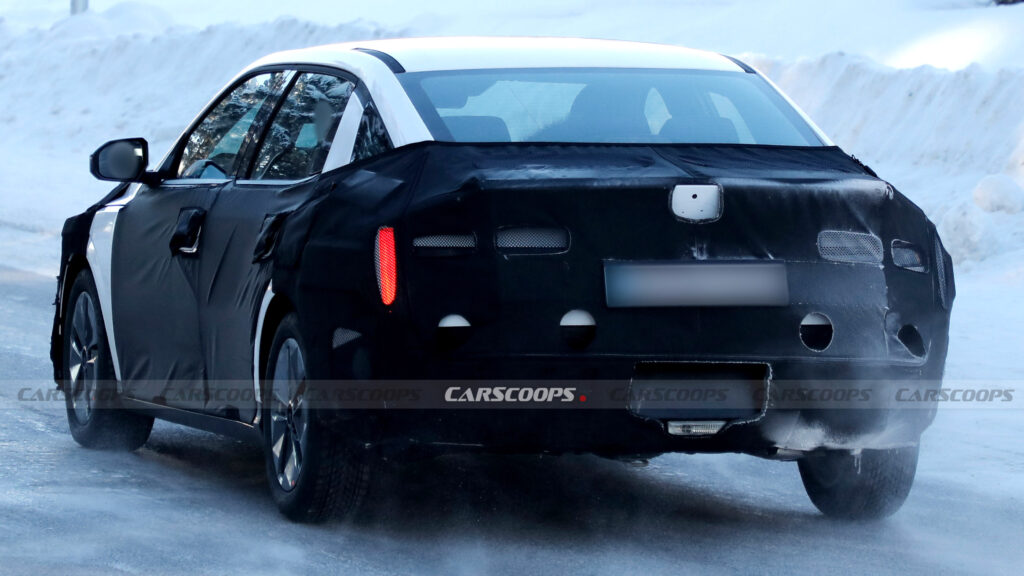
Prototypes of the eighth-generation Elantra have been spotted during cold-weather testing. The car’s exterior has undergone significant changes compared to the current model.
Updated exterior design
The front of the body looks taller and has squarer outlines. Despite the camouflage, T-shaped LED daytime running lights positioned above rectangular headlights are noticeable. The lower grille has become wider and features horizontal crossbars. The main radiator grille itself, judging by everything, will be significantly smaller than on the current model.
In profile, sharp body lines are visible and the roof appears to have become flatter. The car has a powerful C-pillar and a small rear quarter window. The window line has also changed, and the overall body contours are likely to become much more conservative.
Baldauf
The rear is very well camouflaged, but the model evokes associations with Cadillac thanks to the vertical rear lights and horizontal turn signals.
They are complemented by a rounded rear bumper and a moderately sized spoiler.
Expected interior changes and technical features
The prototype’s interior is covered with black fabric, but the car is expected to receive the new Pleos infotainment system. This system, introduced last year, is based on the Android Automotive platform, has a smartphone-like interface, and uses artificial intelligence.

So far, few technical details of the new Elantra are known. It may inherit features from the newer Kia K4. The base model could get a 2.0-liter four-cylinder engine with 147 hp, and a version with a 1.6-liter turbo engine producing 190 hp will also be available.
Furthermore, the appearance of a hybrid modification, as well as a new “N” version, is quite likely. A prototype of the latter was already spotted earlier this year. Rumors also suggest that this time the Elantra might be officially offered on the European market.
Baldauf
The shift to a more conservative design for the Elantra could be a strategic move aimed at attracting a wider range of buyers, especially in markets where classic sedans are still popular. The success of the current model in the US shows that demand for a reliable and economical sedan remains stable. The introduction of the new Pleos technological system and the potential expansion of the powertrain lineup, including a hybrid, could significantly strengthen the model’s competitive position in the context of the general trend towards electrification and increased demands for interior technology. The question of whether the new, less aggressive exterior can maintain the attention that the previous bold design language attracted remains open, but clearly Hyundai is betting on versatility and technological advancement.