 by
by A Mysterious Concept from Genesis
Genesis continues to showcase concepts that each time look increasingly ready for production. The G90 Wingback is one of the most intriguing examples, hinting that the Korean automaker may be seriously considering the possibility of creating a sporty wagon based on its flagship luxury sedan, even if it would be a limited series.
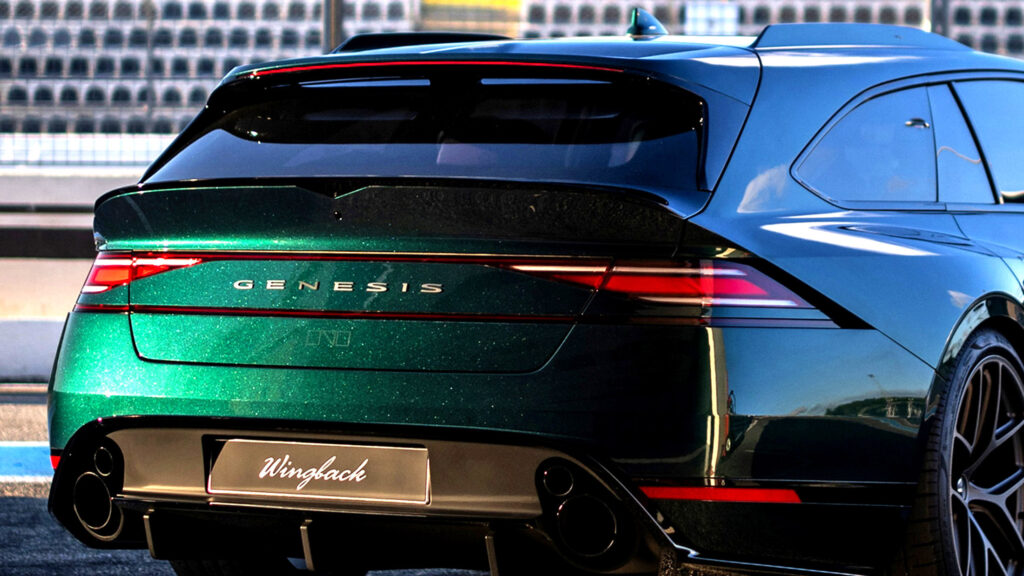
The G90 Wingback concept was first presented on the sidelines of a recent event in France. While the main focus was supposed to be on the production GV60 Magma crossover and the mid-engine Magma GT sports car concept, it was the muscular long-wheelbase G90 that quietly stole the show.
Now Genesis has published a new batch of photos that better reveal the G90 Wingback. According to the company, this wagon is another example of “the diverse forms Magma can take,” continuing ideas that began with earlier G90 X Gran Coupe and Convertible concepts.
Technical Features and Design
The Wingback remains based on the same “unchanged G90 platform,” retaining the 3,180 mm wheelbase and a body length close to the production sedan. However, the similarities end there. Instead of the vertical rear panel of the regular G90, here the tail section is completely redesigned with a full hatchback and a new body kit.
Styling updates include a sharper front bumper, a more aggressive radiator grille, and redesigned air intakes accentuated by spoilers. The fenders are noticeably wider at the front and rear, and a pair of angular fins runs along the roofline instead of traditional roof rails.
However, the most interesting part is the rear, which combines a two-element spoiler, a wide diffuser, and four exhaust tips neatly tucked inside. The concept also features a muted dark green finish and sits on dark 22-inch alloy wheels with low-profile tires.
Sporty and Luxurious Interior
We also get a glimpse of the interior, where traditional leather is replaced by a suede-like material called Chamude. The interior showcases a clean design with a beautiful steering wheel and seats featuring strong side bolstering, trimmed with contrasting green accents, piping, and stitching.
Luc Donckerwolke, Chief Creative Officer of Genesis, views designs like the Wingback as a response to the current flood of SUVs on the market. The “proliferation of SUVs,” in his opinion, will lead to “saturation.” It is then, in his view, that other body types will regain popularity, hence the brand’s experiments with G90-based concepts.
Production Possibilities
Donckerwolke calls the Wingback a “bridge between Magma and the One of One bespoke program,” hinting at the possibility of limited series production. He has also previously stated that G90 derivatives are “very feasible” and would not require significant investment to build.
Adding weight to this statement is the fact that Manfred Harrer, who heads Genesis and its performance development division, confirmed that the company is already developing an updated G90 chassis for the future Magma model.
This platform could just as easily serve as the basis for other variants, including the Wingback and X Gran Coupe, both of which would benefit from the improved driving dynamics built in from the start.
Potential Powertrains

Regarding the engine, the standard G90 uses a twin-turbo 3.5-liter V6, but a full-fledged Magma version would likely need something with more power. An electrified setup seems like a logical next step, offering a balance between power and efficiency. But there are also rumors of a V8, potentially related to the one being developed for the mid-engine Magma GT.
Genesis is already working on a racing V8 engine for its future Le Mans hypercar, and scaling it down for road cars under the Magma brand would certainly make sense from a market positioning standpoint.
After all, the brand aims to compete with divisions like BMW M and Mercedes-AMG, both of which use high-performance hybrid V8 setups for their flagship performance models.
The emergence of such a concept points to deeper processes within Genesis’s strategy. The brand, which quickly earned a reputation in the luxury segment, is now clearly exploring niches where it can express its individuality and technical prowess beyond conventional sedans and SUVs. Experiments with body styles like the wagon reveal a desire to offer customers not just status, but driving emotion in different formats. In a world where electric cars are often criticized for uniformity, such projects remind us of the importance of variety and aesthetics in the future of automobiles.