


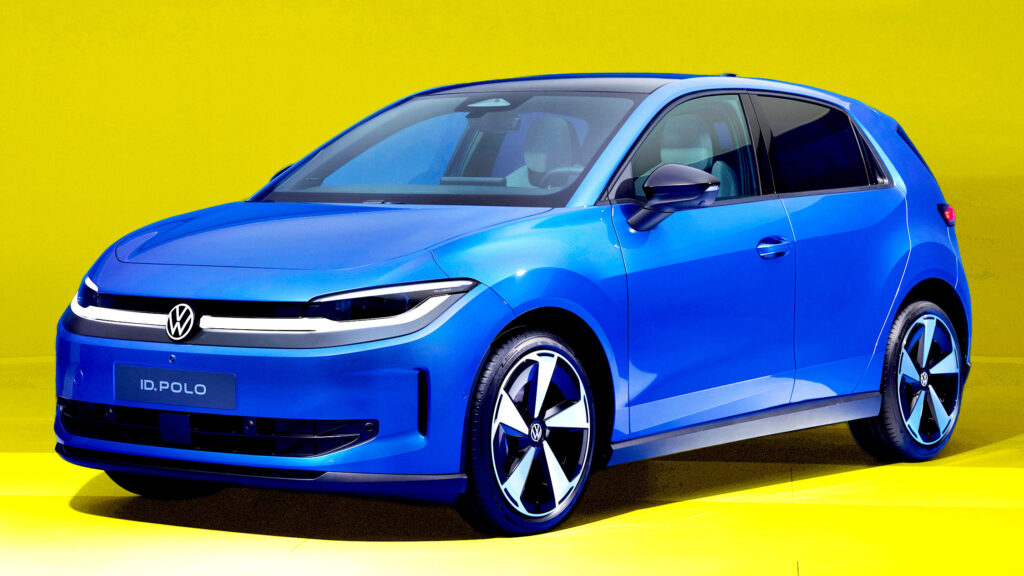
Volkswagen ID. Polo: Electric hatchback starts at €24,995
More than 20 million Polos have found owners since the model launched over 50 years ago. Now Volkswagen is relaunching the entire concept as the ID. Polo — a fully electric seventh-generation hatchback built on the new MEB+ platform with front-wheel drive, a range of up to 283 miles (455 km), and a starting price that keeps it in the affordable segment.
Pricing and availability
Pre-sales have already started in Germany, where the base Trend trim costs €24,995. This is a key figure that Volkswagen is actively promoting, although currently only the mid-range Life trim is available for order, starting at €33,795. Other variants will appear in the summer.
Powertrains and batteries
Three power options are offered at launch. The 114 hp (116 PS / 85 kW) and 133 hp (135 PS / 99 kW) versions are equipped with a 37 kWh lithium iron phosphate battery, providing a range of up to 204 miles (329 km) and supporting DC fast charging at up to 90 kW. Charging from 10% to 80% takes about 27 minutes.
The 208 hp (211 PS / 155 kW) version gets a 52 kWh nickel-manganese-cobalt battery, increasing the range to 283 miles (455 km) and allowing charging at up to 105 kW, reducing charging time to approximately 24 minutes. A GTI version with 223 hp (226 PS / 166 kW) is expected in 2027.
New front-wheel-drive platform
The switch to the front-wheel-drive MEB+ platform offers advantages in space, as unlike the larger ID.3 Neo, there is no motor under the trunk floor. Luggage volume has increased by 25% compared to the gasoline Polo — from 351 to 441 liters, and with the rear seats folded, it reaches 1,243 liters. The cabin also gets an additional 19 mm of space, which rear seat passengers will particularly notice.
Polo dimensions: length 4,053 mm, width 1,816 mm, height 1,530 mm, wheelbase 2,600 mm. This makes it 131 mm shorter and 42 mm narrower than its main competitor, the Renault 5 E-Tech, but practically identical in size to the Cupra Raval, which, like the Skoda Epiq, shares the platform and components with the Polo.
Exterior design
Externally, the stylish ID. Polo is almost identical to the 2023 ID.2all concept, right down to the massive five-spoke wheels and blue body color. The rear door handles are hidden near the C-pillar to maintain clean lines, and a wide transverse light strip at the rear is topped by a red illuminated VW logo, completing the look begun by the white logo at the front.
Retro-digital interior
Inside, the “Pure Positive” design from Volkswagen debuts. Chief designer Andreas Mindt noted that he wanted to make the interior familiar and comfortable. The interior combines a 10-inch digital instrument cluster with a 13-inch central touchscreen for the infotainment system.
Physical buttons control the climate control, a rotary audio controller is located between the front seats, and a “retro mode” on the display transforms the instruments into something resembling a first-generation Golf after its facelift, with a classic speedometer and power indicator instead of a tachometer. A nice touch.
Three trim levels cover the model range. Trend gets LED headlights, a lane-keeping assist system, and standard 90 kW DC charging. Life adds adaptive cruise control, a rearview camera, CarPlay, Android Auto, and wireless charging. Style goes further with IQ.LIGHT matrix LED headlights, 3D taillights, illuminated VW logos front and rear, sport seats, dual-zone climate control, and an updated ID. Light light strip that now extends onto the door panels.
Massage seats
Notable options include a 425-watt Harman Kardon audio system, a panoramic glass roof, and something somewhat unusual for this class: a pneumatic massage function for electrically adjustable front seats with 12-way adjustment and three programs. This is a feature of premium sedans in a hatchback costing less than €25,000.
The ID. Polo also standardly supports Vehicle-to-Load technology, allowing it to output up to 3.6 kW via a Schuko adapter for charging e-bikes or powering external equipment. Depending on the trim, it can tow a trailer weighing up to 1,200 kg.
Affordable charging
In the charging sphere, Volkswagen subsidiary Elli is launching a new urban tariff of €0.39 per kWh for public AC charging at over one million European charging stations. The goal is to make charging on the street as predictable and affordable as charging at home. The dynamic home tariff Naturstrom Flex can reduce home charging costs by up to 30% by automatically charging when electricity prices are lowest.
Apart from the future GTI, shown below in camouflaged form, the ID. Polo lineup looks quite complete for launch. It is practical, has the right price, and the retro display alone could sell quite a few cars.
The Volkswagen ID. Polo enters the market at a very opportune moment, as demand for affordable electric vehicles grows. Its main advantage is the combination of modern technologies, such as the MEB+ platform and V2L function, with practicality and a familiar design reminiscent of the iconic Polo. The price below €25,000 makes it a serious competitor for the Renault 5 and other budget electric cars, and features like seat massage add to its appeal. A successful sales launch could be an important step for Volkswagen in democratizing electric vehicles.