 by
by Hyundai’s MobED Robotic Platform is Ready for Production
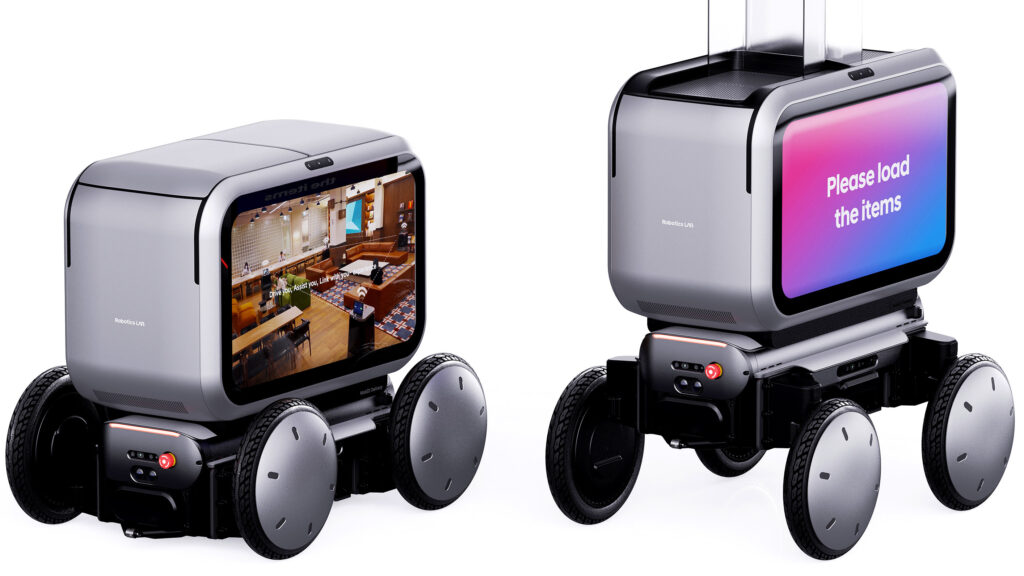
Four years after the first showcase of the Mobile Eccentric Droid (MobED) concept, Hyundai’s robotics lab has unveiled the serial version in Tokyo, Japan. This debut marks a significant step in the company’s expansion into advanced robotics.
The compact platform is designed for full autonomy and utilizes advanced artificial intelligence, allowing it to navigate various surfaces and demonstrate incredible adaptability for different usage scenarios.
How does it move?
At the core of MobED’s capabilities lies its Eccentric Drive system—an intelligent system that allows the robot to adjust its posture and each wheel individually. The result is impressive stability even when moving on sloped or uneven terrain.
For spatial awareness, Hyundai equipped the platform with a set of advanced cameras and lidars. An AI-based obstacle detection system adds another layer of perception, helping the robot navigate confined or crowded spaces without any issues.
Hyundai envisions it in various roles—from “last-mile” delivery to logistical support, with minimal human intervention.
Two Robot Variants

Hyundai introduced two versions of the robot: Basic and Pro. The base model has a length of 1150 mm, a width of 750 mm, and a height of 430 mm. Its weight is 78 kg, with a payload capacity of up to 57 kg.
The Pro variant is slightly taller—650 mm, and heavier—88 kg, although its payload capacity is somewhat reduced to 47 kg.
The biggest difference lies in the level of autonomy. The Pro model is equipped with Hyundai’s full autonomous driving system, while the Basic is manually controlled via a remote.
What powers it?
Both versions are powered by a small 1.47 kWh battery, which provides up to 4 hours of operation. However, compared to some Hyundai electric vehicles, the MobED charges slowly: it takes 2.5 hours to charge the battery from 10 to 90 percent.
Each robot also features universal mounting rails, facilitating the attachment of various tools and modules. In the future, they could perform a range of critical tasks in factories, warehouses, and production sites, reducing the need for human labor.
Commercial sales of the MobED are expected in the first half of 2026. Hyundai has not yet announced prices, but it is clear that the company views this robot not just as a novelty.
The emergence of the serial MobED indicates a more concrete strategy for Hyundai in robotics, extending beyond the automotive industry. Its ability to operate in complex conditions and its modularity open prospects not only for logistics but also, potentially, for the service sector, healthcare, or even entertainment. The success of this platform could significantly influence how companies approach “last-mile” automation and internal production processes in the coming years.