


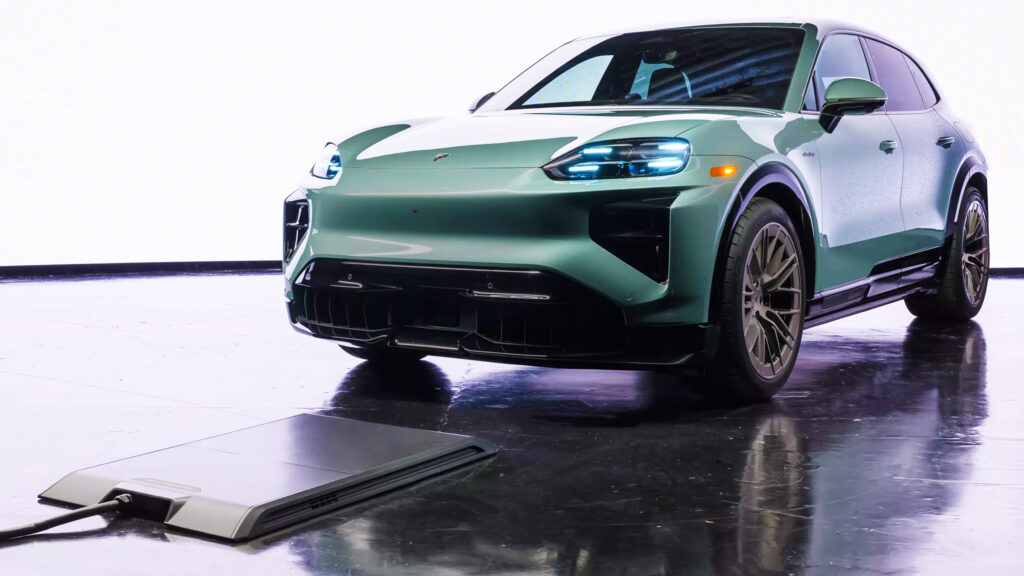
Development of Wireless Charging for the Porsche Cayenne Electric
In the quest to make home charging of electric vehicles as simple as refueling, automakers are beginning to rethink the process itself. Ahead of the fully electric Cayenne’s debut, Porsche confirmed the development of sophisticated inductive charging technology. Now, with the Cayenne Electric on the roads, the brand is preparing to launch an optional wireless charging system for those who prefer to avoid plugging in a cable at home.
The core element of the charging system is a powerful base platform. It weighs 50 kg, plugs into an outlet, and contains a large transmitter coil. The base platform converts alternating current from the grid into direct current, and when the Cayenne Electric is positioned above it, a secondary coil beneath the SUV begins to receive energy.
Forget the cables, the electric Cayenne can charge hands-free
It is important to note that Porsche’s inductive charging technology supports power up to 11 kW. Expert Jason Fenske from Engineering Explained notes that Porsche’s own mobile charging device in the US is limited to 9.6 kW, making wireless charging a faster option for home use by American owners.
Convenience and Efficiency of the System
The wireless charging device comes with special software in the Cayenne Electric’s Surround View parking function. It displays the position of the receiver near the front axle, and a green circle indicates the location of the base platform. Simply position the car so that the green dot is inside the circle, and it will be in the correct position to start charging.
Before the energy flow begins, the system automatically exchanges data, including a password, to prevent potential electricity theft. Wireless charging systems are generally considered less efficient, but Porsche engineers told Engineering Explained that their system demonstrates efficiency from 89 to 92 percent in real-world use, comfortably exceeding the minimum 85 percent requirement of the relevant charging standard.
Porsche also confirmed that Level 1 charging via cable on the Cayenne Electric has an efficiency of only 60 percent, meaning the wireless platform is a significant step forward compared to a standard household outlet.
Technology Cost and Financial Aspects
Future buyers should not be concerned about the system’s safety, as Porsche states that the base platform is fully waterproof and includes sensors to detect foreign objects, immediately stopping charging if anything extraneous is detected.
Ease of use, suitability for everyday use, and charging infrastructure remain decisive factors when it comes to the adoption of electromobility. We are proud that inductive charging will soon be available in series production Porsche vehicles. Charging an electric car at home has never been so easy and convenient
While the system is certainly convenient, it is expensive. In the UK, the full kit is expected to cost around £6,750, with £4,750 of that for the base platform itself.
In the US, the cost of the ground platform is approximately $6,500 before taxes, while the onboard equipment for the Cayenne EV adds another $1,650. A total cost of ownership analysis conducted by Fenske suggests the real costs are not in the electricity at all. He notes that over 200,000 miles, the difference between wireless charging and a traditional Level 2 wired system is about $1,000. Based on the average American mileage of around 13,000 miles per year, it would take approximately 15 years to reach this difference, making the initial equipment premium the primary financial barrier.
The introduction of technology like wireless charging for a premium electric vehicle points to a broader industry trend: the pursuit of absolute convenience, even if it requires a significant initial investment. It is not just a matter of technical progress, but also shaping a new car ownership experience where routine tasks are minimized. The success of such initiatives among buyers will show how important this convenience is compared to classic, more economical solutions, and whether the market is ready to pay a premium to completely “forget the cables.” It also poses new challenges for infrastructure and standardization, as each major manufacturer may develop its own, incompatible systems.