


Business Modification
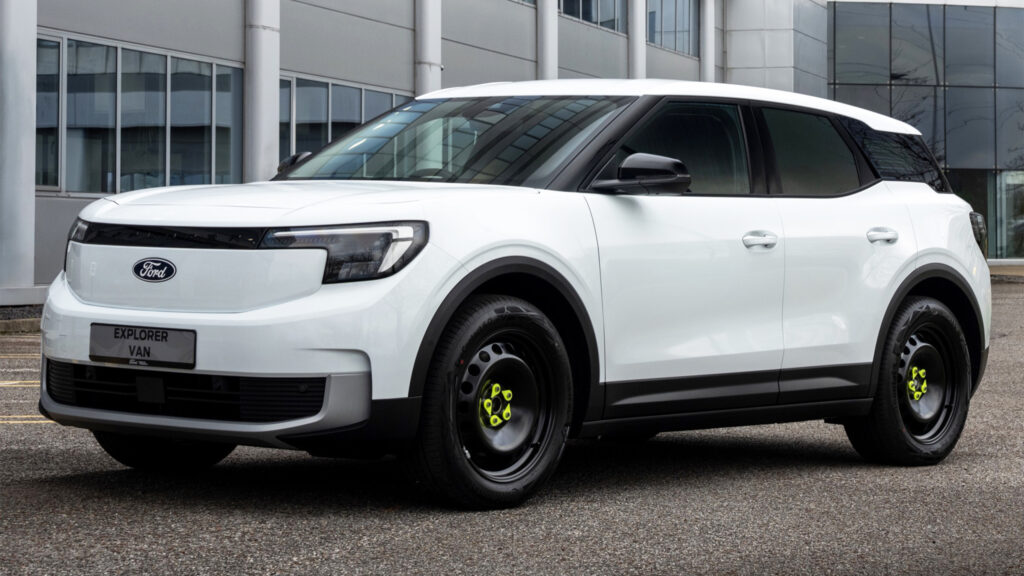
Externally, this vehicle may seem like a regular electric Ford Explorer, but thanks to a series of modifications, it has gained the status of a commercial vehicle in Europe and a new name — Explorer Van. While in the US it could look like an unmarked patrol car, its real purpose is cargo transportation, similar to the Ford Transit, but in a much more compact form.
Technical Transformations
The standard electric Explorer is modified at the Ford Pro center in Dagenham, UK. The key change was the installation of a fixed partition behind the front seats. It is this detail that reclassifies the vehicle from the passenger car category to commercial, granting buyers, including corporate clients, significant tax benefits.
In addition to the partition, the Ford Explorer Van received a flat floor to maximize cargo space, as well as several hooks and adjustable partitions. For those who need even more practicality, the so-called Utility Pack is available. This pack includes an additional front trunk, a roof rack, seat covers, and a protective mesh for the rear window.
Special Packages
The manufacturer also offers two special packages. The Commercial Pack includes a yellow LED panel, a work desk in the rear doors, and warning lights. The Welfare Pack is equipped with a first aid kit, as well as an eye wash station and hand sanitizer.
Undoubtedly, the most interesting design element of this electric vehicle is the simple, black-painted steel wheels with bright yellow lug nuts.
Technical Specifications
Buyers are offered two different powertrains. The base model is equipped with a single rear-axle electric motor producing 282 hp, capable of towing up to 1000 kg. An all-wheel-drive version with two motors and a combined output of 335 hp is also available, with a greater maximum towing capacity of 1200 kg. The range of the rear-wheel-drive version is up to 602 kilometers, while the data for the all-wheel-drive version has not yet been disclosed.
The emergence of the Explorer Van demonstrates how manufacturers are adapting electric vehicle platforms to specific market needs, especially in the commercial vehicle segment. This step not only expands the model range but also opens access to government support programs and tax benefits for businesses, which could be a decisive factor for companies updating their fleets. The emphasis on modularity and additional equipment packages indicates the flexibility of Ford’s approach to meeting the needs of various professional fields, from courier services to emergency crews.