


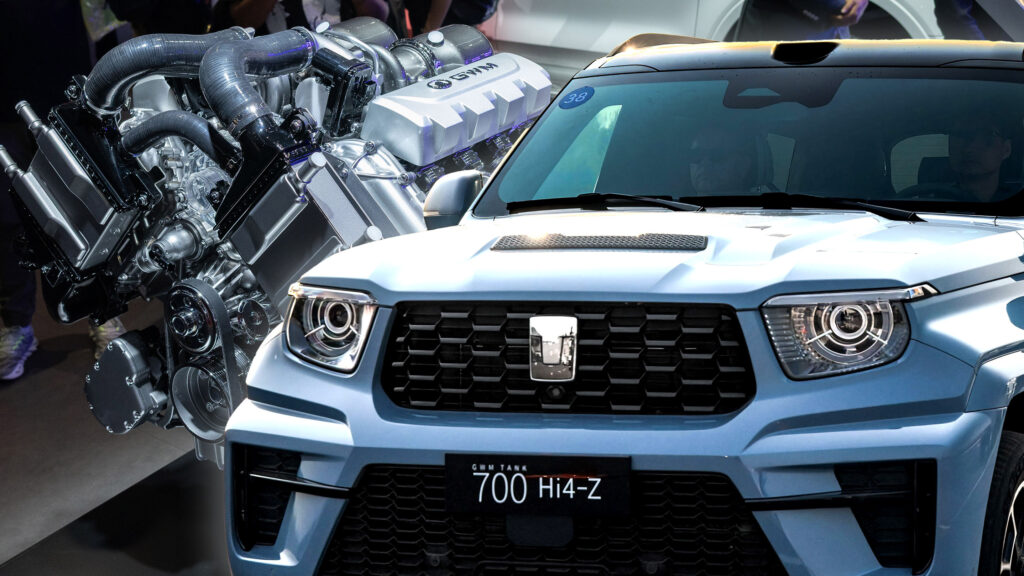
GWM confirms V8 for flagship SUV Tank 700
At a time when many automakers are downsizing engines or abandoning them altogether, a Chinese company is declaring its commitment to large internal combustion engines. GWM has confirmed that its flagship SUV will receive a V8, and this is not being done for Chinese buyers.
Speaking at the Beijing Auto Show, Great Wall Motors (GWM) chairman Jack Wey stated that the Tank 700 will feature a new V8 engine. He also made it clear that this engine was not developed for the domestic Chinese market, where electric vehicles and cars with smaller displacements dominate. Instead, it is aimed at foreign buyers.
“In the future, the Tank 700 will also use a V8 engine,” said GWM chairman Jack Wey to journalists at the Beijing Auto Show.
“This completely contradicts the current situation or trend in China; it is not suitable for the Chinese market. We developed this V8 to meet the needs of more global users, in markets such as Australia and New Zealand.”
V8 Culture
These are places where towing, long-distance travel, and the culture of large SUVs still matter, and where a powerful engine carries as much emotional appeal as practical value.
Wey says that the “regular” V8 for the Tank 700 will differ from the “performance” unit planned for the future GWM supercar, expected to launch in 2027. For that model, the use of a 4.0-liter twin-turbo hybrid V8 has already been confirmed, while the version for the Tank is described as more mainstream.
Beyond PHEV
Mainstream, however, is a relative term. The current Chinese version of the Tank 700 already offers a turbocharged V6 and plug-in hybrid variants with immense power. One version boasts over 860 hp (872 hp), so if GWM installs a hybrid V8 on the same platform, modest figures should not be expected.
The Tank 700 sits at the top of the Tank lineup and combines a massive design with luxurious features and genuine off-road equipment. Think of it as GWM’s answer to SUVs like the Toyota Land Cruiser, Nissan Patrol, and Lexus LX, but with a more aggressive pricing policy.
This move by GWM is an interesting signal against the backdrop of the global trend toward electrification. The company is betting that in markets where electric vehicle infrastructure is less developed, or where powerful engines for heavy-duty conditions are traditionally valued, demand for such vehicles will remain stable. The priority markets of Australia and New Zealand are indicative: large SUVs with V8 engines hold a strong position there, especially among enthusiasts of trailer towing and long-distance travel. Thus, GWM is attempting to occupy a niche that competitors are gradually vacating by switching to smaller engines or hybrids, offering buyers something they may no longer find from other manufacturers.