


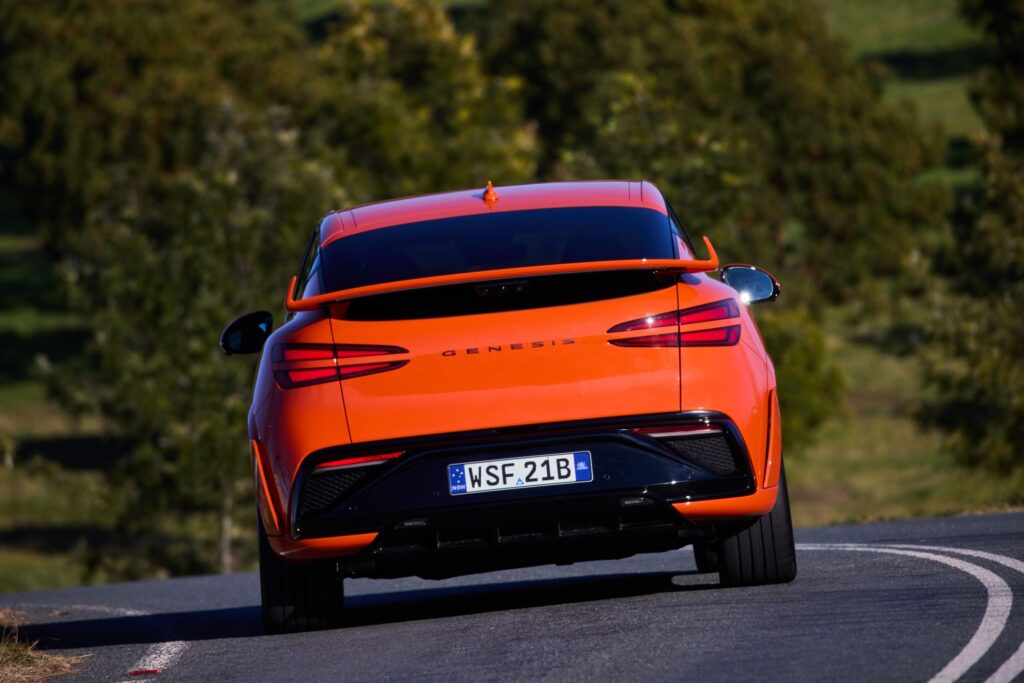
Genesis Magma: A new premium sports sub-brand
Genesis is maturing rapidly. Hyundai’s luxury division has abandoned previous plans to produce only electric vehicles – hybrids and range-extender models are now under development. The official launch of the Magma brand took place at the end of 2024, and it is responsible for the company’s sports direction. What is Magma? It is the equivalent of Hyundai’s N division or BMW M – creating cars with immense power and exceptional control, without sacrificing the luxury that Genesis buyers expect.
Also: GV60 Magma arrives in America with 641 hp, but can only be purchased in three states
Magma focuses not only on road sports cars but also on track versions. The brand recently debuted at the 24 Hours of Le Mans with the GMR-001 hypercar and is considering participation in GT3 racing. The first production model was the GV60 Magma, and we had the opportunity to experience it firsthand. As a glimpse into the brand’s future, this is a very exciting time.
Key specifications of the model
Model: 2027 Genesis GV60 Magma
Starting price: AU$130,000 (US$90,300) excluding on-road costs
Dimensions: 182.4 x 76.3 x 61.4 inches (4,635 x 1,940 x 1,560 mm)
Wheelbase: 114.1 inches (2,900 mm)
Curb weight: 2,270 kg (5,004 lbs)
Powertrain: 84 kWh battery | dual electric motors
Power: 641 hp (478 kW) / 582 lb-ft (790 Nm)
0-100 km/h: 3.4 seconds
Transmission: single-speed
Efficiency: 26.5 kWh/100 km according to test results
On sale: now
Photo: Hyundai Australia
In Australia, Genesis launched the GV60 alongside the new rear-wheel drive GV60 Advanced.
This powerful model arrived more than two years after the debut of the shared platform with the Hyundai Ioniq 5 N. The price starts at AU$130,000 (US$90,300), which is approximately AU$20,000 (US$13,800) more expensive than the Hyundai.
Review: 2027 Genesis GV60 – brilliant, but won’t become a bestseller
Genesis also confirmed US pricing for the 2027 GV60 Magma – much more attractive than the Australian prices. Starting at US$69,950 plus a US$1,545 delivery fee, which is US$17,425 more than the base 2026 GV60 and US$10,050 more than the Hyundai Ioniq 5 N.
Sports essence and technical package
The powerful version of the GV60 arrived after a long wait.
It follows the familiar formula of the Ioniq 5 N and Ioniq 6 N – dual electric motors producing a peak 478 kW (641 hp) and 790 Nm (582 lb-ft) of torque. This is the first model under the Magma brand, setting the tone for future sports cars. Importantly: Magma should not be compared to Hyundai N – it has a different philosophy: to preserve luxury and refinement while adding thrill. Like the powerful Hyundai N electric vehicles, the GV60 Magma has plenty of interesting features, but more on those later. The car looks like a true sports car.
It is wider than the standard version, lower, has distinctive bumpers, 21-inch forged alloy wheels, and an aggressive rear spoiler.
Interior of a true sports car
Photo: Hyundai Australia
The GV60 Magma was launched alongside the updated standard model, so it receives all the same updates. These include a new 27-inch screen that combines the instrument cluster and infotainment system. Importantly, Genesis has made everything much more special than in the regular GV60. Key features: 10-way sports bucket seats, white contrast stitching and piping, a unique steering wheel with a bright orange Magma dial and a Boost button.
Brushed black aluminum trim adds premium feel. Unfortunately, the white interior option available on the standard model is not offered. The premium feel of the Magma cabin is emphasized by the black suede-like Chamude material on the door panels, seats, and headliner. Overall, it is a truly premium space, and most importantly, it has plenty of character – something most electric vehicles lack.
Technology and settings
Photo: Hyundai Australia
There is a special Magma section in the menu for additional settings and viewing real-time sports data.
It is much simpler than the Ioniq 5 N and Ioniq 6 N systems – fewer adjustments and without all the track-focused functions. Standard modes include Range, Comfort, Sport, and a customizable My Drive Mode.
Review: Ioniq 6 N – more Porsche than Hyundai, a true masterpiece
Genesis emphasizes that the GV60 Magma is not meant to be as extreme as the Ioniq 5 N or Ioniq 6 N. Therefore, it has a special GT mode that can be activated with or without virtual gear shifting, enhancing the powertrain and steering. The active sound system can be easily turned on and off.
There is also a Sprint mode that sharpens settings to the maximum, a Drift mode, and battery preparation functions for drag racing and long track sessions.
Driving character and impressions
Photo: Hyundai Australia
Compared to the Ioniq 5 N and Ioniq 6 N, the GV60 Magma does not have as many complex sports menus. It is also not as configurable, which again is not a bad thing – it underscores the car’s more refined and sophisticated character. If N products have a hooligan spirit, the GV60 Magma is better suited for a respectable gentleman or executive who wants something spectacular and fun to drive, but without the harshness.
How does it drive?
As you might imagine from the specs, the GV60 Magma is a truly ferocious performer that somehow retains most of the refinement of the standard model.
Grip is incredible. On the special Pirelli P Zero Elect tires, the GV60 Magma hides its weight remarkably well, and thanks to a shorter wheelbase than the Ioniq 5 N, it feels more compact on twisty roads. Importantly, the Magma remains an enjoyable car for brisk driving while staying comfortable. Admittedly, the suspension is quite firm even in Comfort mode, but it is perfectly acceptable for daily driving. Genesis installed adaptive suspension similar to that used in the Ioniq 6 N.
If you need a GV60 with a soft ride, the standard model would be a better choice.
Sound and feel
Photo: Brad Anderson/Carscoops
The soundscape is not as dramatic as in the N models, but still far better than any other electric vehicle trying to mimic an internal combustion engine sound. For example, compared to the new 6 N, the exhaust “pops” are much quieter, though surprisingly authentic. However, the sound can have an annoying drone in the loudest mode during cruising. Magma made the sound slightly different from Hyundai’s, trying to mimic a six-cylinder engine instead of a turbocharged four-cylinder.
It also “revs” to 9,000 rpm and has external speakers. For those who want the EV to be silent, the sound can be easily turned off in the menu. 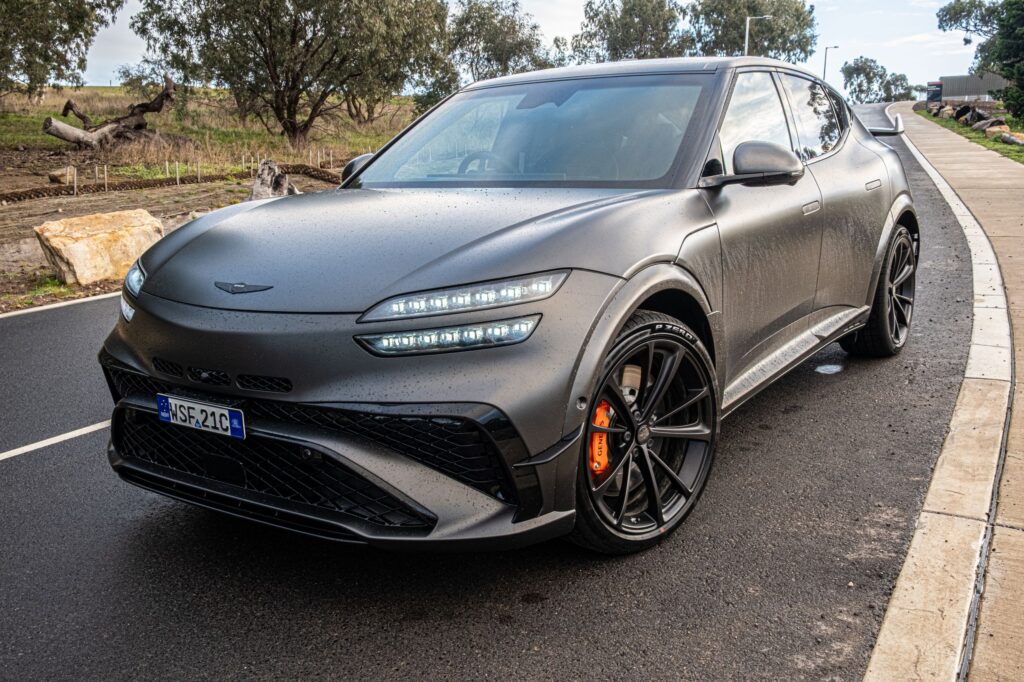

Another area where Genesis succeeds on par with Hyundai’s N division engineers is the gear shift simulation. Like the Ioniq 6 N, the GV60 Magma has eight virtual gears. They provide the same jolt through the chassis when shifting between ranges, significantly enhancing the experience.
Read: 641 hp GV60 Magma arrives, but can only be purchased in three states
Given the power figures, the car is truly fierce in a straight line. Genesis claims 0-100 km/h in 3.4 seconds, and it feels exactly that fast. We tested on a wet road and got 3.7 seconds by GPS timer, so the claimed figure is certainly achievable on dry pavement. For maximum acceleration, the Boost button on the steering wheel adds an extra 30 kW (40 hp) and 50 Nm (37 lb-ft) of torque in 15-second bursts. In Sprint Boost mode, it activates automatically when the accelerator pedal is pressed more than 90%.
Brakes and efficiency
Photo: Brad Anderson/Carscoops
As with other electric vehicles of similar power, realizing the Magma’s potential on the road is difficult – it is only possible on the track. It is a comprehensively phenomenal performer that delivers sensations most EV manufacturers can only dream of. The brakes are also excellent. Up front, there are massive 400 mm discs with four-piston calipers, and at the rear, 360 mm discs with single-piston calipers. These mechanical brakes work together with the regenerative system, allowing the Magma to stop from 100 km/h in 33.8 meters.
Everyday use
A high-performance electric vehicle offers a duality that is hard to match in powerful ICE cars. Switch from GT, Sprint, or Sport to Range or Comfort mode – the GV60 Magma calms down, gliding over asphalt as well as any other luxury crossover. 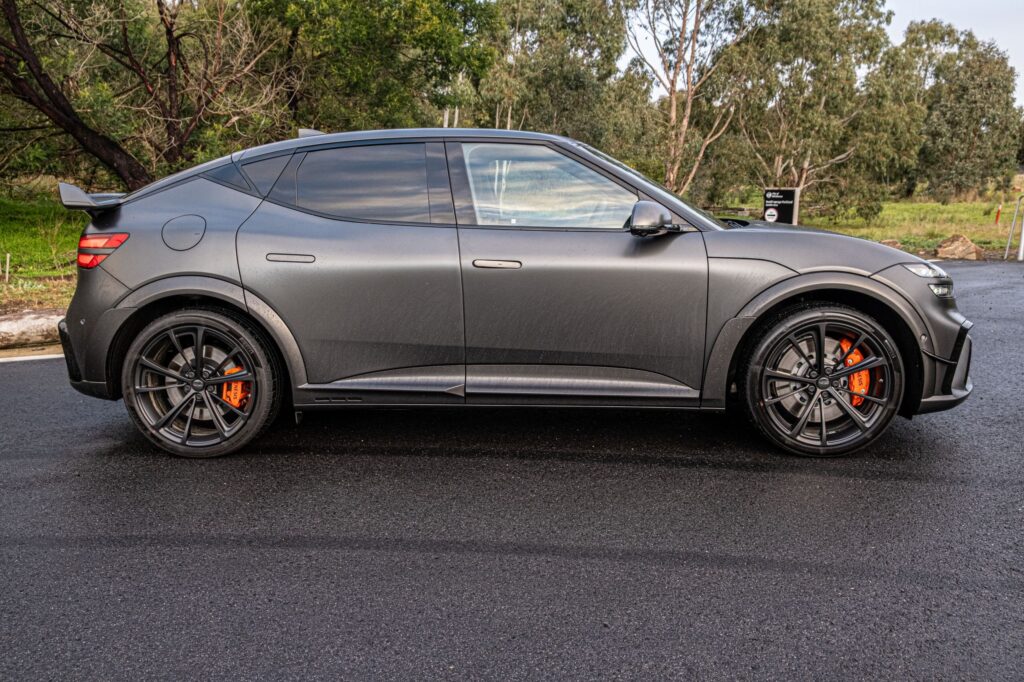
When the paddle shifters are not used for gear changes, they adjust regeneration. Like the standard GV60, the Magma has three levels of regeneration and a one-pedal driving mode. There is also an automatic mode that adjusts regeneration based on navigation data and traffic conditions.
The downside of performance is efficiency. Genesis claims 21.5 kWh/100 km, giving a range of 425 km. However, during our test, which included a one-day event and a few days after, the figure was closer to 27 kWh/100 km, reducing the range to just over 300 km, which is very low. On the other hand, the 800-volt E-GMP architecture allows the Magma to charge quickly. Plugging into a 350 kW charger, where peak power reaches 265 kW, charges the battery from 10 to 80% in 18 minutes.
Conclusion
Photo: Hyundai Australia
Genesis has a difficult task. It remains a relatively young player and has a lot of work to do before the average buyer perceives it on par with BMW, Mercedes, Audi, or Lexus. One could argue that the Magma brand was launched too early. However, despite these challenges, there is no denying that the GV60 Magma is excellent. It won’t be a mass-market bestseller, but it brilliantly balances performance and composure.
It feels more mature than the Ioniq 5 N while being just as fun to drive. The future of the Magma brand looks very promising. Photo: Hyundai Australia/Brad Anderson for Carscoops
In this context, it is worth noting that the emergence of Magma as a separate sports sub-brand signals Genesis’s serious intentions to compete not only in the luxury segment but also in the niche of high-performance electric vehicles. The GV60 Magma demonstrates a mature approach where luxury and comfort are not sacrificed for dynamics, but rather complement each other. This is especially important against the backdrop of growing competition from Porsche, Audi, and other players actively developing their own electric sports models.
The decision to keep the complexity of settings moderate in favor of a holistic driving experience could become a key differentiator for Magma from more tech-centric competitors.