


Updates for Competition
The Mazda BT-50 pickup has long been in the shadow of Australian market leaders like the Ford Ranger and Toyota Hilux. For 2026, Mazda aims to close this gap by expanding the model range with two new variants: the return of the adventure-oriented Thunder version and a new accessible Boss trim with black accents.
The current generation BT-50 debuted in 2020, sharing a platform with the Isuzu D-Max. Four years later, the pickup received a mid-lifecycle update, bringing design changes and updated cabin technology. This update also allowed for the introduction of a new base engine – a 2.2-liter turbo-diesel, which finally reached Australian dealers in September 2025.
Return of the Thunder Flagship
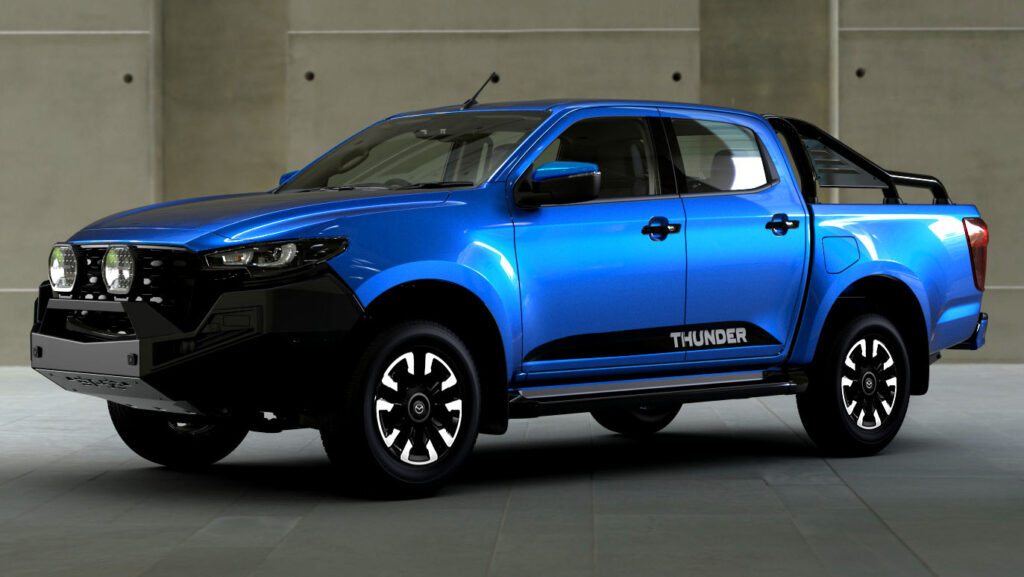
For 2026, Mazda returns the BT-50 Thunder to the role of flagship for the updated lineup. Based on the GT trim, the Thunder version stands out with a single-loop steel bull bar integrating powerful Lightforce Beast LED lights. Also added are a high steel sports-style loop bar, a manual roller tonneau cover for the bed, and black decals with the “Thunder” inscription.
Unfortunately, the 2026 BT-50 Thunder did not receive the extended wheel arches like the previous version. However, they haven’t disappeared completely – buyers can still add them via the Mazda Australia accessories catalog. The list of options for those wanting to create a more off-road-ready vehicle is much broader: a larger three-loop bull bar, 18-inch alloy wheels, a snorkel, a roof-mounted LED light bar, a roof rack, and several rear bed fit-out options.
Unlike the Ford Ranger Raptor, Nissan Navara Pro-4X Warrior, and Isuzu D-Max Blade, which receive special suspension upgrades, the BT-50 Thunder retains standard equipment. This makes it closer in spirit to less hardcore off-road versions like the Toyota Hilux Rugged X, Mitsubishi Triton GSR, and Kia Tasman X-Pro.
Buyers who want something more robust can still order heavy-duty BP-51 or Nitrocharger suspension packages, available for most trims.
New Boss Trim
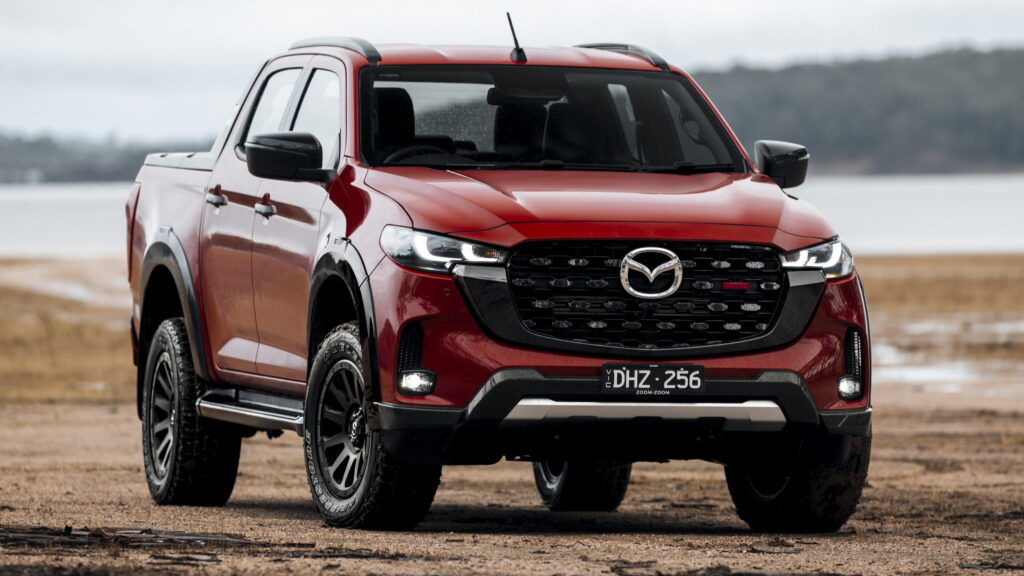
The new BT-50 Boss trim takes a different approach. It is based on the dual-cab, four-wheel-drive XT version and focuses on cosmetic changes rather than off-road attributes. Gloss black elements appear on the door handles, mirror caps, and grille, along with a black steel sports loop bar, a standard bed liner, and side steps.

Diesel Engines
Both the BT-50 Thunder and Boss are supplied exclusively with Mazda’s top 3.0-liter turbo-diesel, producing 187 hp and 450 Nm of torque. The engine is paired with a six-speed automatic transmission that sends power to all four wheels.
Lower trims are available with the smaller 2.2-liter turbo-diesel producing 161 hp and 400 Nm of torque. This unit is combined with an eight-speed automatic and can drive either the rear wheels or all four, depending on the configuration.
Unlike some competitors, the BT-50 model range does not offer electrified powertrains. Recently, the head of Mazda Australia indicated that the company still sees a long-term role for diesel fuel.
Pricing Policy
Orders for the 2026 Mazda BT-50 are already open in Australia. The starting price begins at 38,400 Australian dollars for the base single-cab chassis XS version, equipped with a 2.2-liter diesel and rear-wheel drive.
At the top of the price list is the BT-50 Thunder. In the dual-cab, 3.0-liter diesel, and standard four-wheel-drive version, it costs 78,400 Australian dollars. This makes it 4,910 Australian dollars more expensive than the former top SP variant and 1,486 Australian dollars higher than the price of the competitor Toyota Hilux Rugged X.
The newly introduced Boss trim is positioned in the middle of the range with a price of 60,220 Australian dollars, which is 2,500 Australian dollars more than the XT version it is based on.
The update to the BT-50 model range clearly demonstrates Mazda’s strategy of dividing the target audience: Thunder appeals to outdoor enthusiasts with its readiness for accessories, while Boss offers a stylish look for those seeking a more expressive image without the need for serious off-road modifications. The lack of electrified options in a trending market may raise questions, but it is evident that the company is currently betting on proven diesel technologies, trying to find its niche between powerful competitors through clear differentiation and an expanded choice.