


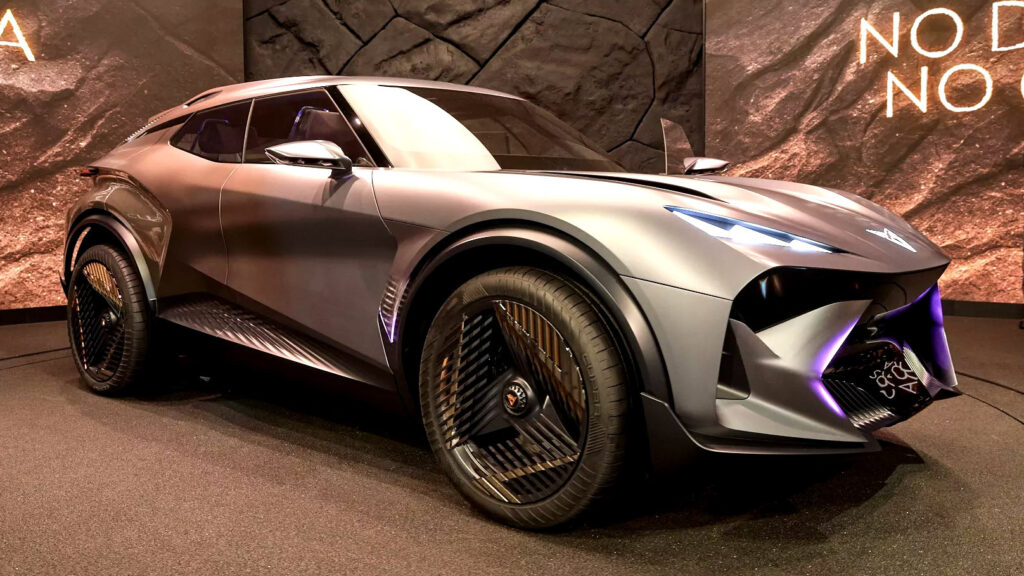
Cupra Tindaya: An electric crossover that challenges boredom
Cupra management has officially confirmed that the aggressive Tindaya concept car will go into series production. This means the European premium SUV market will gain a powerful new player. The striking electric crossover will slot above the Tavascan and Terramar models in the brand’s lineup, competing with established players such as the new BMW iX3, Volvo EX60, and Mercedes-Benz GLC EV.
The car’s design, which last autumn was compared to a Lamborghini creation after a wild night, will undoubtedly attract buyers who find other premium SUVs too boring.
Related news: ABT’s Cupra Formentor has more power than Audi’s Lambo Huracan, thanks to a dying 5-cylinder engine
From concept to reality
The concept first appeared at last year’s Munich Motor Show, looking more like a prop from a science fiction film than a realistic production model. At the time, Cupra primarily positioned it as a design and technology showcase. However, Seat-Cupra CEO Markus Haupt has now confirmed the company is serious about bringing it to market.
“It looks fantastic. Why shouldn’t we build Tindaya? — Haupt asked in an interview with Autocar. — We are really looking at our plans for when we can build Tindaya, but that’s something I can promise. This car will hit the streets in a few years.”
Premium size, premium price
At 4720 mm in length, the Tindaya fits perfectly into the profitable premium SUV segment in Europe. This is a crowded market dominated by German brands, along with competitors from Genesis, Lexus, and Volvo. Cupra believes buyers are craving something less conservative than just another neat executive crossover.
The price is expected to start from around £60,000, which is significantly more expensive than current Cupra models but matches the segment’s price level. Although neither Haupt nor Autocar explicitly mentioned it, there is speculation that the Tindaya is the larger of two models that were supposed to lead Cupra’s plans for expansion into North America. This expansion will no longer happen due to tariffs and weak demand for electric vehicles in the USA.
Electric or range extender
According to the publication, the Tindaya will be based on Volkswagen Group’s new SSP electric platform, which is meant to replace the current MEB architecture across many brands. However, it is reported that Cupra has not yet decided on the final powertrain. The original concept used a hybrid system with a range extender producing 489 hp, combining electric drive with internal combustion engine support. But Haupt hinted that all options remain on the table as the company monitors changing market trends.
“All these discussions are changing daily, very quickly, — he said. — Which powertrains will we end up with? That decision we haven’t made yet.”
Such flexibility is one of the advantages of belonging to the vast Volkswagen empire. SSP is reported to support everything from pure electric vehicles to hybrid setups with internal combustion engines, depending on regional demand.
Cupra, Baldauf
Thus, the Cupra Tindaya is becoming not just another electric crossover, but a bold bid for leadership in design and technology. Abandoning expansion into the US and focusing on the European market could prove to be a strategically sound decision, given the high competition and volatile demand for electric vehicles overseas. Flexibility in choosing the powertrain will allow Cupra to quickly adapt to changing market demands, offering buyers both a fully electric version and a hybrid with a range extender, which could become a key advantage amidst uncertainty regarding charging station infrastructure. It remains to be seen whether this audacious SUV can truly change the rules of the game in the premium segment.