


Expected Debut of the Powerful Version
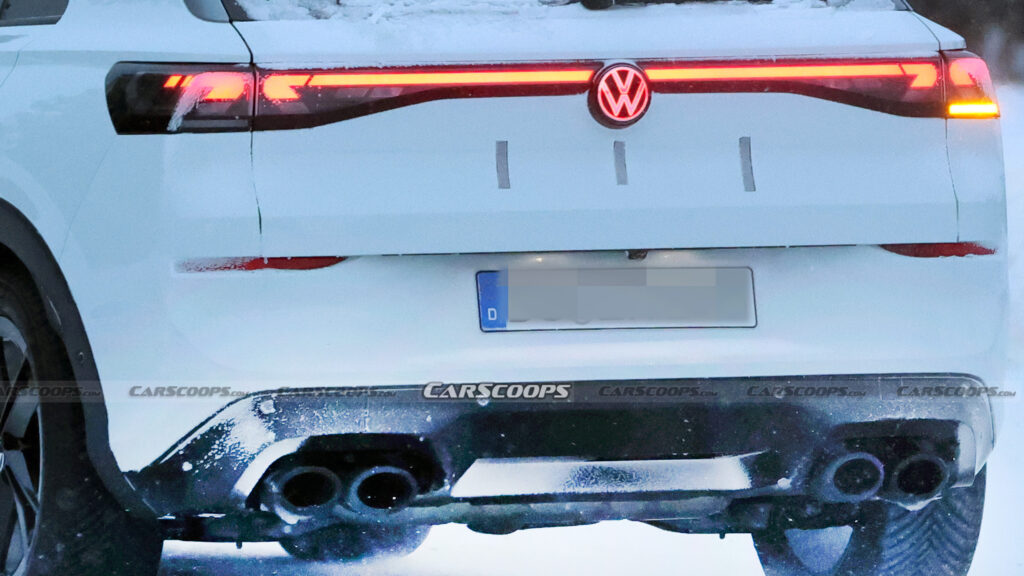
Despite Volkswagen having already unveiled the second generation of the T-Roc, its most interesting version is still awaiting its time. Testing of the new T-Roc R in public space confirms that the car with the R emblem sounds exactly as expected from such a model.
The four exhaust pipes at the rear indicate that this is not just an R-Line version, which received a more aggressive look after the facelift but lacks corresponding power, even in the new plug-in hybrid version.
Our sources report that the R model will not become a plug-in hybrid, although it will receive a 48-volt mild-hybrid system, just like the base T-Roc.
Hybrid System for Ecology
The previous T-Roc R developed 296 horsepower, while the new one will get a full 328 hp, as in the Golf R. This means the hybrid system will not increase power compared to the Golf R, but will significantly reduce CO2 emissions, which is critically important for the European market. Unfortunately, as before, the T-Roc and T-Roc R models will not be officially presented in the USA.
Power, as before, will be transmitted to all four wheels via a preselective gearbox, allowing the T-Roc R to accelerate to 100 km/h in less than 5 seconds. Volkswagen is expected to equip this compact crossover with the same torque vectoring system on the rear axle as the Golf R, and the drive mode selector will likely receive a Drift mode.
Updated Interior and More Space
The driver will be greeted in the cabin by bucket seats with the R logo, a thick-rimmed steering wheel, a 10-inch digital instrument cluster, and a 12.9-inch touchscreen for the multimedia system. Furthermore, thanks to a wheelbase length of 2,631 mm, which is 28 mm more than the previous model, passengers will get more space.
Volkswagen already showed a camouflaged R version with 20-inch wheels and an Akrapovic exhaust system back in November, so the full premiere is not far off. The car is expected to be fully unveiled this spring.
The appearance of the T-Roc R continues the trend of tightening environmental requirements for even the most powerful cars. The use of mild-hybrid technology specifically to reduce emissions, rather than to increase performance, is a clear example of how manufacturers are adapting to new standards. This may also indicate the future of the R lineup, where efficiency and environmental friendliness will be closely intertwined with high dynamics. Market conditions, including the absence of the model in North America, remind us of the different priorities and regulatory environments in different regions of the world.