


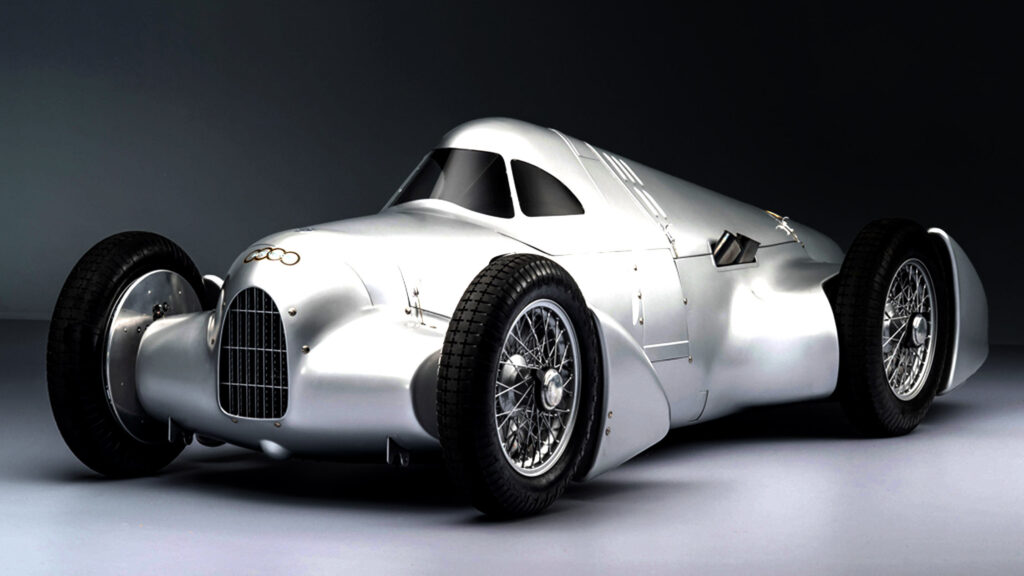
Revival of a legendary record holder
Audi has revived one of its most insane pre-war cars, which participated in a speed battle with the Mercedes “Silver Arrows.” At that time, there were no speed limiters to prevent records from being set.
History of the “Lukka” car
The car was named “Lukka” after the Italian town near which a specially prepared version of the racing Auto Union Type A reached an incredible 203 miles per hour (327 km/h). This achievement broke the previous record of 197 miles per hour (317 km/h), set by Rudolf Caracciola in a Benz car several months earlier.
Even today, these figures are impressive — the 2026 Porsche 911 Turbo S only accelerates to 200 miles per hour (322 km/h). But in 1935, when the average car barely reached 50 miles per hour (80 km/h), such performance seemed incredible. The same applied to the engine power — 338 horsepower (343 PS) from a massive 5.0-liter 16-cylinder engine.
Rebuilt from scratch
The fate of the original car is unknown. It is only known that many Auto Union racing cars disappeared behind the “Iron Curtain” in communist Russia during the war, and were never seen again. Therefore, the task of recreating “Lukka” from scratch was undertaken by British classic racing car specialists Crossthwaite and Gardiner. They already had experience with similar projects, including the Type 52 for Audi Tradition, the historical division of the German automaker.
This was not a simple scanning of old blueprints into modern software. C&G had some documents from the Audi archives but mainly relied on a series of original photographs during the three-year creation process.
Design and technical features
The result is impressive even by modern hypercar standards. The body looks as if it were sculpted by the wind itself: enclosed wheels, a smooth roof, and a tail tapering to a sharp point. Most road cars only began actively using aerodynamics in the 1980s, but in the 1930s, every hundredth of a drag coefficient point mattered when it came to setting a speed record.
Although the finished car is very close to the original, a few subtle changes were made to the design, using parts and ideas from later Auto Union models. For example, the ventilation system was improved to prevent the body from overheating — a solution that Auto Union engineers first applied at the AVUS race in Berlin in May 1935. The engine was also upgraded to 6.0 liters and 513 horsepower (520 PS) for increased reliability.
Modern use
Theoretically, the 960-kilogram (2116-pound) “Lukka” should be faster than ever, although Audi does not plan to test this. However, the unique silver car will participate in this year’s Goodwood Festival of Speed in July.
This project demonstrates how historical cars can get a second life thanks to modern technology and the skill of restorers. The recreation of “Lukka” is not just a tribute to the past, but also a testament to how far engineering solutions had advanced even in the 1930s. Today, such machines become not just museum exhibits but live participants in events, allowing new generations to see and hear the true speed monsters of the past.