


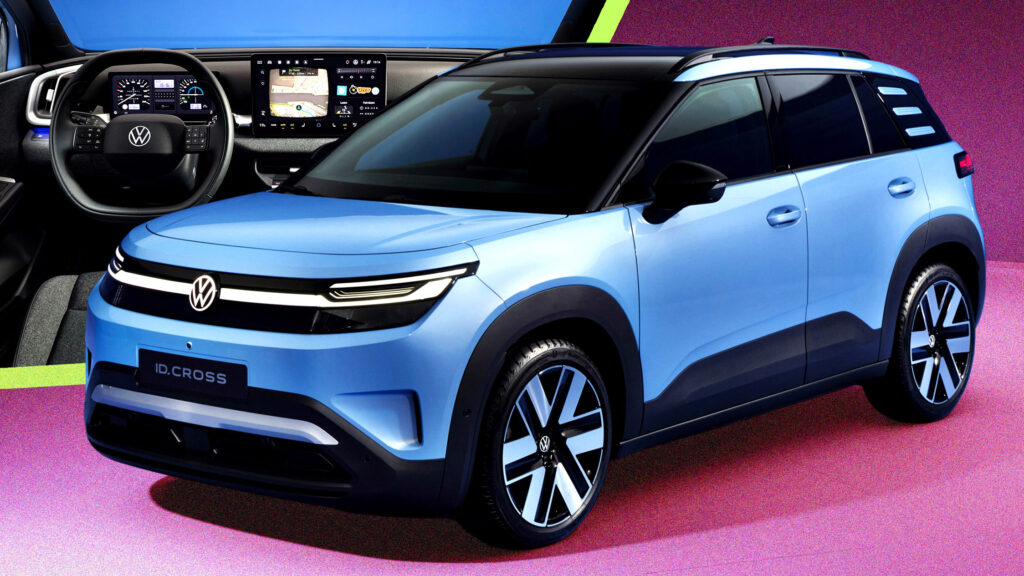
New Crossover from Volkswagen: ID. Cross
The new ID. Cross is the SUV version of the ID. Polo model, which will go on sale in the fall starting at €28,000. The car will be offered with two battery options: 37 kWh and 52 kWh, with the larger one providing a range of up to 271 miles. The power of the single-motor setup ranges from 114 to 208 horsepower, and the cabin retains many physical buttons.
Affordable Electric Vehicle with Premium Ambitions
Affordable electric SUVs are appearing one after another, but the new VW ID. Cross has an advantage that many competitors lack. The production version, almost identical to last year’s ID. Cross concept, promises premium features and a confident new design in VW’s language, while maintaining an attractive starting price of €28,000.
The small five-seat SUV, sibling to the ID. Polo model introduced earlier this year, will arrive in Europe in the fall of 2026. At just over 4,150 mm in length with a wheelbase of 2,601 mm, the ID. Cross will compete with models such as the Kia EV2 and Renault 4.

Space and Practicality
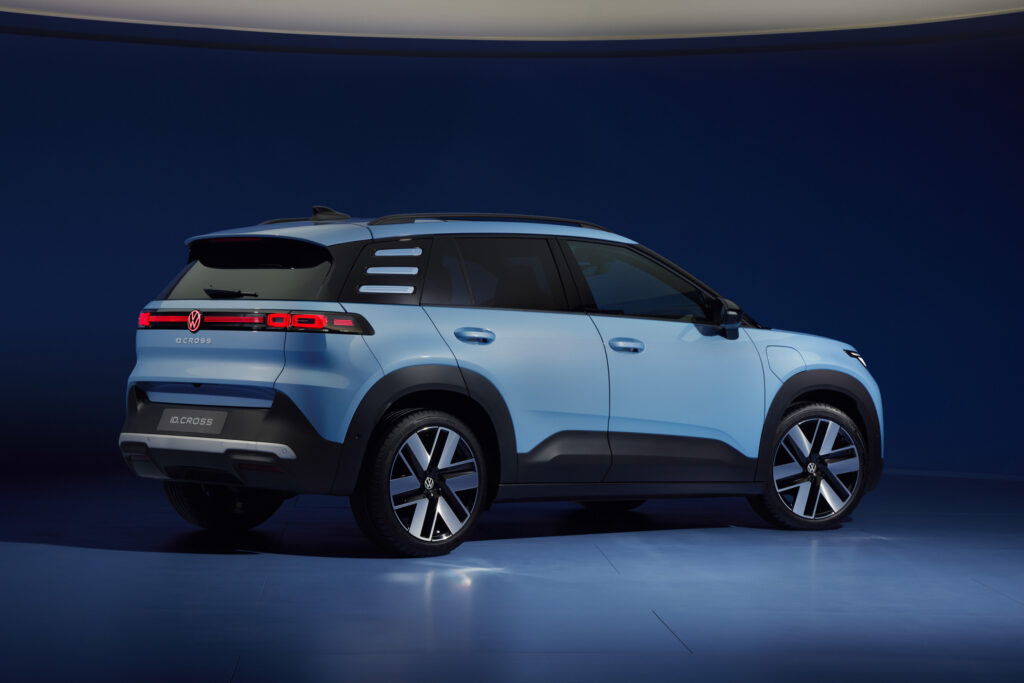
Given these dimensions and competitors, one might not expect much space, but VW claims that clever packaging allows the ID. Cross to provide more passenger and luggage room than its rivals. Cargo volume behind the rear seats is 475 liters, plus a convenient front trunk of 25 liters for charging cables — a combination that favorably distinguishes it from the EV2, Renault 4, and even the larger petrol-powered T-Roc from VW.
Powertrain Options and Range
Buyers will be able to choose between two battery packs and three power variants, all implemented through a single-motor front-wheel-drive setup. The entry-level version combines a 114 hp electric motor with a 37 kWh battery, while higher trims offer a 133 hp motor with the same battery or a 208 hp version with the larger 52 kWh battery.
The flagship combination provides a projected WLTP range of up to 436 km, compared to 452 km for the EV2 and 398 km for the Renault 4. With the base 37 kWh battery, the range drops to 316 km, which again falls between the competitors’ figures: Kia — 317 km, Renault — 306 km. This is also slightly lower than the 328 km that the brand quotes for the lighter ID. Polo with the same battery.
Charging Speed and Features
As with the ID. Polo, charging figures are acceptable but not revolutionary. The smaller battery supports DC fast charging at up to 90 kW, while the larger one increases this to 105 kW. In either case, VW claims that charging from 10 to 80 percent under ideal conditions should take about 24 minutes. A vehicle-to-load function is also included, allowing external devices to be powered from the battery.
Cabin with Physical Buttons
Borrowed from the ID. Polo, which is based on the same MEB+ platform, the cabin aims to correct some of VW’s recent past mistakes. Most surfaces of the dashboard are covered in premium fabric, and genuine physical buttons are located on the steering wheel and on the console beneath the 12.9-inch infotainment screen.
Buyers can enhance this premium feel with quite luxurious features, including optional front seats with 12-way power adjustment and built-in massage programs. Depending on the trim, matrix LED headlights, a panoramic glass roof, adaptive cruise control, and a Harman Kardon audio system with 10 speakers are also available.
Design and Market Positioning
The designers clearly wanted the ID. Cross to look expensive, much like the Mk4 Golf succeeded in doing nearly 30 years ago. Slim lighting, clean body surfaces, and a modern silhouette give it significant showroom appeal. It may not have the quirky character of the Renault 4, but the result is a handsome SUV that looks more expensive than it actually is.
At a price of €28,000, the base version of the ID. Cross with a 37 kWh battery and 114 hp motor matches the price of the Renault 4 but surpasses it in range and falls only slightly short in power. A bigger challenge for VW will likely be the Kia EV2, which starts in Europe at €26,600, offers slightly more range and a standard 144 hp motor.
The VW ID. Cross enters the market at a very opportune time, as demand for affordable electric vehicles is growing. Its main advantage is the combination of an attractive price, practical space, and recognizable design that looks more expensive than its cost. The revival of physical buttons in the cabin could also be a strong argument for buyers who are skeptical of full touchscreen controls. However, competition from the Kia EV2, which offers more for less money, will be a serious challenge. The choice between these two models will likely come down to personal preferences in design and brand, as well as how important the extra space offered by VW is.