


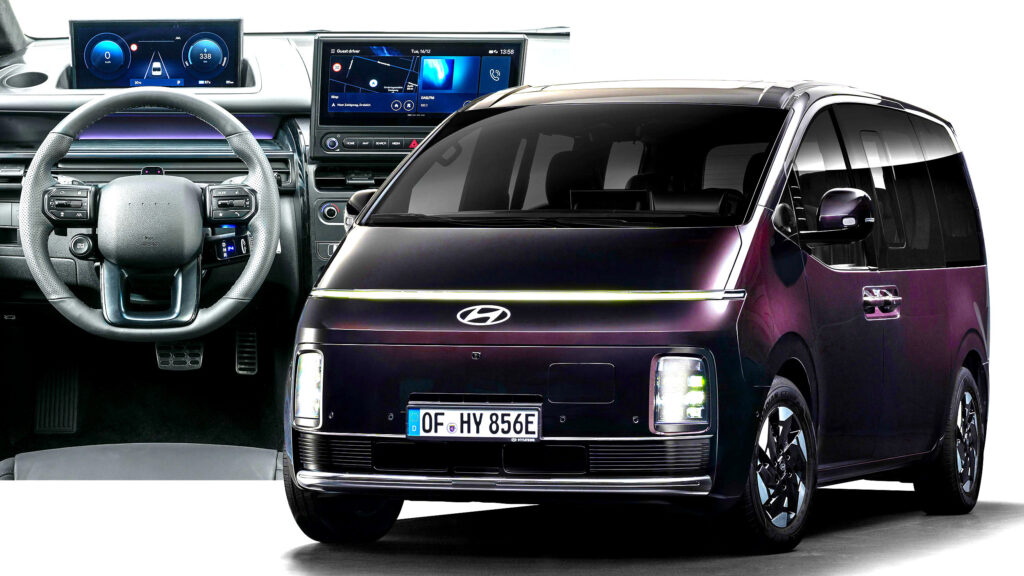
The electric version of the Hyundai Staria debuted in Korea earlier this year along with the updated model lineup. Now this van with a futuristic spaceship design has reached Europe. The company positions it as a competitor to the Volkswagen ID. Buzz, but the Staria turns out to be larger in all key dimensions and offers more space for passengers and luggage.
Exterior and dimensions
To distinguish the electric Staria from petrol and hybrid versions, it is enough to look at the front. It has a new bumper with a smooth panel in place of the grille, a charging port, and active louvers in the lower air intake. Additionally, the electric version is distinguished by aerodynamic wheel discs and a separate badge on the huge rear doors.
The Staria is 5,253 mm long, so it is noticeably larger than the VW ID. Buzz and Kia PV5. It also exceeds the standard versions of the Ford E-Tourneo Custom, VW e-Caravelle, Peugeot e-Traveller, Citroen e-Spacetourer, Opel Zafira-e Life, and Fiat E-Ulysse. Admittedly, long-wheelbase versions of some of these models can be even longer. The situation is similar with the new Mercedes-Benz VLE executive shuttle.
Rich equipment
In Europe, the Staria Electric is available in three trim levels: Trend, Prime, and Calligraphy. Even the base version includes full LED headlights, two 12.3-inch displays, heated front seats, parking sensors, a rearview camera, a set of driver assistance systems, and a three-row nine-seat cabin.
The optional driver assistance package adds navigation, highway driving assistant, and a V2L adapter. The Premium package adds power sliding doors and a power tailgate, sliding windows, sunshades, acoustic and thermal dark-tinted glass, as well as wireless charging. In the Prime trim, all of this is already included as standard. In addition, Prime has leather upholstery and ventilated front seats, and for an extra charge offers a sliding roof above the first row and a panoramic roof above the second.
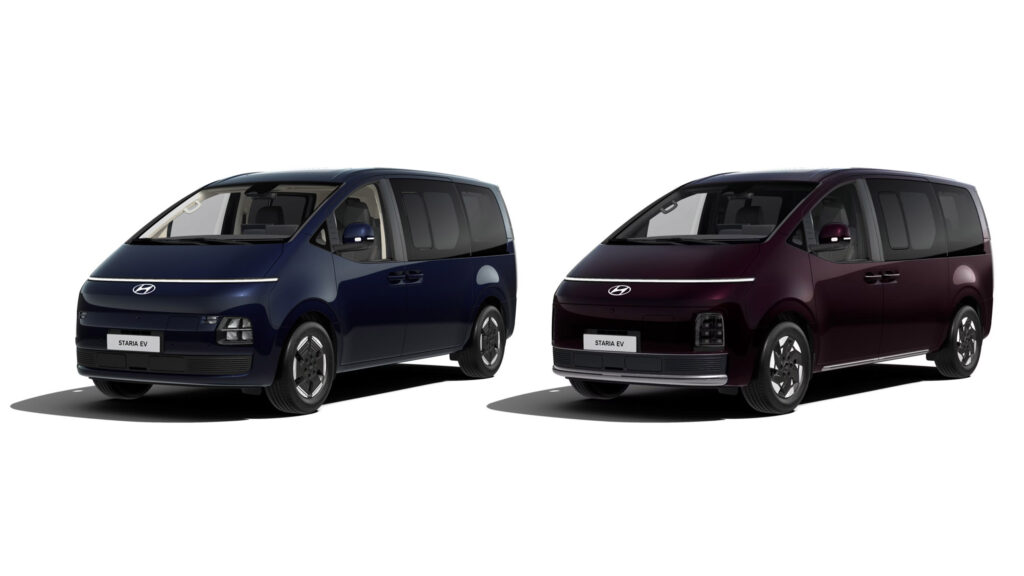

The photo shows the top Calligraphy trim. This is the only version with a seven-seat cabin. In the second row, there are two comfortable seats with heating, ventilation, and a relaxation function. The flagship also received ambient lighting, a Bose audio system, a 360-degree camera, a suede-like headliner, Nappa leather, and the Passenger View and Talk system.
On the outside, the Calligraphy features a different front bumper with larger projection headlights, Parametric Pixel LED lamps that rise along the pillars to the roofline, and an exclusive Galaxy Maroon color.
Space for nine and luggage
In the nine-seat version, the cargo volume behind the third row reaches 1,303 liters. There is also a front trunk with a volume of 24 liters for charging cables. Payload is 750 kg, and the maximum trailer weight is 2,000 kg.
Technical specifications
The electric Staria is powered by a single electric motor on the front axle with 218 hp (160 kW). Energy is stored in an 84 kWh battery, which provides 430 km under the WLTP cycle. Thanks to the 800-volt architecture, the vehicle can charge from 10 to 80% in about 20 minutes at a fast charger. A heat pump and battery heater are standard equipment.
Prices in Germany
On the German market, the Hyundai Staria Electric in the base Trend trim starts at €57,450 ($66,800). The mid-level Prime starts at €63,650 ($74,000), and the top Calligraphy at €66,950 ($77,800). The optional Assistance and Premium packages add €2,100 ($2,400) each, and the panoramic package costs €1,300 ($1,500).
For comparison, the smaller VW ID. Buzz Pro with the long wheelbase and an 86 kWh battery starts in Germany at €57,887 ($67,300). The VW e-Caravelle with the short wheelbase and a 70.9 kWh battery costs from €66,080 ($76,800).
The announcement of European prices makes the Staria Electric one of the most prominent players in the large electric family van segment. Hyundai has chosen a strategy in which the buyer gets a larger vehicle than the ID. Buzz at a comparable price. Moreover, the 800-volt platform, fast charging, and V2L function make this model practical not only for carrying a family, but also for travel or working on the road.
Now the main question is how the new Staria Electric will perform in real conditions on European roads. If Hyundai manages to maintain its price advantage and offer proper service infrastructure, this model could become a serious competitor not only to the Volkswagen ID. Buzz, but also to more traditional commercial vans.