


Record-breaking April for electric vehicles in Australia
Data from the Australian Federal Chamber of Automotive Industries and the Electric Vehicle Council indicate a significant shift in the market. In April 2026, out of 92,591 new cars sold (up 2.2% from April 2025), 16.4% were fully electric models. This equates to 15,185 vehicles. For comparison, only 6,010 electric cars were sold in April 2025.
Hybrids also on trend
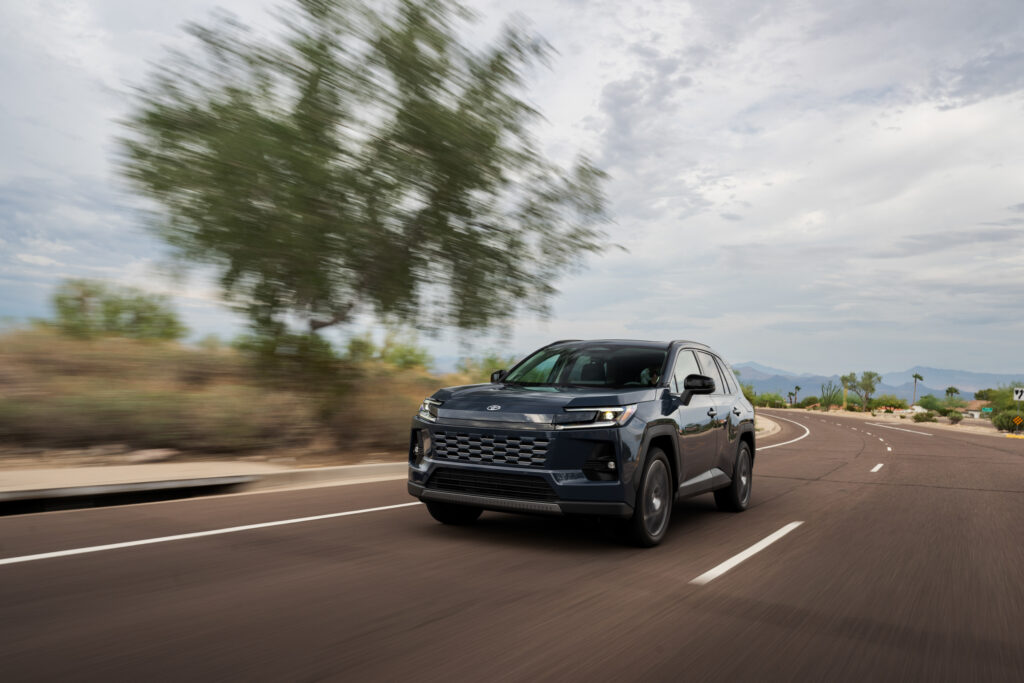
It wasn’t just electric vehicles that posted strong results; hybrids were also in demand. In fact, 18,162 new hybrids were sold in April 2026, boosted by the first full month of sales for the Toyota RAV4, which became Australia’s most popular car. Plug-in hybrids also saw growth, with 9,628 new units sold in April 2026.
Decline in petrol and diesel car sales
While electric vehicles, hybrids, and plug-in hybrids enjoyed the spotlight, partly thanks to tax incentives, traditional petrol and diesel cars took a hit in April 2026. Sales of new petrol cars fell 30.1% compared to April 2025. Sales of new diesel cars dropped by 21.7%. This decline may also be linked to the ongoing conflict in the Middle East, which has significantly impacted crude oil supplies to Australia, leading to rising fuel prices and some local shortages.
Leaders among electric vehicles
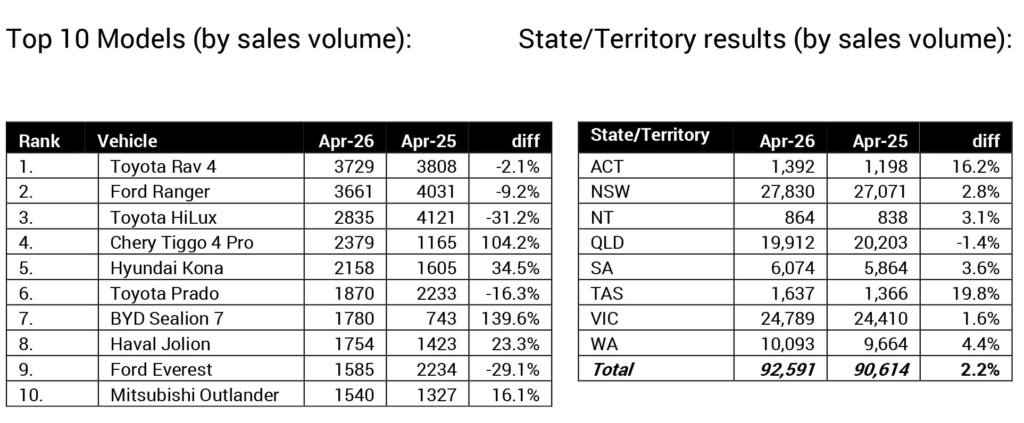
In April 2026, the BYD Sealion 7 dominated the electric vehicle rankings with 1,780 units sold. Meanwhile, the Tesla Model Y sold nearly 1,000 fewer units, although its sales grew 193.6% year-on-year, as last year’s model was due for replacement.Overall, the BYD brand sold 7,702 new units. Other strong players in the Chinese EV segment included the Geely EX5 with 1,202 deliveries and 1,006 units from Chinese brand Zeekr, of which 973 were the 7X model. In the passenger car segment, the Tesla Model 3 narrowly beat the BYD Seal with figures of 403 versus 370 deliveries.
Toyota remains leader, Ford and Mazda lose ground
Despite a 21.6% year-on-year sales decline, Toyota remained Australia’s new car sales leader in April 2026. They sold 15,185 units, followed by BYD with 7,702 new cars.
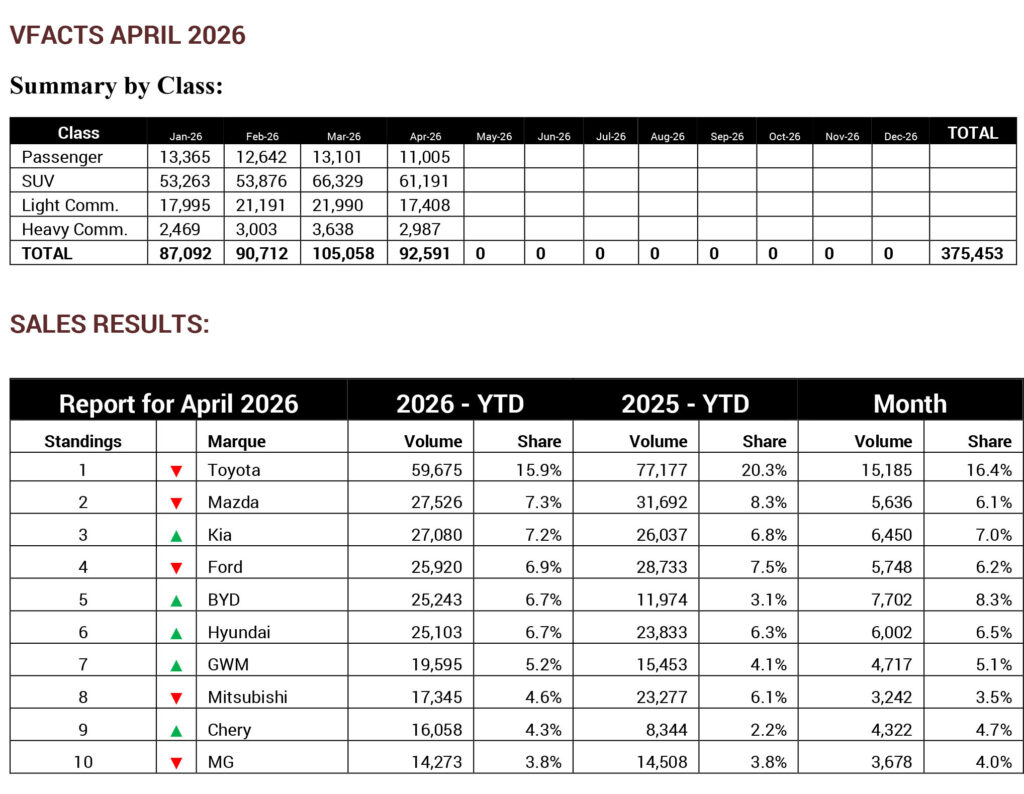

BYD’s rise to second place means Ford and Mazda, traditionally second and third, now find themselves in fifth and sixth places with 5,748 and 5,636 units respectively. However, the Ford Ranger held onto the silver medal as the second most popular car, slotting in between the RAV4 and the Hilux.
Changes in the top ten
Looking at overall new car sales in Australia, Kia and Hyundai took third and fourth place in April with 6,450 and 6,002 units sold respectively. Of course, these two automakers also have electric and hybrid models in their portfolios. The same applies to Chery in eighth place and MG in ninth, while Isuzu rounded out the top ten, ahead of Mitsubishi.

Interestingly, the growth in the EV share to one in six cars sold comes against a backdrop of overall market growth. Chinese brands like BYD, Geely, and Zeekr are not only capturing the EV segment but also beginning to displace traditional players from the overall rankings. At the same time, the success of the Toyota RAV4 shows that hybrid technology remains an important transitional step for consumers not yet ready to fully switch to electric power. The sales decline for Ford and Mazda may indicate that the Australian market is adapting to new technologies faster than expected, putting additional pressure on manufacturers slow to electrify their lineups.