


The Problem of Extreme Speed Violators in New York
Speeding is a common occurrence, but its danger increases significantly in dense urban environments with many pedestrians. In New York, this has not stopped a number of drivers who have accumulated fines reaching five-figure sums for violations captured by surveillance cameras. Many of them continue to drive, and some appear to ignore the fines entirely. New data suggests the state system may also be ignoring them.
The Scale of Violations and System Inaction
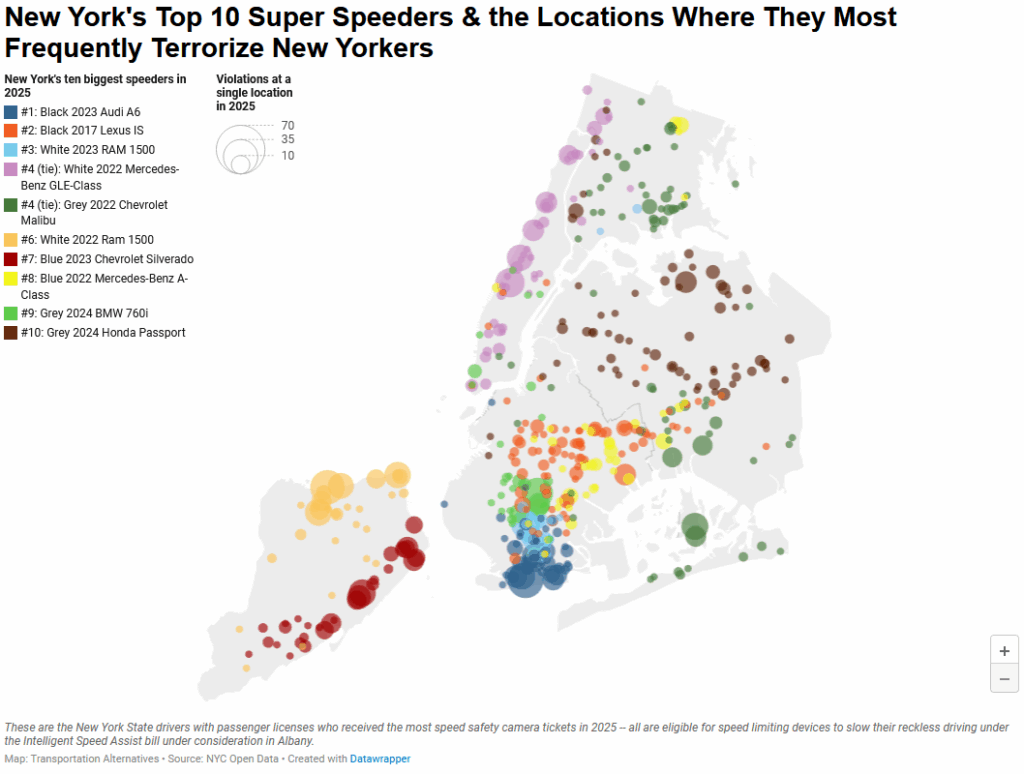
Road safety advocacy groups, Transportation Alternatives and Families for Safe Streets, have published a report exposing the state’s worst speed “super-violators.” According to the data, the top ten drivers with the most violations in school zones received an average of 179 fines each in 2025. The absolute record-holder received 259 fines.
That driver, behind the wheel of a 2023 Audi A6, reportedly accumulated over 1000 camera-issued fines since mid-2023. Despite paying over $63,000 in fines, the car continues to be recorded for violations in Brooklyn.
The same car topped a similar list in 2024, holding the dubious first place for two consecutive years. Other violators appear less inclined or able to pay. For example, a 2017 Lexus IS from the list has nearly $20,000 in unpaid fines, and a 2022 Mercedes-Benz GLE-Class has over $23,000 after 177 fines in 2025. A 2024 Honda Passport owes almost $31,000. Many vehicles in the report show minimal or zero payment history, despite thousands of dollars in fines.
In other words, the automated system can quickly generate fines, but its effectiveness in dealing with repeat offenders remains questionable. Available data indicates the cameras do almost nothing to change these drivers’ behavior.
Safety Threat and Proposed Measures
Activists emphasize that such drivers pose a serious threat to public safety. They point out that over 2.5 million New Yorkers live within a five-minute walk of intersections where the worst violations were recorded. The group advocates for the passage of the “Stop Speeding Super-Violators” bill, which would require drivers with 16 or more violations in a year to install a device in their vehicle that limits speed to 5 mph over the posted limit.
While this measure seems reasonable, there are nuances. The data does not link the hundreds of violations by these specific drivers to specific crashes, injuries, or fatalities. This does not mean speeding is not dangerous—it unquestionably increases the severity of accident outcomes. However, the activists’ comparison of this behavior to “shooting into a crowd” could be considered an exaggeration.

Gaps in the Enforcement System
Another fact remains indisputable: there are serious gaps in law enforcement. A similar situation with the same Audi driver was described a year earlier, and he again tops the list. Then and now, he continued to drive, paying tens of thousands of dollars as if speeding near a school were a trivial matter. The fines for him seem to have simply become a cost of doing business. Several other violators on the list, judging by everything, simply ignore the fines altogether.
It seems that for now, “super-violators” can continue to flout the rules without a real threat of losing their driving privileges. The more things change, the more they stay the same. This situation points to a systemic problem where the fiscal mechanism is not accompanied by effective administrative measures, such as blocking vehicle registration or revoking driver’s licenses for the most hardened repeat offenders, rendering the entire system for preventing dangerous driving ineffective.