


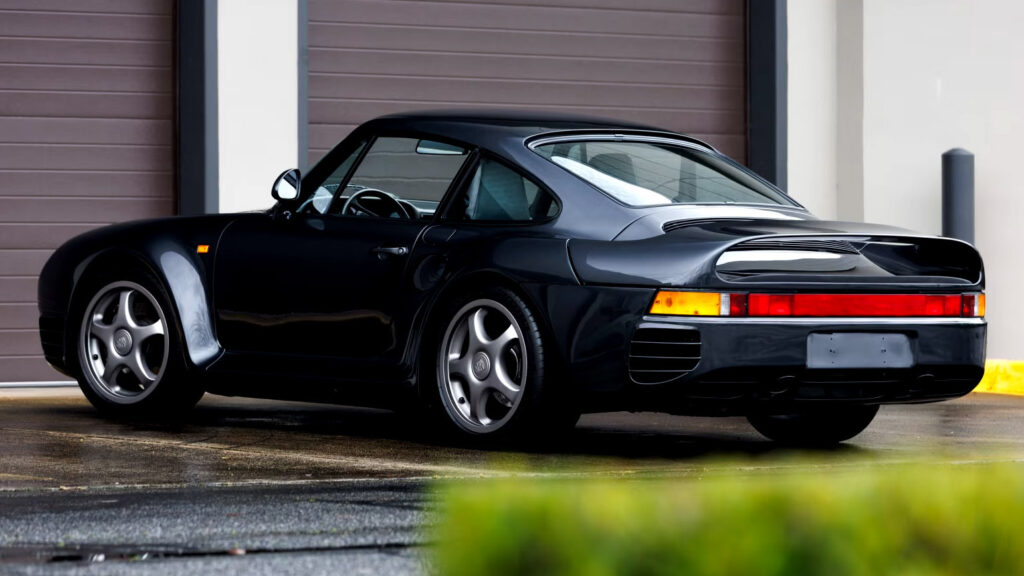
Legendary Porsche 959 to be auctioned with no reserve price
Collectors have hunted for decades for analog supercars that defined the face of the 1980s. Among them, the Porsche 959 holds a special place — a technological breakthrough from the German automaker. Once the fastest production car in the world, its value has skyrocketed in recent years.
One of the few 959 examples legally imported into the US will be put up for auction by Mecum next month. This car is offered with no reserve price, is completely original, and has a mileage of only 3,521 miles (5,666 km). For such a rare model in this condition, the absence of a reserve is the main news — whoever offers the highest amount takes the car.
History and technical specifications
Only 292 road-going versions of the 959 Komfort were ever produced. This particular car originally lived in Japan and was imported to the US in the early 2000s, where it was modified by the company Canepa to comply with local environmental regulations. Details about its ownership and service history are hardly disclosed, nor is it known whether any previous owner attempted to reach its top speed of 198 mph (319 km/h).
The car has a dark gray body color and retains its original 17-inch wheels with Michelin tires. Compared to modern supercars, which often feature sharp lines and acute angles, the 959’s body looks incredibly smooth, helping it cut through the air with minimal resistance. The design is soft yet aggressive, and it only gets better with age.
Interior and market value
The interior also perfectly matches a car of that era: black leather on the seats, door panels, and dashboard. The seats have silver and cream leather inserts, which is not found on all 959s.
Ten years ago, a used Porsche 959 could be bought for less than $1 million. Those days are gone. Prices now regularly exceed $2 million, and one example earlier this year in Arizona sold under the hammer for $2.53 million. This lot is expected to fall within the same price range.
This Porsche 959 is not just a car but a true artifact of automotive history. Its rarity, original condition, and low mileage make it a desirable exhibit for any serious collection. The lack of a reserve price adds intrigue, as it could both attract more bidders and lead to an unexpectedly low final price, although the latter is unlikely. Given the growing interest in classic 80s supercars, this auction will undoubtedly attract the attention of wealthy collectors worldwide, and the final price could set a new benchmark for the market.