


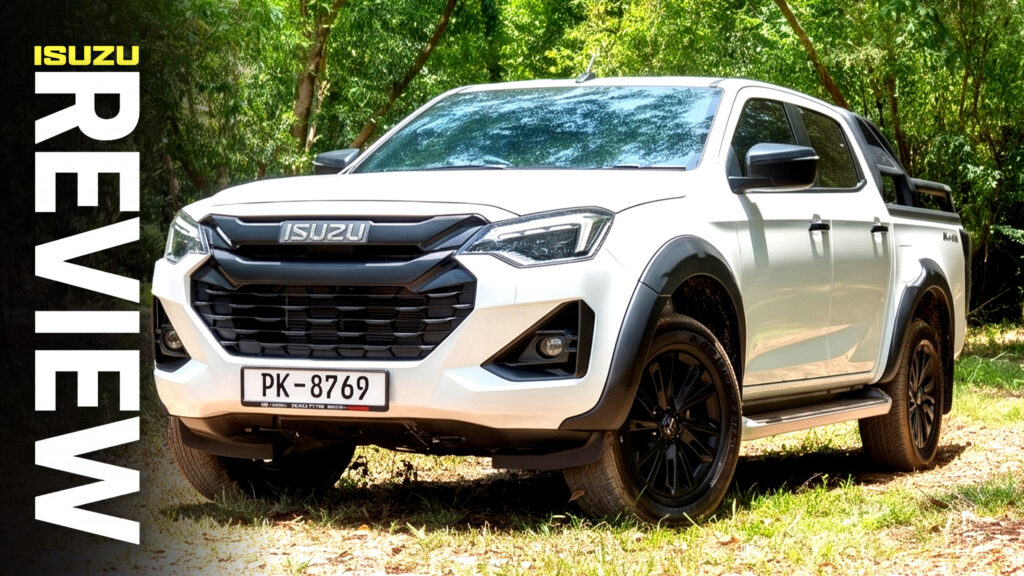
PROS ›› Durability, off-road capability, focus on the basics CONS ›› Refinement, paper specifications, basic interior
The Hidden Subculture of Southeast Asia
In Southeast Asia, there is a subculture that remains invisible to most. For many, pickup trucks are purely utilitarian tools, as intended. But for others, they become a means of self-expression, thanks to a massive tuning community.
It’s not just about the usual lift kits and massive tires. It’s about air suspension or hydraulics, powerful audio systems, and engines pushed to the limit with forged internals and turbos bigger than a child’s head. One of the most popular platforms for this is the Isuzu D-Max.
Isuzu and Tuning Culture
Isuzu has embraced tuning culture so much that it has created its own specialized versions, like crazy drag special editions. However, what we have here is far from a high-horsepower nitrous-fed creation. Instead, this is a more basic version of the D-Max with the 3.0-liter engine, which has obviously earned its fanbase for a reason.
QUICK FACTS
Model: 2026 Isuzu D-Max 3.0 Diesel
Starting Price: AU$70,990 ($48,835)
Dimensions: 208.3 x 73.6 x 71.3 in (5,295 x 1,870 x 1,810 mm)
Wheelbase: 123.0 in (3,125 mm)
Curb Weight: 4,332 lbs (1,965 kg)
Powertrain: 3.0L turbo-diesel R4 / part-time 4WD
Power: 188 hp (140 kW) / 450 Nm (332 lb-ft)
Suspension: Independent double wishbone with coil springs front / semi-elliptical leaf spring rear
On Sale: Now
Why Isuzu Is a Name Not Everyone Knows
If you’re not familiar with the Isuzu brand, we don’t blame you. The Japanese automaker left the American market back in 2009, leaving behind only faint memories of the Trooper and Rodeo from the ’90s. But step into any dealership in Southeast Asia, Australia, or the UK, and Isuzu will be a household name, especially in the truck segment where its reputation for diesel durability borders on legendary.
This is where the D-Max comes into play. It is the bread and butter for Isuzu, and it is a huge part of their success. In fact, it is literally the foundation of their passenger vehicle lineup, as their only other offering, the MU-X, is an SUV adapted from the D-Max.
What Does the D-Max Offer?
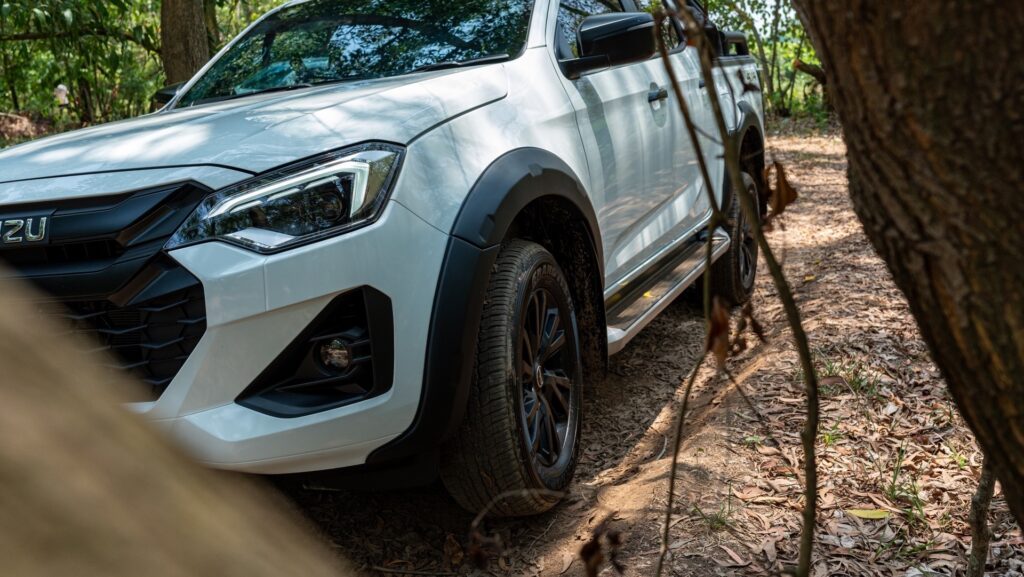

If you are familiar with other competitors in this class, such as the Toyota Hilux, Ford Ranger, and Mitsubishi Triton, the D-Max occupies exactly that space. You get a ladder frame chassis, a choice between single and double cab variants, and four-wheel drive.
Besides the 3.0-liter unit under the hood of this pickup, there is also a 1.9-liter diesel and a 2.2-liter diesel. And this, essentially, is the Isuzu philosophy. Their expertise lies in diesel engines, and so if you are looking for a petrol alternative, you’re out of luck.
Comparison with Competitors
That 3-liter four-cylinder engine produces 187 horsepower (190 hp / 139 kW) and 450 Nm (332 lb-ft) of torque, which is not class-leading. The Ford Ranger, available with a 3.0-liter V6, produces 247 hp (250 hp / 184 kW) and a significant 600 Nm (443 lb-ft) — numbers that matter for those who need to tow.
Even other four-cylinder variants, the Hilux and Triton, surpass it. The Toyota with its 2.8-liter engine can produce 201 hp (204 hp / 150 kW) and 500 Nm (369 lb-ft) of torque (with automatic), and the Mitsubishi produces 201 hp (204 hp / 150 kW) and 470 Nm (347 lb-ft).
On paper, the D-Max doesn’t look great. But numbers rarely tell the full story. The 4JJ3 engine is believed to be tuned conservatively, and given the feedback on long-term ownership, this pays off in reliability. Remember that tuning culture I mentioned? This is the diesel equivalent of something like the 1JZ/2JZ in terms of the number of modifications people have devised to unlock its potential.
And yes, behind the wheel, the D-Max doesn’t feel less gifted than its rivals. In light off-road conditions, the torque is available at low revs and is steady, without making the engine strain. In other words, not once did I think: “Oh, how I wish there were 50 Nm more torque here, like in the Hilux.”
How Does It Handle Off-Road?
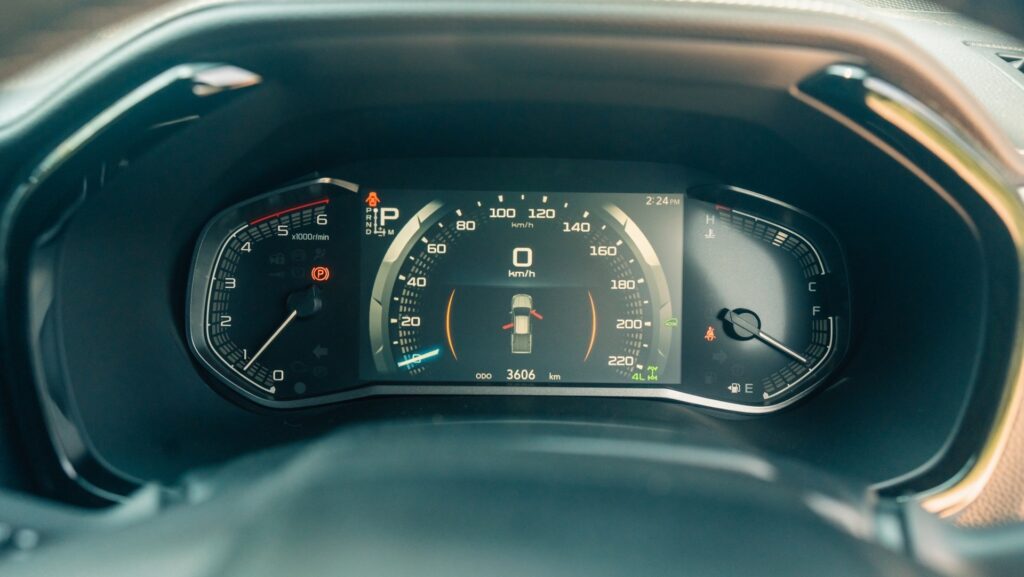
Approaching rough tracks that usually make pickups without a locking differential nervous, the D-Max coped surprisingly easily. And although a rear differential lock is an option, our test vehicle was not equipped with it. Instead, you get the ‘Rough Terrain’ mode, which was added in the latest update.
This mode uses electronics to brake the wheel that has lost traction, which would otherwise spin uselessly. Thus, the D-Max can redistribute torque — even in 2WD mode — and continue moving with minimal effort. It is not a differential lock, so for slippery surfaces requiring something bigger and heavier, you will likely need locked axles. But the new mode has its uses and works exactly as intended on uneven terrain.
The controls are very analog, tactile, and intuitive. The mentioned mode is activated with one button press. No need to dive into menus, interact with a touchscreen, or go through safety warnings. One button. The same can be said for the four-wheel drive system, which is controlled by a large, easily accessible knob. You can switch from 2H to 4H on the fly (shifting to 4L requires a full stop) up to 100 km/h (62 mph).
However, it is important to note that this is still a part-time 4WD system. This means you can only use it on unpaved roads. Unlike some competitors, the D-Max does not have a center differential, and therefore cannot offer a way to use all four wheels on paved surfaces. So if you are looking for something that gives more confidence on a wet road, the D-Max, unfortunately, is not for you.
What About Everyday Use?
This is where the D-Max starts to feel less suitable for daily tasks. While it is a ladder frame pickup with 4WD, there is, of course, a segment of buyers who want to see their pickups more car-like. The D-Max is not that.
The cabin, while not offensive, simply doesn’t have the same level of softness as the Ford Ranger or Kia Tasman. There is a lot of tough, scratch-resistant plastic, large handles, and massive buttons that clearly state what this was created for: more severe operating conditions.
You still get things like a power driver’s seat, cruise control (not much ADAS for this Southeast Asian specification), and a decent stereo system. But the money wasn’t spent on making it car-like. As a result, you have an outdated infotainment system which, while supporting wired Android Auto and Apple CarPlay, feels a generation or two behind. The screen is slow to respond, the graphics are barely better than Windows XP, and the overall atmosphere is more utilitarian than comfortable.
And there’s nothing wrong with that. Well, except perhaps the screen could have a higher resolution. But aside from that, I like that the D-Max is built for a specific purpose. Competitors have softer options. But this is not that, and it doesn’t try to be — something which, I imagine, many owners actually appreciate.
What could be improved is the behavior on highways. Body roll and overall road comfort are well controlled, and I prefer the D-Max’s approach over the softer (and therefore more wallowy) way of its SUV cousin, the MU-X. But the steering is quite dead, wind noise on the highway is noticeable, and if you push the revs above 2500 rpm, the diesel clatter is audible in the cabin.
These are things that, if Isuzu could fix them, wouldn’t alienate existing buyers or affect its capability or durability. It would just bring the D-Max closer to its competitors in terms of refinement.
Verdict and Price
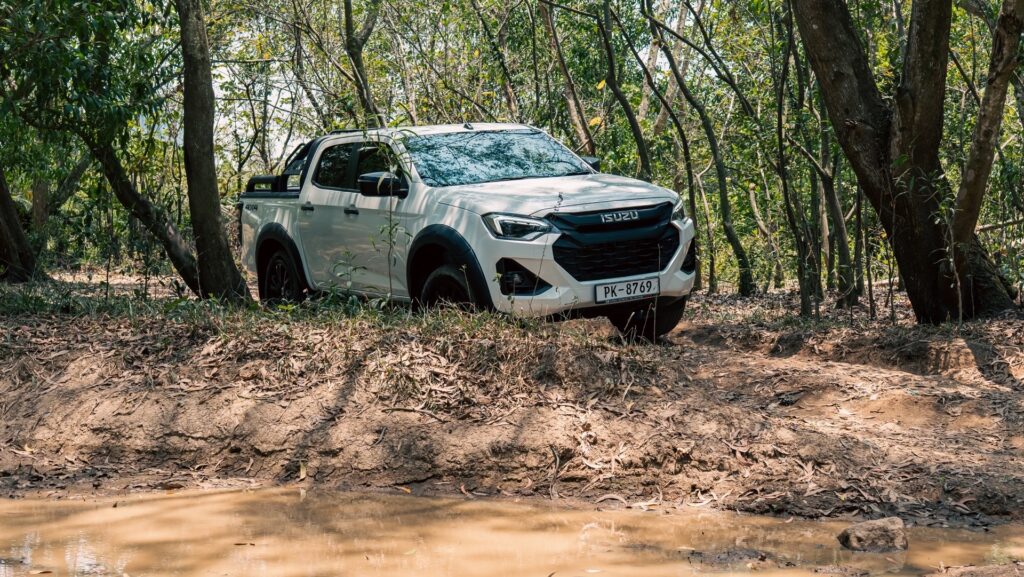
The Isuzu D-Max tested here was in Sri Lanka, where this 3.0-liter model will cost around LKR 23,000,000 (~$72,000). For comparison, a similarly equipped Toyota Hilux or Ford Ranger will cost you over LKR 25,000,000, which is a significant difference. The same story is true in Australia, where the D-Max is one of the country’s best-selling vehicles, and the picture is similarly competitive.
The price range starts from around AU$36,000 for the base 2.2-liter single cab version, while the 3.0-liter double cab variants, which are the most sought-after, cost from AU$55,000 to AU$70,500 for the top-spec X-Terrain. Overall, the D-Max is still cheaper than the Hilux and Ranger, pound for pound, in terms of price.
But what place does the D-Max hold in the overall pickup landscape? Firstly, it doesn’t try to be a lifestyle vehicle disguised as a workhorse. Instead, it is a workhorse that has enough polish to function as a daily driver. The 3.0-liter diesel isn’t quick, but it is very capable, and the 4WD system is honest and effective.
Is it the most powerful in its class? No. Does it have the most refined interior or the flashiest infotainment system? Also no. But the D-Max has always competed on a different axis: reliability, serviceability, and the total cost of ownership that makes accountants and fleet managers quietly rejoice. And this, I suspect, is where it will continue to win hearts and wallets.

Thus, the D-Max remains an interesting proposition in a market dominated by more powerful and technologically advanced rivals. Its strength is not in the numbers on paper, but in its proven reliability and ability to perform hard work without unnecessary compromises. For those who value practicality over luxury, this pickup could be the ideal choice, especially given its lower price and immense tuning potential, which makes it a favourite among enthusiasts worldwide.