


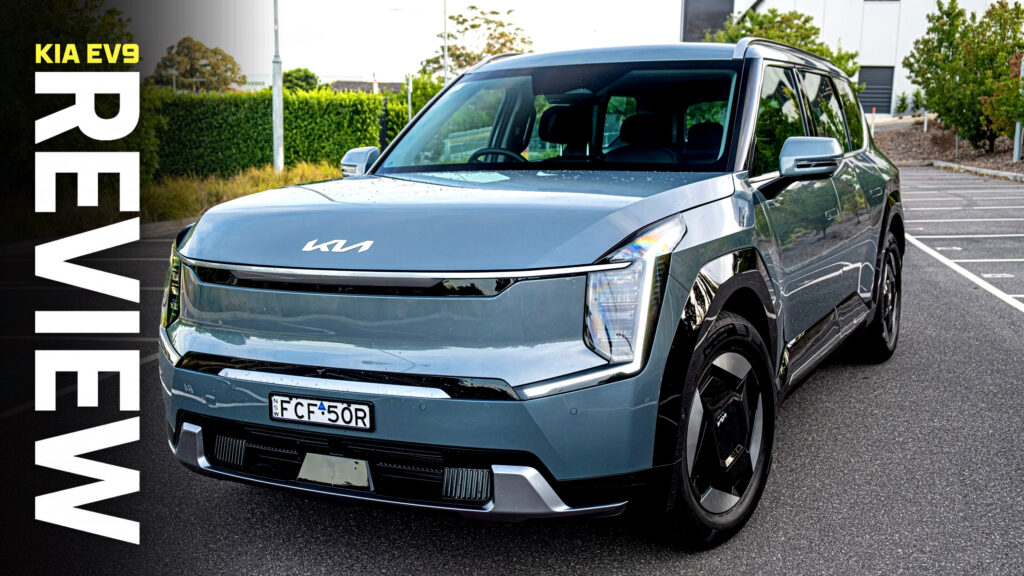
Pros: Power, spacious cabin, high level of comfort.
Cons: Hyundai Ioniq 9 is more luxurious, high price, not the best efficiency.
Market Entry and Positioning
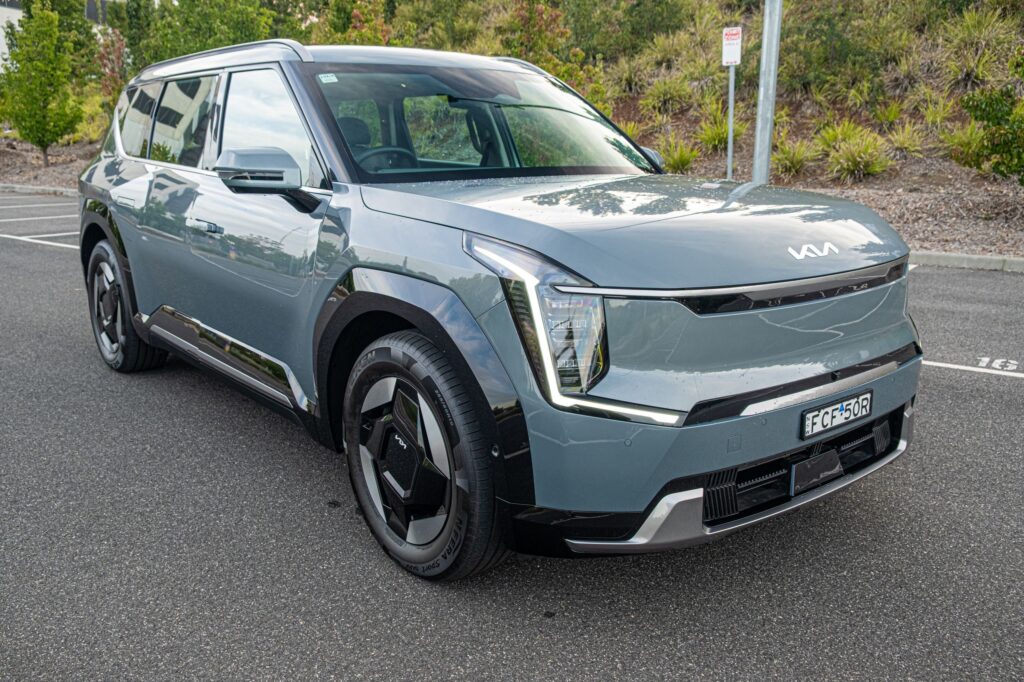
The Kia EV9 arrived on the Australian market two years ago as the first full-size electric SUV with three rows of seats, and it immediately attracted attention. Its design, inspired by sharp-edged concept cars, was a turning point for the Korean brand in its move towards the premium segment. For the local market, it was not just another model update, but a true statement of intent and perhaps the most important Kia model in recent years.
Competition in the Electric SUV Market
In the two years since its launch, the segment of full-size electric SUVs has not become significantly more crowded. The Australian market still offers a limited choice of three-row electric vehicles: only the Volvo EX90 and the well-thought-out Hyundai Ioniq 9 have joined the conversation. The arrival of a seven-seat Tesla Model Y, which technically has three rows of seats, is also expected.
The question is whether the EV9 retains the same appeal two years later as it did at the start, or if it has been overshadowed by new competition? We spent a week with the mid-spec Kia EV9 Earth to find out.
Key Specifications and Pricing
EV9 prices in Australia have remained stable since its arrival, which is a positive factor, however the car is still expensive. The base Air trim starts from 106,404 Australian dollars. The Earth trim we reviewed starts from 119,273 Australian dollars. The arrival of the sporty GT version is expected soon, with its price approaching the 150,000 Australian dollar mark. At that price, the buyer is making a serious financial statement.
Technical Features of the Earth Trim
The mid-spec EV9 Earth looks attractive on paper. It uses the same powertrain as the top GT-Line: a 99.8 kWh battery and two electric motors with a combined output of 283 kW (380 hp) and 700 Nm of torque. For comparison, the base model is equipped with a smaller 76.1 kWh battery and only a single rear electric motor.
Kia claims a range of 512 km for the EV9 Earth, which is the best figure in the lineup, as well as a 0-100 km/h acceleration time of 6.0 seconds. This is slower than the GT-Line (5.3 seconds), likely due to software limitations, as the technical hardware is identical.
Interior: Space, Functionality, and Materials

Given its large dimensions, the EV9’s interior proves to be truly spacious. It’s a genuine seven-seater, or a six-seater in the captain’s chair configuration. The dashboard, as in other Kia models, is formed by three screens: a 12.3-inch multimedia screen, a 5-inch climate control screen, and a 12.3-inch instrument panel.
The implementation of the climate control screen raises questions: it is positioned between the two large displays and is often obscured by the steering wheel rim. Fortunately, there are physical temperature and ventilation controls on the panel, so the need to use the screen rarely arose.
A recent acquaintance with the Hyundai Ioniq 9, which is built on the same platform, allows for a comparison. Although the Ioniq 9 in the top Calligraphy trim is more expensive, its interior feels significantly more luxurious. This doesn’t mean the EV9’s interior is bad—it’s very good. But where Hyundai used a variety of colors, materials, and shapes, the interior of the EV9 Earth looks rather gloomy, offered exclusively in black artificial leather with a lot of plastic. At this price, more is expected.
Comfort and Practicality
From a functional standpoint, everything is excellent. The front seats are comfortable, as are the very soft headrests. There are plenty of charging ports, as well as heating and ventilation functions for the front seats. The second row is extremely spacious, with ample leg and headroom even in the middle seat. Thanks to the straight roofline, there is enough space even in the third row. The cargo volume is also impressive: 828 liters with the third row folded and 2,318 liters with the second and third rows folded.
Dynamics and Handling
Although the Kia EV9 Earth is not positioned as a sports SUV, it has a clear sporting streak. Unlike the Ioniq 9 Calligraphy, which moves more smoothly, the EV9 has noticeably stiffer suspension and more dynamic behavior. This doesn’t mean it feels like a true sports car, but Kia’s engineers clearly aimed to create something that driving enthusiasts would appreciate.
Despite the tendency towards stiffness typical of heavy electric vehicles, the EV9 remains comfortable and absorbs bumps well, almost matching expensive European competitors. Thanks to the suspension tuning, the EV9 handles surprisingly well and offers a great deal of road grip considering its size.
Kia has successfully suppressed cabin noise, eliminating excessive tire or wind noise. The steering has a pleasant weight, the brakes are well-tuned, and regenerative braking can be adjusted on the fly using paddles on the steering wheel.
Minor Shortcomings and Efficiency
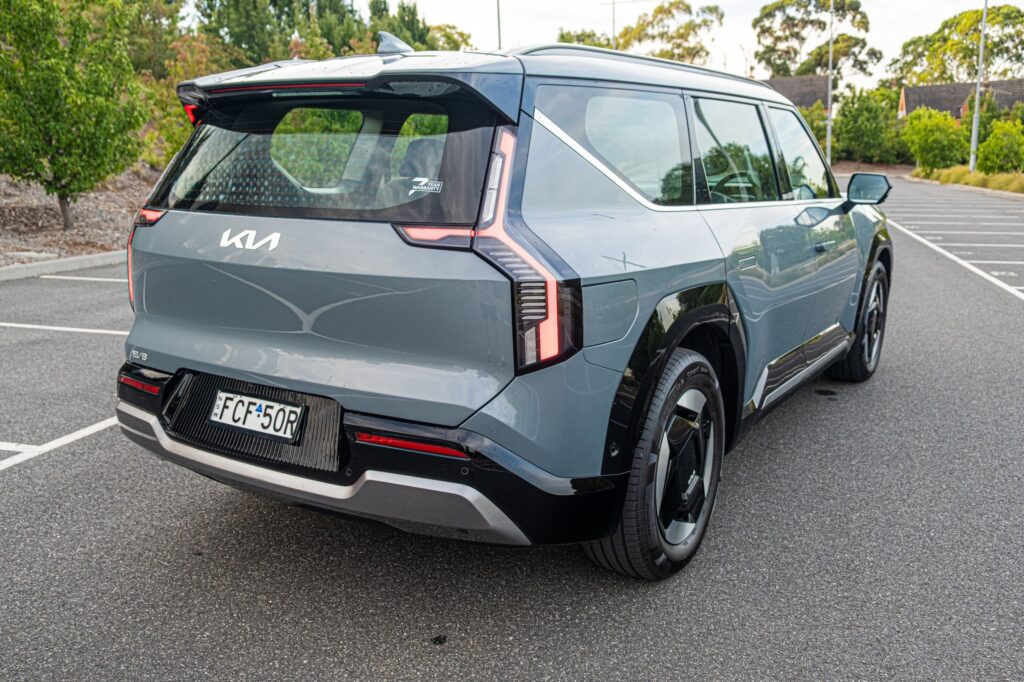
The EV9 doesn’t have many shortcomings, but they exist. The driver monitoring system proves to be overly activist, giving warnings even with a brief glance away from the road. The multimedia quick-access buttons, executed as tactile keys, are very inconvenient to use while driving.
The 800-volt architecture allows the battery to be charged from 10 to 80% in just 24 minutes, which is impressive for a nearly 100 kWh battery. However, energy consumption efficiency leaves something to be desired. The claimed 22.3 kWh/100 km turned into 23 kWh/100 km in practice, even with predominantly driving in eco-mode and using regenerative braking.
Summary and Market Position
The Kia EV9 has demonstrated relatively good sales since its launch. In Australia, 269 units were sold last year, exceeding the Volvo EX90 figure (209 units). In the US, sales dropped significantly after the cancellation of the federal electric vehicle tax credit.
Should Kia panic? Hardly. The market for large electric SUVs will never be mass-market, and a drop in demand does not mean the EV9 has become less attractive. It remains as good a car as it was at the start. However, it has to compete not only with other brands but also with its own models, such as the hybrid Sorento and Telluride, and convince buyers to choose it over the more luxurious Hyundai Ioniq 9. The EV9 will likely remain most attractive to those specifically seeking an electric vehicle, not just the most cost-effective seven-seat SUV in terms of price and quality.
Progress in the electric vehicle industry continues, and each new model sets higher standards. The EV9 remains an important player, especially for families who need space and are ready to switch to electric. Its technical equipment, fast charging, and dynamics remain strong arguments. The future of the model will likely depend on further infrastructure development, government support, and Kia’s ability to adapt to a rapidly changing market where consumers increasingly value not only technology but also driving emotions and interior execution quality.