


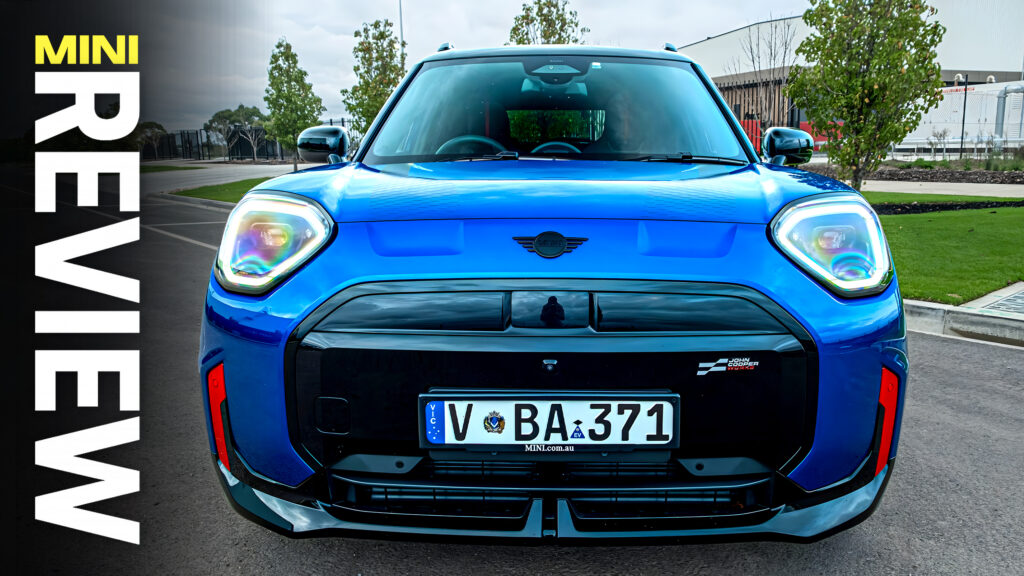
Mini Aceman JCW e: A Sporty Electric Crossover with Character
The launch of the Mini Aceman a few years ago came as a surprise, as it seemed the British brand already had enough models in its lineup. However, unlike the smaller Cooper and the larger Countryman, which exist in both internal combustion engine and fully electric versions, the Aceman is available exclusively as an electric vehicle. This is arguably one of the most stylish options in this market niche, competing with models like the Volvo EX30, Skoda Elroq, and Kia EV3.
We recently spent a week with the Mini Aceman to understand what it truly represents. And we didn’t just take any version, but the flagship Aceman JCW e Favoured, designed to show what the lineup is capable of when nothing holds it back.
Key Specifications
Model: 2026 Mini Aceman JCW e Favoured
Starting Price: AU$65,990 ($46,200) excluding on-road costs
Dimensions: 4079 x 1754 x 1514 mm
Wheelbase: 2606 mm
Curb Weight: 1745 kg
Powertrain: 49 kWh battery / single electric motor
Power: 255 hp (190 kW) / 350 Nm
0-100 km/h Acceleration: 6.5 seconds (as measured by us)
Transmission: Single-speed
Efficiency: 13.8 kWh/100 km (according to manufacturer)
On Sale: Now
The market for electric “hot hatches” is quite small, but it is slowly growing. In terms of performance figures, the Aceman can easily be dismissed compared to other electric hatches, including the smaller two-door Mini Cooper JCW. However, that doesn’t mean the Aceman is uninteresting.
The four-door car is equipped with a 49 kWh battery that powers a single electric motor producing 190 kW (255 hp) and 350 Nm of torque. This is significantly less than the electric Countryman SE ALL4 in JCW trim, which delivers 230 kW (308 hp) and 494 Nm. But, unlike that model, the Aceman is front-wheel drive and feels much more manic on an open road. More on that later.
In Australia, the Aceman JCW e Favoured we tested is available from AU$65,990 ($46,400). This is more than some competitors, but Mini models have often commanded a price premium over less stylish rivals, so this price tag is not excessive.
Sporty, But Small
The Aceman’s interior can be described as joyful, much like other modern Mini models. As far as practicality goes, the Aceman lacks some of the conveniences found in other EVs. It retains a transmission tunnel, albeit smaller than in ICE models, with space for only a phone, two cupholders, and a small storage compartment. The door pockets are also small. However, Mini more than compensates for this with its personality.
The dashboard of our test car was upholstered in black recycled knitted polyester with a sporty red pattern on the passenger side. It also featured red contrast stitching, a red strap serving as the lower steering wheel spoke, and numerous gold-colored accents, including the speaker grilles and door handles.
In the center is the familiar round Mini infotainment display with wireless Apple CarPlay and Android Auto. As in other Mini models, there is a somewhat old-fashioned head-up display that projects onto a transparent panel rising from the dashboard. Although this looks a bit dated, a major advantage is that it remains visible when using polarized sunglasses.
Since we tested the John Cooper Works version, it also included a Harmon Kardon sound system, a panoramic glass roof, and power-adjustable seats with a massage function for the driver. It also featured one of the best ambient lighting systems I have ever seen, projecting various patterns onto the dashboard and door panels, and even had checkered patterns on both sides of the glass roof.
The second row is large enough for children but is not suitable for tall adults due to limited legroom and even less headroom. With the rear seats up, trunk volume is up to 300 liters, and with the seats folded, it expands to 1005 liters.
Fast, But with Compromises
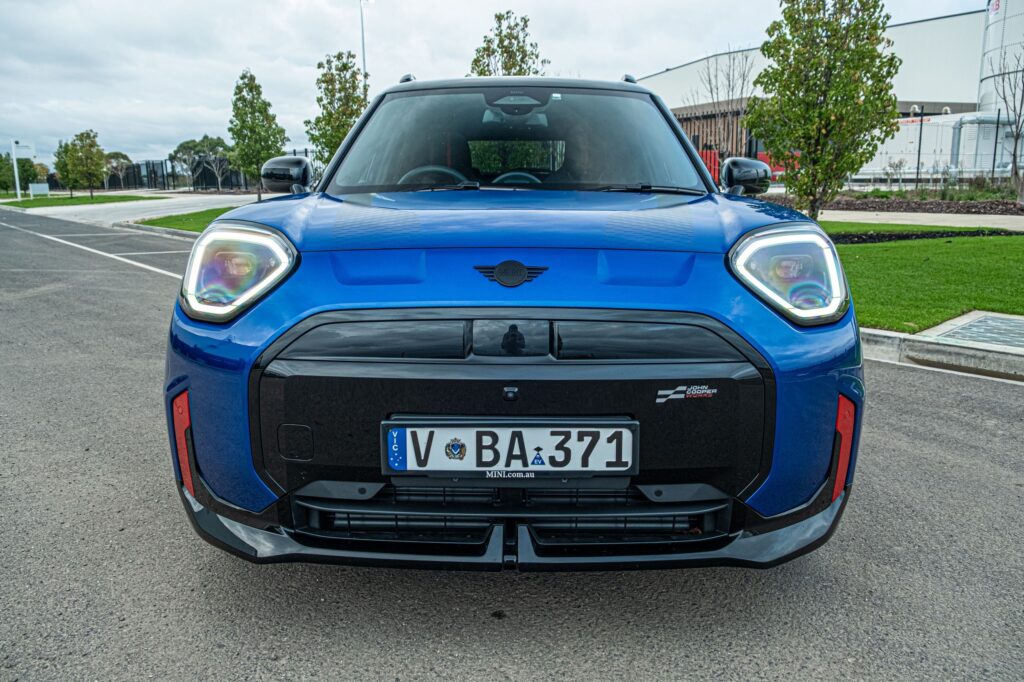

My first impressions behind the wheel were excellent. In fact, after a week driving the more powerful Countryman SE ALL4, getting into the Aceman e JCW, I was puzzled whether I had read the specifications correctly and whether the Aceman actually had more power.
The Aceman’s power delivery is noticeably sharper than that of the larger electric Countryman. While the Countryman’s all-wheel-drive configuration, and that of most other dual-motor EVs, provides smooth, uninterrupted power and traction, the Aceman feels instantly more thrilling as it frantically tries to channel power exclusively to the front wheels.
The downside of this setup is torque steer. When flooring the accelerator, the steering wheel aggressively pulls left and right, reminiscent of some front-wheel-drive hot hatches from a decade ago. This can be fun, but it can also be unsettling, especially if the wheel pulls to one side even during attempted smooth acceleration. The situation is significantly amplified by pressing the Boost button on the steering wheel, which instantly adds an extra 20 kW (27 hp) for 10-second intervals.
Similarly, the Aceman struggles to put its power down on the road, especially in wet conditions, repeatedly engaging the traction control system during acceleration.
We found the Aceman e JCW to be slightly slower than Mini claims. The manufacturer states it can accelerate from 0 to 100 km/h in 6.4 seconds, but our best time was 6.5 seconds, with two other runs at 6.7 seconds. In-gear acceleration is acceptable: 5.6 seconds from 60 to 120 km/h.
Fun in the Corners, Harsh Everywhere Else
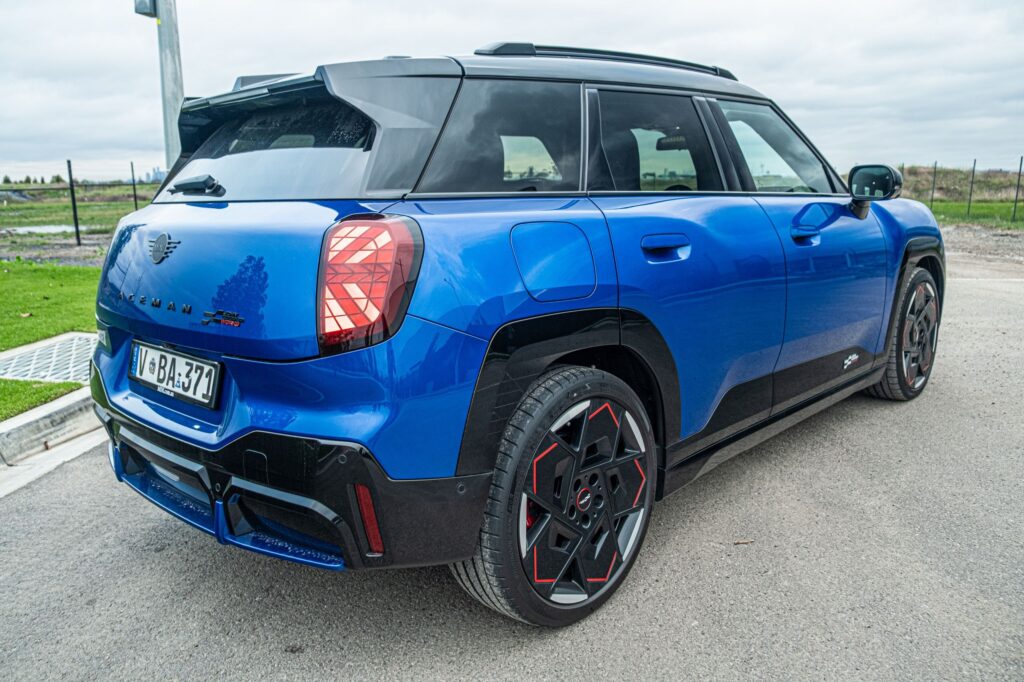
As thrilling as the Aceman is to steer, the overall driving experience is spoiled by the ride quality. EVs often have fairly stiff suspension because they must carry heavy battery packs under the floor. However, this Mini has such a harsh ride that my ten-year-old Renault Megane RS, once notorious for its stiff suspension, feels quite soft in comparison.
On undulating roads, you feel every bump in the Aceman. On particularly bad roads, I noticed my partner’s head bouncing like a bobblehead doll. While it’s undeniable that the Aceman feels connected to the road, there is no good reason for such a stiff suspension. This might work on a perfectly smooth racetrack, but it’s unsuitable for driving on regular roads, let alone daily commutes in a sprawling city full of potholes.
On the other hand, the electric Aceman is great fun to throw into corners. Although it weighs a fair bit – 1745 kg – it feels significantly lighter, and the ultra-direct steering makes it easy to place on the road, allowing you to hit apexes perfectly. However, regardless of the driving mode, and even if the traction control system is switched off, it still intervenes mid-corner, desperately trying to keep the front wheels under control.
While the Aceman eJCW is fun to drive, it is not as thrilling as internal combustion engine hot hatches and sporty crossovers in this price range.
Drive Calmly – The Range Will Pay Off
Limited range is also an issue. The 49 kWh battery is roughly on par with some others in this class, like the EX30 with its base 51 kWh unit and the smaller Alpine A290 with its flagship 52 kWh pack, but those models don’t offer the same level of power. Mini claims a range of just 355 km, but it drops significantly if you start driving the way this car was designed to be driven.
However, unlike some other EVs, it should actually be possible to achieve the claimed range. If driven more calmly, the Aceman is happy to average 14 kWh/100 km with the most aggressive regenerative braking setting.
Verdict
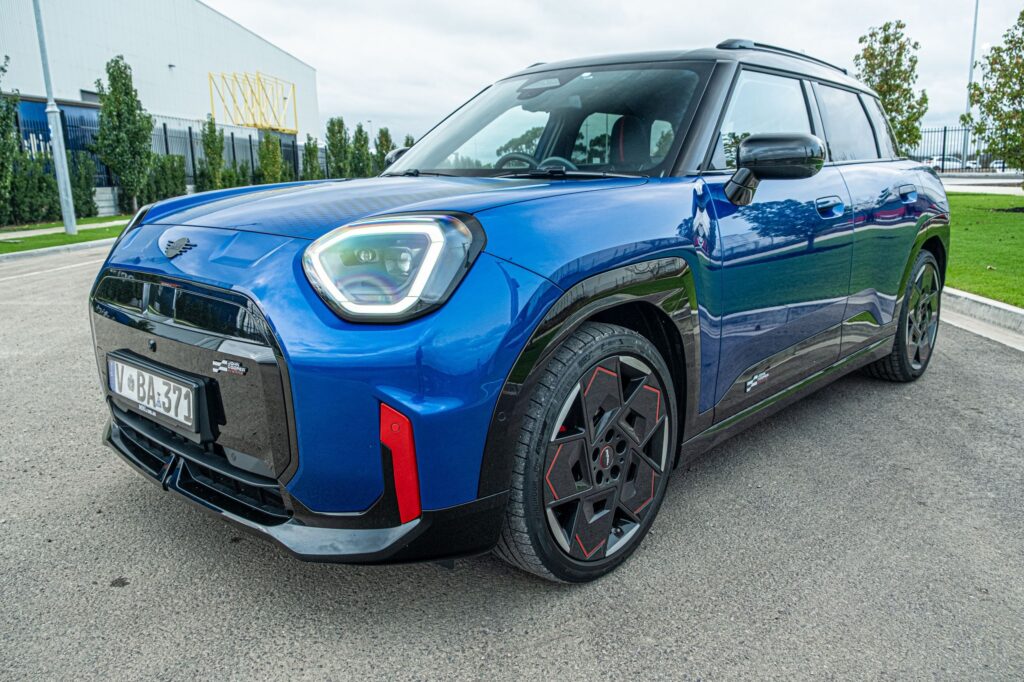
We applaud Mini for developing the sporty JCW version of the Aceman, as it is genuinely an interesting car to drive. It feels faster than it actually is, hides its weight well, and has direct, engaging steering.
Unfortunately, it is let down by its suspension, which makes it jittery and harsh on anything but the smoothest surfaces. If Mini could provide a more comfortable ride and tame the torque steer, this could be a very compelling option. For now, interested buyers should probably choose one of the cheaper, less sporty versions.
It is worth noting that the Mini Aceman JCW e is a prime example of how the desire to create a truly sporty electric vehicle can lead to certain compromises in everyday comfort. The stiff suspension and aggressive power delivery make it exciting on a twisty road but also turn it into a trial for daily city driving. This is a car for enthusiasts willing to put up with discomfort for the sake of thrilling driving emotions, but for most buyers, more balanced competitors like the Volvo EX30 or Kia EV3 might be a more practical choice. Choosing the Aceman is a conscious compromise between style, drive, and comfort.